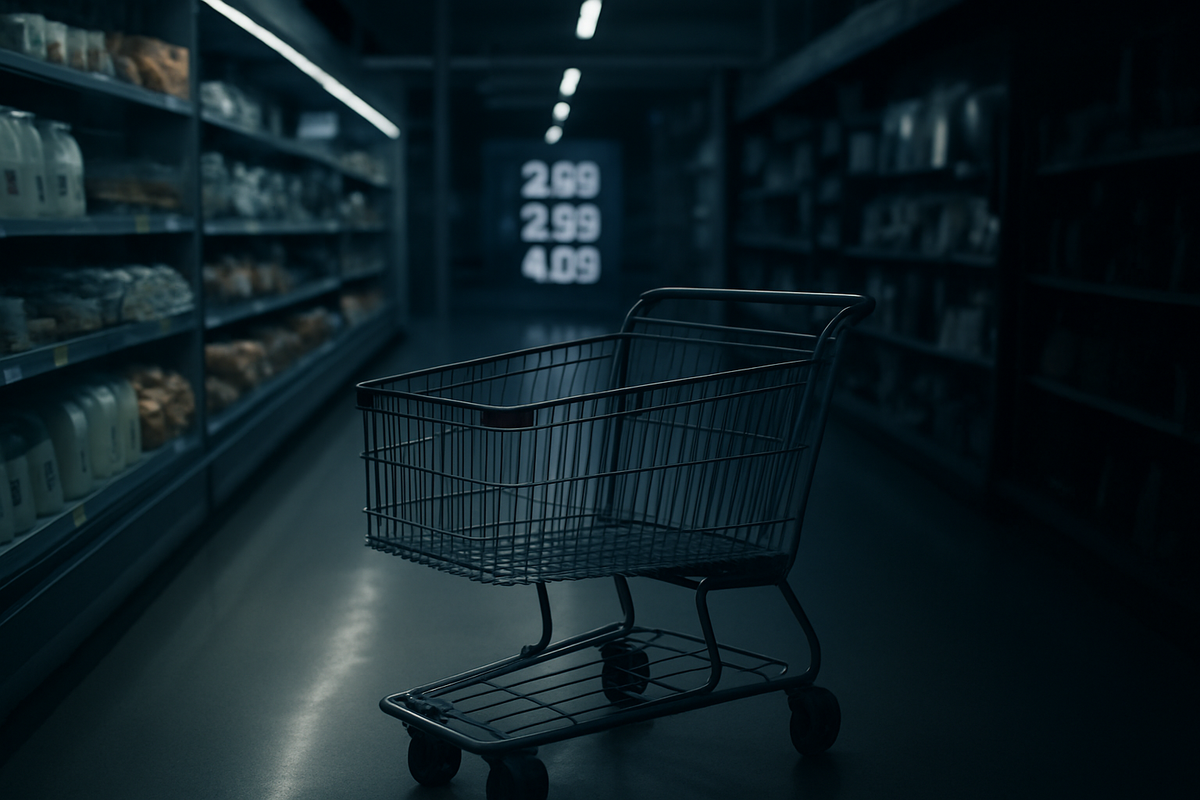
The American consumer, long the indomitable engine of the global economy, appears to be finally hitting the brakes. Recent data released this week shows that real retail spending—the total value of goods purchased adjusted for the eroding effects of inflation—fell by 0.7% in the most recent month. This contraction signals a significant shift in behavior as households move from a period of resilient post-pandemic spending into a defensive crouch, prioritizing essential "needs" over discretionary "wants."
The implications of this decline are already rippling through the financial markets. Investors are recalibrating their expectations for the retail sector, moving away from high-growth discretionary plays and seeking refuge in defensive staples. As the "spending hangover" of the mid-2020s takes hold, the divide between retailers that provide basic necessities and those that rely on impulse purchases has never been more pronounced, marking a potential turning point for the U.S. economic outlook in the first half of 2026.
A Cold Snap in the Consumer Economy
The 0.7% drop in real retail sales reported by the Commerce Department was sharper than many economists had projected, catching Wall Street off guard. While nominal sales—the raw dollar amount spent—remained relatively flat, the adjustment for a 3.2% year-over-year inflation rate revealed a meaningful decline in the actual volume of goods moving off the shelves. This divergence highlights a painful reality for the average consumer: while they are handing over more cash at the register, they are walking out of the store with fewer items in their bags.
The timeline leading to this moment has been a slow burn of mounting pressures. Throughout late 2024 and 2025, consumers relied on credit cards and dwindling pandemic-era savings to maintain their lifestyles. However, with interest rates remaining "higher for longer" and credit card delinquencies reaching a decade high, that safety net has finally frayed. The immediate catalyst for the most recent month’s decline was a sudden 25-cent spike in gasoline prices in early March 2026, which effectively acted as an overnight tax on disposable income, forcing immediate cuts in other areas of the household budget.
Initial market reactions were swift and unforgiving. Discretionary sectors, including apparel, electronics, and home furnishings, saw their indices drop by nearly 2.5% within hours of the report's release. Analysts noted that the "non-store" or online retail category—previously a bastion of growth—also contracted by 0.7%, suggesting that even the convenience of e-commerce is no longer enough to entice a weary public. This widespread retreat suggests that the "K-shaped" recovery, which favored higher earners for years, is finally seeing the top of the 'K' begin to bend under the weight of persistent macro headwinds.
A Tale of Two Retailers: Walmart vs. Target
The impact of this spending pullback is perhaps most visible in the diverging fortunes of the nation's two largest general retailers. Walmart (NYSE: WMT) has emerged as a clear beneficiary of the "flight to value." With approximately 60% of its revenue derived from groceries and household staples, Walmart’s business model is inherently insulated against discretionary downturns. Furthermore, the company has successfully captured "trade-down" traffic, as households earning over $100,000 per year migrate from premium grocers to Walmart’s more affordable private-label brands. By leveraging its massive scale to implement "Rollbacks" on over 7,000 items, Walmart has maintained foot traffic even as the broader market stumbles.
In contrast, Target (NYSE: TGT) finds itself in a more precarious position. Target’s product mix is heavily weighted toward discretionary categories such as home decor, fashion, and electronics—the very items consumers are now striking from their shopping lists. While the company has attempted to pivot by slashing prices on thousands of basic items to drive traffic, its brand identity as a "mission-driven" destination for affordable luxuries is working against it in a "needs-only" environment. Target’s forecast for flat sales in 2026 reflects the reality of a consumer base that is no longer making the high-margin "impulse buys" that typically fill Target's red carts.
Other major players are also feeling the heat. Costco Wholesale Corporation (NASDAQ: COST) continues to show resilience due to its membership-based model and focus on bulk value, though even its high-income members are showing signs of caution in the "treasure hunt" aisles. Meanwhile, Amazon.com Inc. (NASDAQ: AMZN) is facing pressure as shipping costs rise alongside fuel prices, and consumers become more selective about their Prime deliveries. The divide is clear: companies that sell what people need are surviving, while those that sell what people want are searching for a new strategy.
Broader Significance and Historical Precedents
This decline fits into a broader trend of "consumer exhaustion" that economists have been tracking since the inflationary surge of the early 2020s. Historically, when real retail spending falls by more than 0.5% in a single month during a non-recessionary period, it often serves as a "canary in the coal mine" for a broader economic cooling. Comparisons are being drawn to the 2007-2008 period, where a combination of high energy prices and tightening credit eventually broke the back of consumer demand. While the current labor market remains stronger than it was in 2008, the lack of real wage growth relative to the cost of living is creating a similar structural squeeze.
There are also significant policy and regulatory implications to consider. The persistent nature of inflation, despite high interest rates, puts the Federal Reserve in a difficult position. If the consumer continues to pull back, the risk of a hard landing increases, yet cutting rates too early could reignite the very inflation that is currently stifling retail growth. Additionally, the retail industry is bracing for potential shifts in trade policy; with ongoing discussions regarding new tariffs on imported goods from Asia and Mexico, retailers like Target that rely heavily on international supply chains could face a double whammy of higher costs and lower demand.
The ripple effects extend beyond the big-box stores to their partners and suppliers. Logistics firms and consumer packaged goods (CPG) companies are already seeing a shift in volume. Manufacturers of name-brand products are losing market share to private-label alternatives, forcing a "price war" in the aisles that could further squeeze margins across the entire supply chain. This is not just a retail story; it is a fundamental realignment of the American consumption model.
What Comes Next: Pivots and Potential Scenarios
In the short term, the retail landscape will likely remain volatile. If gas prices remain elevated through the 2026 summer driving season, the 0.7% decline seen this month may only be the beginning. Retailers will need to engage in aggressive promotional activity to clear inventory, which will likely weigh on profit margins throughout the next two quarters. We can expect to see more companies following Walmart’s lead, doubling down on "value messaging" and expanding their own-brand offerings to keep price-sensitive shoppers coming back.
Long-term, this pullback may force a strategic pivot in the retail industry away from expansion and toward efficiency. The era of "over-retailing," characterized by massive floor plans and endless product varieties, may give way to a more streamlined approach. Target, for example, may need to permanently alter its merchandise mix to include a higher percentage of staples, essentially "Walmart-izing" a portion of its business to ensure consistent traffic. For investors, the focus will likely shift from "top-line growth" to "free cash flow" and "margin resilience" as the primary metrics of success.
Market opportunities may emerge in the form of consolidation. Smaller, debt-laden retailers that cannot afford to compete on price may become acquisition targets for giants like Walmart or Amazon. Conversely, if the consumer pullback leads to a significant enough slowdown, it may finally provide the "deflationary pressure" needed for the Federal Reserve to begin a series of rate cuts, potentially setting the stage for a retail recovery in 2027.
Final Assessment: Navigating the New Normal
The 0.7% drop in real retail spending is a clear signal that the post-pandemic party is over. The American consumer is no longer willing or able to ignore the rising costs of fuel and food. As we move further into 2026, the retail sector will be defined by a stark separation between the "essentials" and the "extras." Investors should remain cautious, focusing on companies with strong balance sheets and a high percentage of grocery and staple sales, while remaining wary of those tied strictly to discretionary spending.
The market moving forward will be characterized by lower volume and higher competition for every dollar. The "American consumer" has not disappeared, but they have become profoundly more disciplined. For the first time in years, the power has shifted from the seller to the buyer, and only the retailers who can prove their value every single day will remain standing.
In the coming months, keep a close eye on consumer sentiment surveys and the monthly CPI reports. If inflation continues to outpace wage growth, the "pullback" we are seeing today could evolve into a more permanent "retrenchment," with lasting consequences for the U.S. economy and the global markets alike.
This content is intended for informational purposes only and is not financial advice.