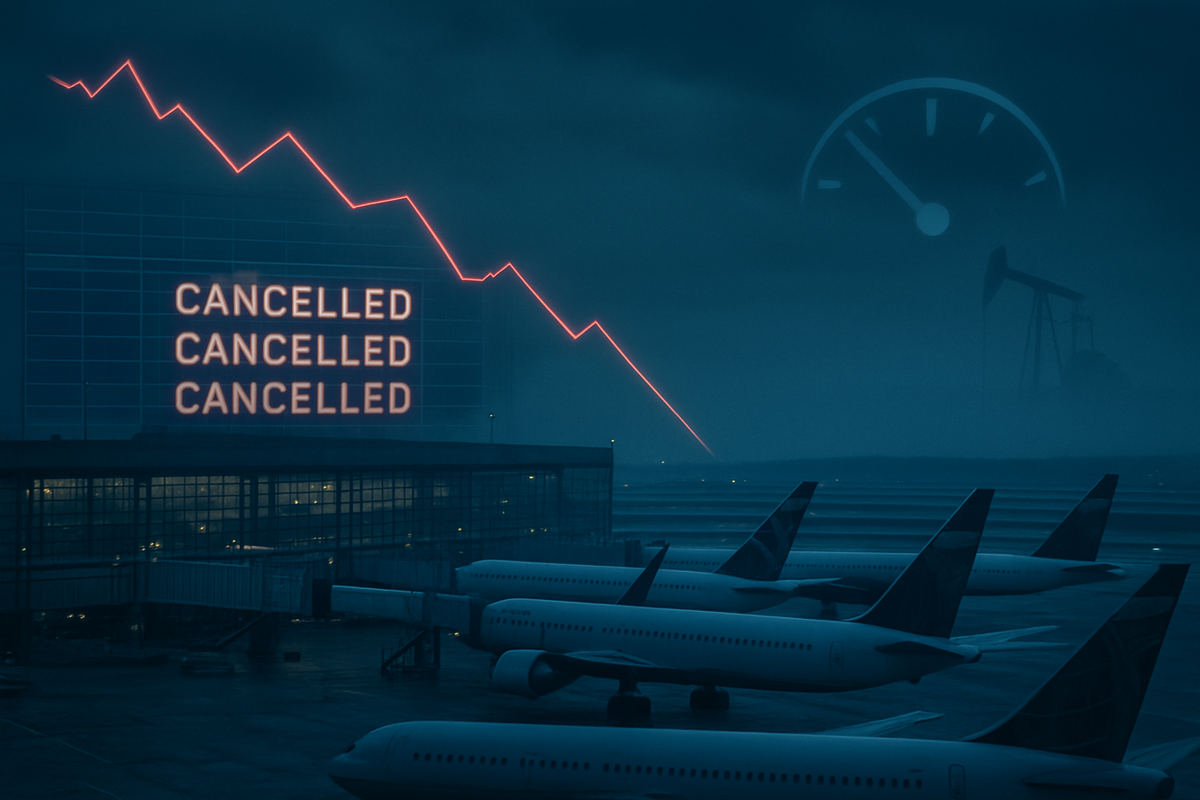
The global aviation sector is facing its most significant crisis since the post-pandemic recovery, as a "perfect storm" of surging jet fuel prices and escalating geopolitical instability in the Middle East threatens to derail industry profitability. Over the past week, the "Big Three" U.S. carriers have seen their valuations crater, with investors reacting to a sharp spike in crude oil prices following joint U.S.-Israeli military strikes in the region. This sudden volatility has forced airlines to abandon optimistic 2026 growth projections in favor of emergency cost-cutting and route suspensions.
As of March 6, 2026, the immediate implications are stark: spot jet fuel prices at the U.S. Gulf Coast have surged to $4.12 per gallon, a level not seen in nearly four years. For an industry that has largely moved away from fuel hedging, this direct exposure to energy markets is creating a massive drain on liquidity. With thousands of international flights already canceled and consumer confidence wavering, the airline industry is entering a period of forced contraction that could reshape the competitive landscape for years to come.
Geopolitical Shockwaves and Energy Volatility
The current crisis traces its roots to late February 2026, when an abrupt escalation in Middle Eastern tensions led to the closure of major airspace corridors. By early March, the conflict had forced the closure or severe restriction of primary transit hubs in Dubai, Doha, and Abu Dhabi. This logistical nightmare resulted in the cancellation of over 21,300 flights globally in the first week of March alone. The immediate reaction in the energy markets was even more punishing for carriers; crude oil prices jumped 30% year-to-date, with "crack spreads"—the difference between the price of crude oil and the petroleum products extracted from it—causing jet fuel prices to outpace even the rise in crude.
The timeline of this downturn was accelerated by a series of disappointing quarterly guidance reports released in January and February. While 2025 concluded with record top-line revenues, the onset of 2026 has seen the "Big Three" struggle with domestic operational headwinds and rising labor costs, leaving them ill-prepared for an external energy shock. Stakeholders, including major institutional investors and labor unions, are now closely monitoring management's response to the $4.12-per-gallon price point, which many analysts consider a "break-even" threshold for several legacy carriers. Market reaction was swift and brutal; on March 5, 2026, airline stocks suffered their worst single-day rout in over a year, led by a 6.5% drop in shares of American Airlines.
The Unhedged Giants: Winners and Losers
The primary victims of this downturn are the unhedged U.S. majors, most notably American Airlines Group Inc. (NASDAQ: AAL). American entered 2026 with the thinnest margins among its peers, making it the most vulnerable to fuel volatility. The company has already suspended its Philadelphia-to-Doha service indefinitely and warned of a potential Q1 2026 adjusted loss of up to ($0.50) per share. With every one-cent increase in jet fuel costs adding an estimated $50 million to its annual expenses, AAL's stock has plummeted 15% in the last seven days, trading near $11.79.
United Airlines Holdings, Inc. (NASDAQ: UAL) and Delta Air Lines, Inc. (NYSE: DAL) are also reeling from the impact. United’s aggressive international expansion has become a liability, as it was forced to suspend flights to Tel Aviv and Dubai. Its stock fell 8.7% on February 27, 2026, following news of shipping restrictions in the Strait of Hormuz. Delta, while remains the most profitable of the group, has seen its premium-heavy model struggle to offset a 7% decline in "Main Cabin" revenue. Delta’s management recently indicated that a sustained 10% increase in fuel would add $1 billion to its 2026 fuel bill. In contrast, European carriers like Ryanair Holdings plc (NASDAQ: RYAAY) and International Consolidated Airlines Group S.A. (LON: IAG), which maintain robust fuel-hedging programs, may emerge as relative "winners" by maintaining more stable pricing structures and capturing market share from their more exposed American rivals.
Industry Trends and Historical Precedents
This event fits into a broader industry trend of "post-hedging vulnerability." Following the volatility of 2022, many U.S. carriers transitioned away from expensive fuel hedges to save on premiums during periods of relative stability. However, the events of early 2026 highlight the catastrophic risk of this strategy when geopolitical black-swan events occur. The ripple effects extend beyond the airlines themselves to aerospace giants like The Boeing Company (NYSE: BA), which may see a slowdown in new aircraft orders as carriers prioritize liquidity over fleet renewal.
Historically, this downturn bears a striking resemblance to the 2022 energy crisis triggered by the conflict in Ukraine. However, the current situation is complicated by a more fragile global supply chain and higher labor costs that did not exist four years ago. Regulatory implications are also surfacing, as the Department of Transportation faces pressure to address consumer rights during massive flight cancellations. The precedent being set today suggests that the era of "cheap" international travel may be ending, as airlines are forced to permanently bake higher fuel and security premiums into their ticket prices.
Looking Ahead: Strategic Pivots and Market Scenarios
Looking ahead, the short-term focus for AAL, UAL, and DAL will be capital preservation. We can expect to see further route consolidation, particularly on underperforming long-haul flights, and a potential "right-sizing" of flight schedules to ensure higher load factors. If fuel prices remain above $4.00 per gallon through the summer travel season, the industry may see a renewed push for government subsidies or a return to aggressive fuel surcharges that could further dampen consumer demand.
In the long term, this crisis may accelerate the adoption of Sustainable Aviation Fuel (SAF) and more fuel-efficient aircraft, though the high capital expenditure required for such a pivot is currently at odds with the need for immediate cash savings. Strategic pivots toward "premium-only" or higher-margin routes are likely, as carriers move away from the volume-driven models that have failed them in this high-cost environment. Market opportunities may emerge for low-cost carriers that can maintain domestic efficiency, but for the legacy giants, the next twelve months will be a fight for margin stability in an increasingly hostile global climate.
Conclusion: Watching the Skies and the Spreads
The downturn of early 2026 serves as a stark reminder of the airline industry’s inherent fragility and its extreme sensitivity to geopolitical and energy shocks. The combined impact of $4.00+ jet fuel and the Middle East conflict has effectively wiped out the profit gains of late 2025, leaving American, United, and Delta in a defensive posture. The key takeaway for the market is that revenue growth alone is insufficient to protect airline stocks when cost structures are left exposed to the whims of global oil markets.
Moving forward, the market will likely remain bearish on the sector until there is a clear de-escalation in the Middle East or a stabilization of energy prices. Investors should watch closely for the Q1 2026 earnings calls in April, specifically looking for updates on hedging strategies and revised capacity guidance. The lasting impact of this event may well be a permanent shift in how U.S. airlines manage risk, signaling a retreat from the unhedged optimism that characterized the previous three years of the aviation recovery.
This content is intended for informational purposes only and is not financial advice