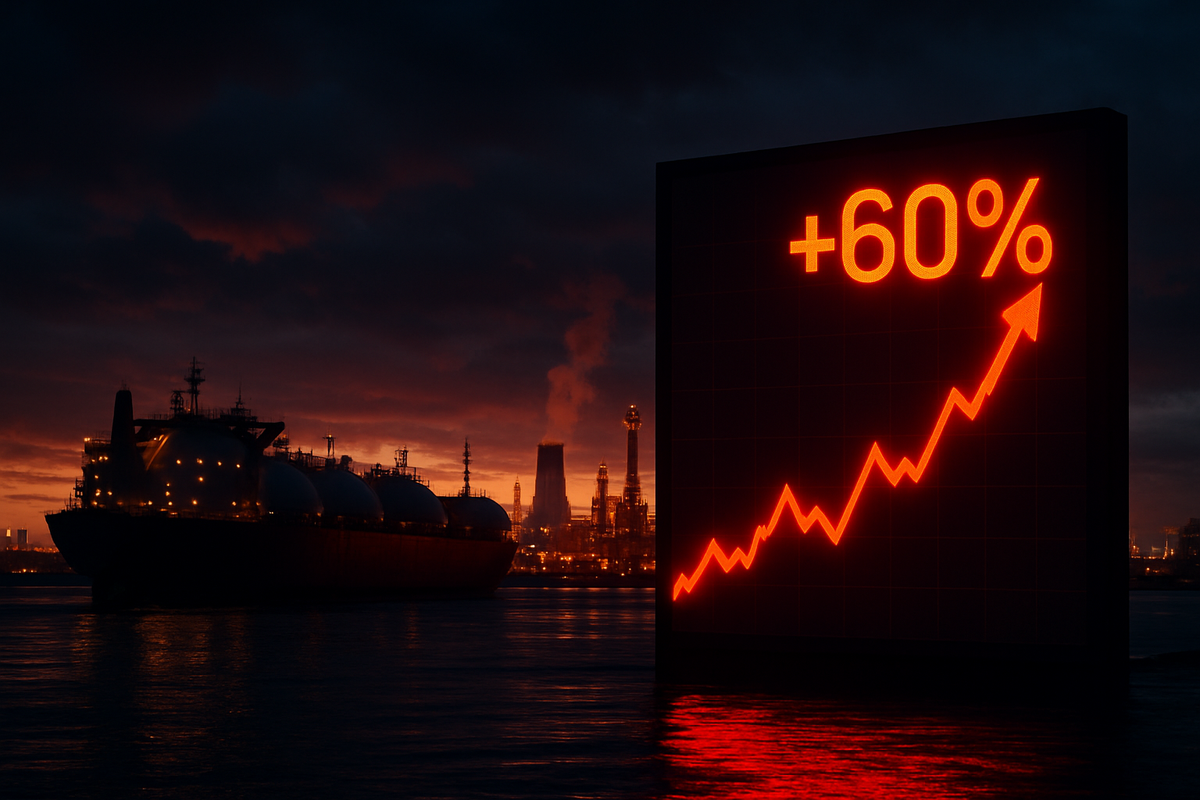
The global energy market has been plunged into a state of high-alert following a report from the World Bank detailing a staggering 59.4% surge in European natural gas prices throughout March 2026. This "March Shock," as it is being dubbed by traders in London and Brussels, has effectively erased two years of post-inflationary stability, sending the Dutch TTF benchmark—the primary pricing hub for European gas—peaking near €70/MWh. The sudden volatility has sent shockwaves through the global Energy Price Index, which saw a 41.6% monthly jump, marking one of the most significant disruptions to the commodity markets in the modern era.
The immediate implications of this spike are twofold: a renewed threat of stagflation across the Eurozone and a critical test for the maritime energy infrastructure that Europe has spent billions to develop. As natural gas prices act as the "master feedstock" for various sectors, the World Bank’s findings indicate that the crisis is already bleeding into other major commodity categories. Fertilizer prices have climbed by over 26%, and Brent crude oil prices breached the $100 per barrel mark in mid-March, settling around $113 as of this week. For the public, this translates to an immediate rise in utility forecasts and a hawkish pivot from central banks that had only recently begun to lower interest rates.
A Perfect Storm: Geopolitical Siege and Infrastructure Failure
The catalyst for this unprecedented price action was a "perfect storm" of geopolitical blockades and physical infrastructure damage in the Middle East, according to the World Bank's April 2026 Commodity Markets Outlook. The timeline of the crisis began in late February 2026 with the "Siege of Hormuz," a series of naval skirmishes that resulted in a partial blockade of the Strait of Hormuz. This maritime artery is responsible for the passage of roughly 20% of the world’s Liquefied Natural Gas (LNG). The blockade immediately choked off critical Qatari exports destined for European terminals, which had become the continent's primary source of gas following the 2022 pivot away from Russian pipelines.
The situation deteriorated further in mid-March with the "Qatar Shock." Targeted drone strikes hit the Ras Laffan Industrial City in Qatar, causing extensive damage to several massive liquefaction "trains." The World Bank reports that these strikes effectively removed 17% of Qatar’s LNG export capacity from the global market overnight. With European storage levels already seasonally low at 49%, a desperate bidding war erupted between European and Asian buyers for the remaining Atlantic basin cargoes. This scarcity was exacerbated by a colder-than-expected transition into spring, forcing energy companies to draw down inventories at an unsustainable rate.
Winners and Losers in a Volatile Energy Landscape
In the wake of the price surge, a clear divide has emerged between energy producers and industrial consumers. Equinor ASA (OSE: EQNR) has emerged as the "bedrock" of European energy security. As the continent’s largest remaining pipeline supplier, Equinor’s unhedged production has reaped record-high premiums. Analysts have recently upgraded the company’s 2026 earnings per share (EPS) estimates by a staggering 80%, with UBS raising its price target as the company becomes the primary beneficiary of the supply-side shock. Similarly, Cheniere Energy, Inc. (NYSE: LNG) has seen its Gulf Coast terminals become a vital lifeline for Europe. The completion of Train 5 at its Corpus Christi facility in early 2026 allowed the company to capture these high spot prices, leading to a forecast 2026 adjusted EBITDA of up to $7.25 billion.
However, the picture is more complicated for integrated majors like Shell PLC (NYSE: SHEL). While high oil and gas prices generally boost margins, Shell’s significant investments in Qatari infrastructure have left it exposed to physical volume losses. The company was forced to lower its Q1 2026 production guidance due to the disruptions at Ras Laffan. On the losing side of the ledger are the industrial giants. BASF SE (ETR: BAS) has warned that current gas prices are "unsustainable," leading to 30% price hikes for its core chemical products and potential production freezes at its Verbund sites. Yara International ASA (OSE: YAR), one of the world's largest fertilizer producers, was forced to implement 25% production curtailments across its European fleet in March, as natural gas represents roughly 80% of its variable costs.
Shifting Paradigms: From Pipeline to Maritime Vulnerability
The World Bank’s report highlights a significant shift in the broader industry trend: Europe has successfully transitioned away from "pipeline dependency" only to create a new "maritime vulnerability." This event fits into a historical precedent of energy transitions where moving from one fuel source to another introduces unforeseen risks. Just as the 1970s oil shocks exposed the vulnerability of crude oil supply chains, the 2026 March Shock has exposed the fragility of global LNG shipping lanes. The concentration of liquefaction capacity in a handful of geopolitical chokepoints has now become a central concern for European Union policymakers in Brussels.
The ripple effects are extending far beyond the energy sector. High gas prices have driven up the cost of nitrogen-based fertilizers, which the World Bank warns could lead to a "yield cliff" in the 2027 harvest as farmers scale back purchases due to costs. Regulatory implications are also mounting; there is now an immediate push within the EU to accelerate non-maritime energy resilience, including massive investments in grid expansion and long-term storage that do not rely on the volatile Strait of Hormuz. Central banks, including the European Central Bank (ECB) and the Bank of England, have been forced into a hawkish stance, with traders now pricing in interest rate hikes to combat energy-driven inflation.
The Road Ahead: Strategic Pivots and Scenarios
Looking forward, the energy market faces a period of intense restructuring. In the short term, the primary challenge will be refilling European storage levels before the winter of 2026/27. This will require a sustained high-price environment to continue attracting U.S. LNG cargoes away from the Asian market. Long-term, we can expect a strategic pivot toward "non-maritime" energy infrastructure. This may include a renewed focus on domestic biogas production, accelerated nuclear deployment in regions like France and Eastern Europe, and a doubling down on cross-border electrical interconnections.
Potential scenarios for the remainder of 2026 range from a gradual stabilization if the Hormuz blockade is fully lifted, to a deepening crisis if further infrastructure in the Middle East or North Africa is targeted. Investors should watch for "demand destruction" in the industrial sector—if companies like TotalEnergies SE (NYSE: TTE) or Exxon Mobil Corporation (NYSE: XOM) begin to see their industrial clients permanently shuttering plants in Europe, the long-term demand for gas could drop, leading to a period of lower, but more volatile, pricing.
Conclusion: Navigating the New Energy Reality
The World Bank's report on the 60% surge in natural gas prices serves as a stark reminder that energy security is a moving target. The key takeaway from the March Shock is that the global dash for LNG has replaced old geopolitical risks with new ones centered on maritime chokepoints and liquefaction hubs. Moving forward, the market will likely be characterized by "energy bifurcation," where regions with domestic production or secure pipeline access thrive, while those reliant on global maritime trade face permanent risk premiums.
For investors, the coming months will require a close eye on storage injection rates and geopolitical developments in the Middle East. While the 2026 surge has provided a windfall for producers like Equinor and Cheniere, the broader economic fallout—manifesting as persistent inflation and industrial contraction—could eventually weigh on global growth. The lasting impact of this event will likely be a fundamental reassessment of how Europe and the global economy value energy resilience versus cost-efficiency.
This content is intended for informational purposes only and is not financial advice