The global copper market faced a significant supply-side jolt this week as Ivanhoe Mines (TSX: IVN) announced a dramatic reduction in production guidance for its flagship Kamoa-Kakula Copper Complex in the Democratic Republic of Congo (DRC). Shares of the Canadian miner plummeted 12% following the revelation that persistent flooding and unforeseen seismic activity have severely hampered operations, forcing the company to cap its 2026 output at a maximum of 330,000 tons—a stark contrast to previous growth projections that had positioned the site as a future cornerstone of global supply.
This development has sent ripples through the base metals sector, reigniting concerns over the fragility of the "green metal" supply chain. As the world pushes toward aggressive electrification and artificial intelligence infrastructure expansion, the sudden loss of nearly 100,000 tons of expected copper from one of the world’s highest-grade mines threatens to widen an already precarious global deficit. For investors, the 12% sell-off represents a sharp reversal for a stock that had been a darling of the energy transition trade.
Operational Turmoil at the World's Rising Copper Giant
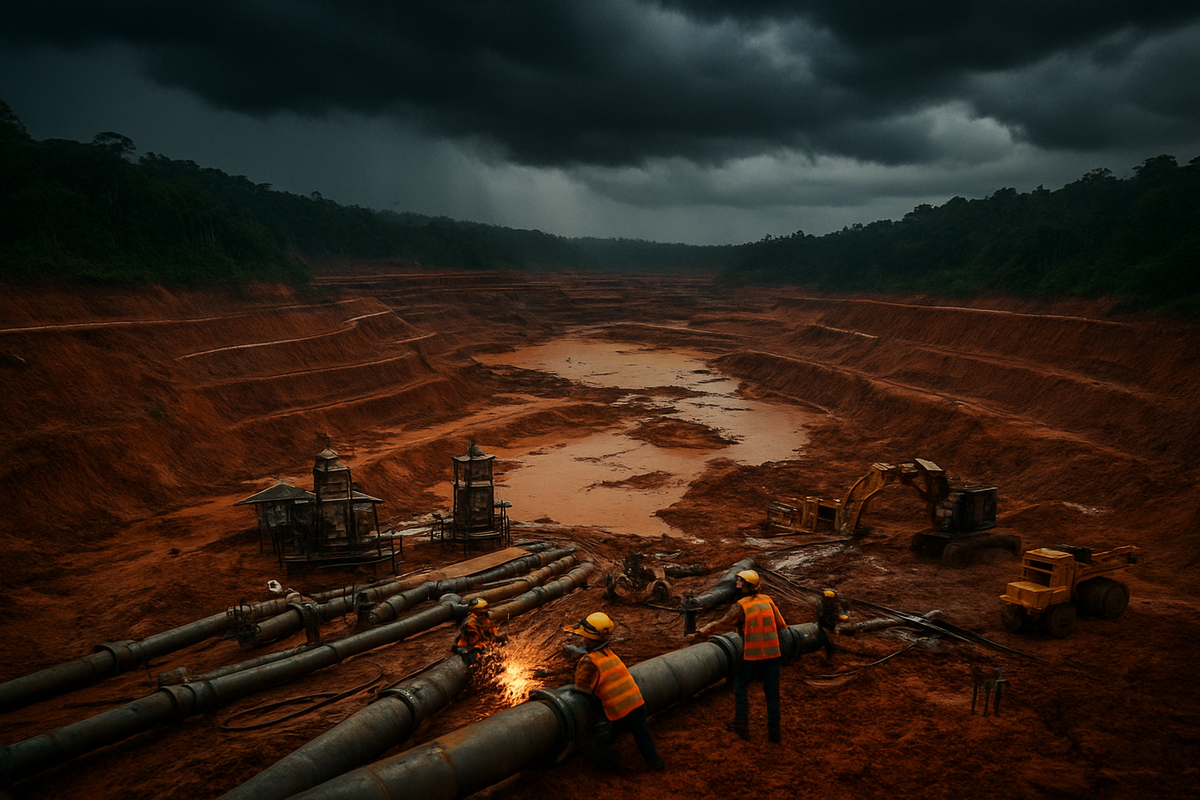
The crisis at Kamoa-Kakula is the culmination of a year-long struggle against the elements. While the market only fully priced in the damage this week, the trouble began in May 2025, when a major seismic event triggered significant flooding in the eastern section of the Kakula mine. Initial reports from the company suggested the impact would be temporary, but a "material reset" published in a technical report on March 31, 2026, revealed a far more somber reality. The flooding not only halted operations for several weeks last year but also compromised the structural integrity of several high-grade zones, leading to a 25% reduction in the mine’s total contained copper reserves.
In the wake of these events, Ivanhoe has been forced to adopt a "cautious operating strategy," shifting focus from aggressive extraction to long-term underground rehabilitation. The 2026 production target has been slashed to a range of 290,000 to 330,000 tonnes, down from an earlier forecast of 420,000 tonnes. Furthermore, the company has pushed back its milestone of reaching a 500,000-tonne annual production threshold from 2027 to 2028. This delay is particularly stinging for stakeholders who had viewed Kamoa-Kakula as the primary engine for Ivanhoe's transformation into a top-tier global producer.
The market reaction was exacerbated by reports of heavy insider selling just weeks before the forecast was slashed. Market sentiment soured as data showed high-ranking executives, including Co-Chair Robert Friedland, had liquidated significant portions of their holdings in early March. This has led to intense scrutiny from institutional investors and analysts, who are now questioning the transparency of the company’s communications regarding the severity of the flooding during the latter half of 2025.
Market Winners and Losers in the Wake of the Cut
The immediate loser is, undeniably, Ivanhoe Mines (TSX: IVN). The 12% drop in share price wiped out billions in market capitalization and has forced a revision of the company's cash cost guidance. With lower ore throughput and higher expenses related to dewatering and infrastructure repair, C1 cash costs are expected to spike to between $2.60 and $3.00 per pound for the remainder of 2026, squeezing margins at a time when the company needs capital for its smelter completion.
Conversely, the supply shortfall is a "bullish shock" for other major copper producers. Companies like Freeport-McMoRan (NYSE: FCX), BHP Group (NYSE: BHP), and Southern Copper (NYSE: SCCO) stand to benefit as the reduction in Kamoa-Kakula's output tightens the global market. Analysts at J.P. Morgan have updated their 2026 copper deficit projections to over 500,000 tonnes, suggesting that copper prices, already trading near historic highs of $6.00/lb, could see further upward pressure. This creates a favorable tailwind for miners with stable operations in more predictable jurisdictions.
The Democratic Republic of Congo itself also faces a setback. As the government seeks to leverage its mineral wealth for national development, a reduction in output from its premier copper asset means lower tax revenues and royalties. This event highlights the ongoing "jurisdiction risk" associated with the DRC, where geographical and infrastructure challenges can suddenly derail even the most sophisticated mining operations.
Broader Implications for the Global Energy Transition
The Ivanhoe production cut fits into a broader, more alarming trend in the mining industry: the increasing difficulty of bringing and keeping "Tier 1" assets online. The seismic activity at Kakula serves as a reminder that as mines go deeper to access higher grades, geological risks escalate. This event mirrors previous disruptions at other major sites, such as the Cobre Panama closure or operational delays at Rio Tinto's (NYSE: RIO) Oyu Tolgoi, reinforcing the narrative that the transition to a low-carbon economy is being throttled by mining bottlenecks.
Furthermore, the timing could not be worse for the technology sector. The massive build-out of data centers required for generative AI is consuming vast amounts of copper for power distribution and cooling systems. With Ivanhoe’s output curtailed, the competition for refined copper between the EV industry and the AI sector is likely to intensify. This may force manufacturers to look more seriously at copper substitutes, such as aluminum, though performance trade-offs remain a significant hurdle.
Regulatory bodies and policy-makers in the West are also likely to take note. The reliance on a handful of massive mines in politically or geologically volatile regions like the DRC remains a strategic vulnerability. This event may accelerate the push for "friend-shoring" and increased investment in domestic mining projects in North America and Australia, even if those projects offer lower grades than the African copper belt.
The Road Ahead: Recovery or Prolonged Stagnation?
In the short term, Ivanhoe Mines must prove to the market that its dewatering and rehabilitation efforts are yielding results. The company has installed high-capacity submersible pumps from China and is reportedly 70% finished with the stabilization of the western zone. If the 2027 production guidance of 380,000 to 420,000 tonnes can be maintained without further downgrades, the stock may find a floor. However, any further seismic events or delays in the "Stage Two" recovery plan could lead to another round of de-risking by institutional holders.
The long-term challenge for Ivanhoe will be restoring investor trust. The company needs to demonstrate that the revised reserve model—which reflects a 28% drop in reserve grades—is a "floor" rather than a continuing trend. Strategic pivots may include accelerating exploration at its Western Foreland permits to find satellite deposits that can offset the losses at Kakula. Additionally, the completion of the on-site smelter remains a critical milestone; if Ivanhoe can process more of its own ore into high-value blister copper, it may be able to recoup some of the lost revenue despite the lower volume.
Summary and Investor Outlook
The 12% collapse in Ivanhoe Mines' stock is a stark reminder of the volatility inherent in high-stakes mining. The reduction of the 2026 forecast to 330,000 tons of copper is not just a blow to the company, but a significant event for the global base metals market that exacerbates a growing supply-demand gap. Key takeaways include the unexpected severity of the 2025 seismic events, the resulting 25% reserve downgrade, and the controversial timing of insider sales that has left a cloud over the management team.
Moving forward, investors should keep a close eye on the monthly operational updates from Kamoa-Kakula, specifically the progress of the dewatering stages and the stability of the ore grade being processed. The broader market will also be watching for a potential breakout in copper prices as the reality of the 2026 deficit sets in. While Ivanhoe remains a holder of a world-class asset, it has transitioned from a high-growth "sure bet" into a complex recovery story that will require patience and rigorous risk management from those still holding the shares.
This content is intended for informational purposes only and is not financial advice.