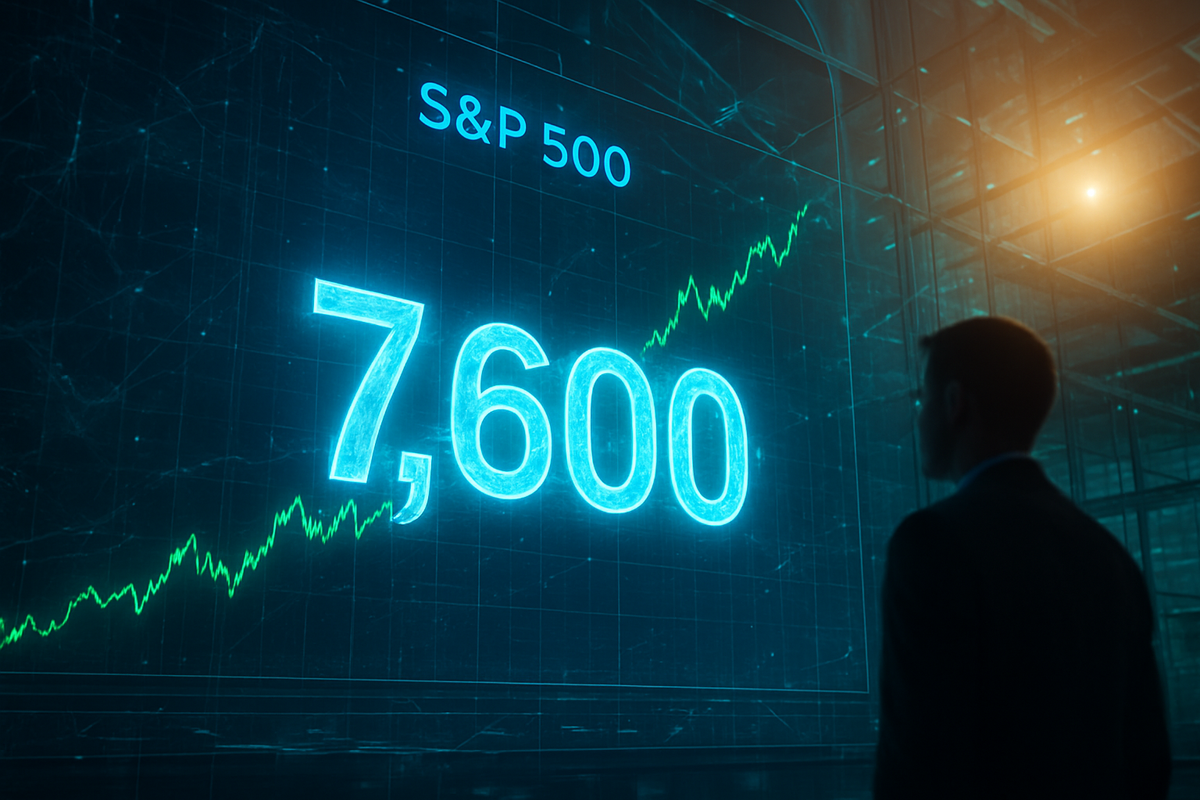
In a bold assertion that has reignited investor optimism following a volatile start to the year, Goldman Sachs (NYSE: GS) has issued a definitive call for the S&P 500 to reach 7,600 by the end of 2026. The investment bank’s equity strategy team, led by outgoing Chief U.S. Equity Strategist David Kostin and his successor Ben Snider, argues that the current market environment represents a "tactical reset" rather than a fundamental decline. At the heart of their thesis is a projected 12% surge in corporate earnings, which they believe will be driven by a significant transition in the artificial intelligence landscape—from a period of massive capital expenditure to one of tangible productivity gains.
The implications of this forecast are profound for a market that has spent the first quarter of 2026 grappling with geopolitical tensions and fluctuating energy prices. If Goldman’s projections hold true, the S&P 500 would see an upside of approximately 15% from its early April levels, effectively erasing the losses of a difficult Q1 and setting the stage for a sustained, fundamental-driven rally. By focusing on "earnings durability" and a "Goldilocks" macroeconomic backdrop, Goldman is signaling to the market that the next phase of the bull run will be defined by corporate efficiency and margin expansion rather than the speculative multiple expansion seen in previous years.
Fundamentals Over Froth: The Path to 7,600
The release of Goldman Sachs' updated outlook comes at a critical juncture. As of April 3, 2026, the S&P 500 has been hovering between 6,575 and 6,600, reflecting a roughly 4.6% decline since the start of the year. This dip was largely precipitated by a "fast-and-furious" deleveraging event in March, triggered by escalating conflict in the Middle East that briefly sent oil prices skyrocketing above $110 per barrel. However, Goldman’s strategists view this recent technical breakdown—where the index dipped below its 200-day moving average—as a necessary "clearing of the decks" that has removed the speculative "froth" of late 2025.
The timeline leading to this 7,600 target is rooted in a shift in corporate behavior. For the past two years, the narrative was dominated by "AI infrastructure spend," with companies pouring billions into hardware. Goldman now argues that 2026 is the "Execution Phase." Their report suggests that the massive investments made by tech and non-tech firms alike are finally beginning to manifest in the bottom line. The projected 12% increase in Earnings Per Share (EPS) would bring the index's aggregate earnings to a range of $305 to $309, providing a "fundamental floor" that justifies a forward P/E multiple of 22x.
Market reaction to the call has been cautiously optimistic. While some skeptics point to the lingering risks of sticky inflation and high energy costs, institutional desks have noted that Goldman’s macro team, led by Jan Hatzius, is also forecasting a robust 2.6% U.S. real GDP growth for 2026. This is significantly higher than the consensus estimate of 2.0%, suggesting that the broader economy may have more "under-the-hood" strength than current headlines suggest. Furthermore, the firm expects the Federal Reserve to continue its easing cycle, eventually settling at a terminal rate of 3.0% to 3.25%, providing the liquidity needed to support higher valuations.
Winners and Losers: The Broadening of the Rally
While the "Magnificent Seven" have long been the primary engines of market growth, Goldman’s 2026 outlook emphasizes a "broadening" of the rally into sectors that have previously lagged. Leading the charge are semiconductor giants like NVIDIA (NASDAQ: NVDA) and Micron (NASDAQ: MU). Micron, in particular, is highlighted for its dominance in High Bandwidth Memory (HBM), a critical component as AI applications move from data centers to edge computing and consumer devices. Goldman believes these companies will continue to beat expectations as the demand for high-performance silicon remains insatiable.
In the financial sector, Goldman identifies "quality growth" opportunities in legacy institutions that have successfully integrated automated wealth management and AI-driven risk modeling. JPMorgan Chase (NYSE: JPM) and Bank of America (NYSE: BAC) are cited as primary beneficiaries of this trend. These banks are expected to see margin expansion as AI reduces operational overhead while a stabilizing yield curve improves net interest income. For these firms, the 12% earnings growth target seems not just achievable but conservative, provided the labor market remains resilient.
Conversely, the losers in this scenario are likely to be companies that failed to adapt to the high-rate, high-efficiency environment of the mid-2020s. Firms with "zombie" balance sheets or those in sectors with high labor intensity and low automation potential—such as certain traditional retail and legacy transportation sub-sectors—may struggle to keep pace with the 7,600-target trajectory. Goldman’s report suggests a widening "productivity gap" where the top-tier companies pull away from the laggards, potentially leading to a wave of consolidations and M&A activity throughout the remainder of 2026.
AI Execution and the Productivity Paradigm Shift
The broader significance of Goldman’s call lies in its focus on productivity as a deflationary force. Historically, when labor markets are tight and wages rise, corporate margins are squeezed. However, Goldman argues that the current cycle is different due to the rapid deployment of generative AI across white-collar and service industries. This shift represents a historical precedent similar to the internet boom of the late 1990s, but with a much faster adoption curve. By automating routine tasks, companies are managing to maintain record-high margins even in the face of persistent wage pressures.
This event also highlights a pivot in market leadership. The "AI Spend" era was about the providers of technology; the "AI Execution" era is about the users. If non-tech sectors like Industrials and Healthcare can replicate the margin successes of the tech sector through AI integration, the entire composition of the S&P 500's profitability could be permanently elevated. This has significant regulatory and policy implications, as governments may begin to look closer at the labor displacements caused by this productivity surge, potentially introducing new fiscal measures to balance the economic gains.
Furthermore, Goldman’s bullishness acts as a counter-narrative to the "stagflation" fears that permeated the market in early 2026. By tethering their 7,600 target to earnings rather than just "hope," they are challenging the notion that the market is overvalued. This sets a high bar for upcoming Q2 and Q3 earnings seasons, where companies will be expected to provide concrete evidence of these AI-driven efficiencies. If the data supports the theory, it could lead to a significant reallocation of capital from defensive assets like gold and bonds back into high-quality equities.
The Road Ahead: Scenarios and Strategic Pivots
Looking forward, the success of Goldman’s 7,600 call depends on several "Goldilocks" variables remaining in balance. In the short term, investors will be watching for a cooling of geopolitical tensions in the Middle East. If oil prices stabilize back toward the $80 range, the "tax on the consumer" will lift, supporting the middle-income spending that Goldman expects to contribute to a $100 billion boost in economic activity this year. Long-term, the focus will remain on whether the 12% earnings growth is a one-time leap or a sustainable new trend driven by permanent technological shifts.
For corporate leaders, the mandate is clear: adapt or diminish. Strategic pivots toward "AI-first" operational models are no longer optional. We are likely to see a surge in specialized software adoption and a restructuring of corporate hierarchies to favor lean, tech-augmented teams. The challenge will be managing this transition without alienating a workforce that is already feeling the pressures of a rapidly changing economy. For the market at large, the "scenario to watch" involves the Federal Reserve; if inflation remains stickier than Jan Hatzius predicts, the Fed may be forced to hold rates higher for longer, which would test the 22x P/E multiple Goldman has used for its target.
Final Assessment: A Fundamental Marathon
Goldman Sachs' projection of 7,600 for the S&P 500 serves as a powerful reminder that the market is, in the long run, a "weighing machine" of corporate earnings. By stripping away the noise of Q1 volatility and focusing on the underlying productivity of American enterprise, Kostin and Snider have provided a roadmap for what they call a "broad-based marathon." The core takeaway is that the bull market is not dead; it is simply evolving from a speculative sprint into a fundamental-driven climb.
As we move further into 2026, investors should keep a close eye on quarterly margin reports and the pace of Fed rate cuts. If corporate America can indeed deliver the 12% EPS growth promised, the 7,600 level may not just be a target, but a stepping stone to even higher records. However, the path will likely remain choppy. The lasting impact of this forecast will be measured by how many companies can actually turn the "promise of AI" into "profit from AI." For now, Goldman Sachs has set the bar high, and the market is watching to see who clears it.
This content is intended for informational purposes only and is not financial advice.