Driven by significant capital investment and enterprise adoption, the AI market continues to expand, with its scale projected to reach USD 3.4 trillion by 2033. The rising usage of generative AI and increasing corporate adoption rates are further deepening AI applications.

TAIPEI, TAIWAN (MERXWIRE) – In recent years, artificial intelligence (AI) has rapidly expanded globally, moving from technological applications into the core of daily life and transforming how people work and access information. Taking ChatGPT as an example, the application ranked eighth in global downloads between September and November 2024, with monthly active users exceeding 250 million, indicating that generative AI has moved beyond early experimentation into large-scale adoption.
According to a report by market research firm Grand View Research, the global artificial intelligence market size was estimated at USD 390.91 billion in 2025 and is projected to reach USD 3.49726 trillion by 2033, with a compound annual growth rate (CAGR) of 30.6% from 2026 to 2033. The report notes that the primary growth drivers are the rapid adoption of generative AI and agentic AI by enterprises. With substantial capital investment and expanding application scenarios, AI is accelerating its transition from experimental technology to core business infrastructure.
The report states that AI is rapidly shifting from a single-tool application toward cross-industry integration, covering sectors such as healthcare, retail, manufacturing, and supply chain. Enterprise adoption is primarily focused on content generation, customer service, software development, and workflow automation, gradually embedding AI into operational structures. Meanwhile, software and deep learning technologies continue to dominate the market, while healthcare and automotive sectors are experiencing faster growth, indicating AI’s expansion into high-value decision-making scenarios.
Generative AI, widely used in business environments, is rapidly becoming mainstream. According to data from Microsoft’s AI Economy Institute, approximately 16.3% of the global population is expected to use generative AI by the end of 2025. At the same time, 88% of companies have adopted AI in at least one business function. Although most remain in pilot stages, about one-third have already begun scaling their AI initiatives.
In terms of application formats, AI tools are moving toward integration, with “all-in-one AI” becoming a new trend. These tools are centered on conversational interfaces and integrate multiple functions such as writing, image generation, coding, and document understanding. For example, Genspark AI is designed with a multi-model architecture, combining mainstream models such as GPT-5, Claude, and Gemini, offering a cross-task AI workspace that has attracted market attention.
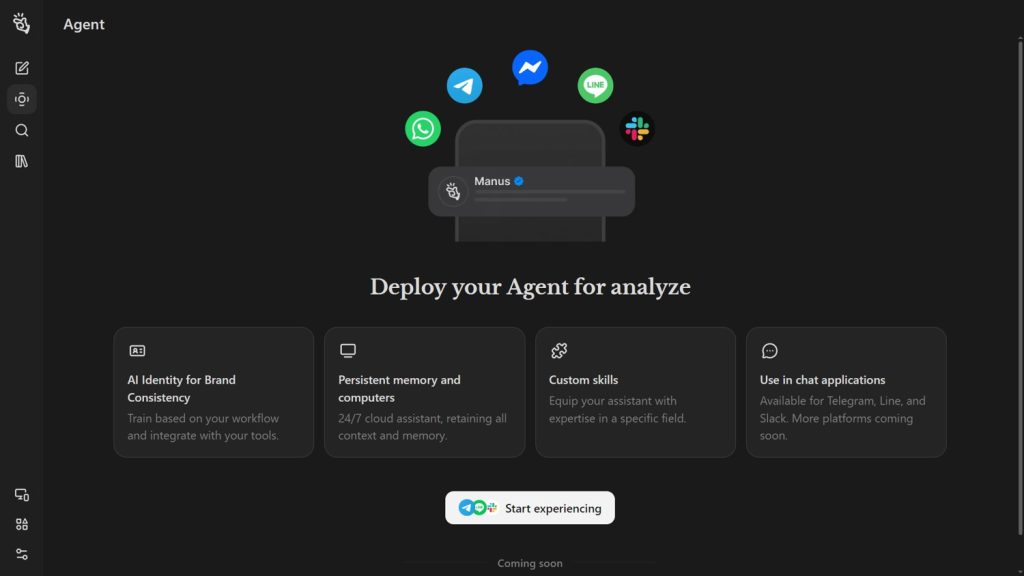
In addition, agentic AI is also gaining increasing market attention. Taking Manus AI as an example, such applications emphasize autonomous task decomposition and multi-step workflow execution, assisting users in data organization, content creation, and decision support. As model capabilities continue to improve, agentic AI is gradually evolving from an assistive tool into a task-oriented automated system, expanding the depth and scope of AI in real-world applications.
In practical applications, AI has deeply integrated into various workplace scenarios, enabling tasks that once required significant time and manpower to be completed more efficiently. From content creation and data organization to report analysis and decision support, AI significantly shortens workflows, allowing individuals and teams to accomplish tasks that previously required cross-department collaboration in less time. This not only improves efficiency but also reduces repetitive and complex workloads, optimizing workplace operations and working methods.
Notably, as generative AI penetrates daily life, the relationship between humans and technology is undergoing a structural shift. AI, once viewed primarily as a supporting tool, is now gradually becoming a basis for decision-making. Beyond assisting in searching and organizing information, AI increasingly provides summaries and recommendations, leading users to shift from actively searching for information to relying on AI-generated outputs.
From rapid user growth and explosive market expansion to enterprise adoption and tool integration trends, AI is reshaping the global industrial structure at an unprecedented pace. With continuous technological advancement and deeper application, artificial intelligence is no longer merely a topic within the tech industry, but a foundational infrastructure that profoundly impacts economic structures and daily life, continuously driving changes in operational models across sectors.