Earnings results often indicate what direction a company will take in the months ahead. With Q3 behind us, let’s have a look at SentinelOne (NYSE: S) and its peers.
Cybersecurity continues to be one of the fastest-growing segments within software for good reason. Almost every company is slowly finding itself becoming a technology company and facing rising cybersecurity risks. Businesses are accelerating adoption of cloud-based software, moving data and applications into the cloud to save costs while improving performance. This migration has opened them to a multitude of new threats, like employees accessing data via their smartphone while on an open network, or logging into a web-based interface from a laptop in a new location.
The 9 cybersecurity stocks we track reported a satisfactory Q3. As a group, revenues beat analysts’ consensus estimates by 1% while next quarter’s revenue guidance was in line.
Amidst this news, share prices of the companies have had a rough stretch. On average, they are down 11.9% since the latest earnings results.
SentinelOne (NYSE: S)
Built on the principle of "fighting machine with machine," SentinelOne (NYSE: S) provides an AI-powered cybersecurity platform that autonomously prevents, detects, and responds to threats across endpoints, cloud workloads, and identity systems.
SentinelOne reported revenues of $258.9 million, up 22.9% year on year. This print exceeded analysts’ expectations by 1.1%. Overall, it was a strong quarter for the company with a solid beat of analysts’ billings estimates and an impressive beat of analysts’ EBITDA estimates.
“We continue to demonstrate a strong combination of top-tier growth and margin improvement. Our third-quarter performance underscores the growing demand for our AI-native security platform that combines data, intelligence, and defense,” said Tomer Weingarten, CEO of SentinelOne.
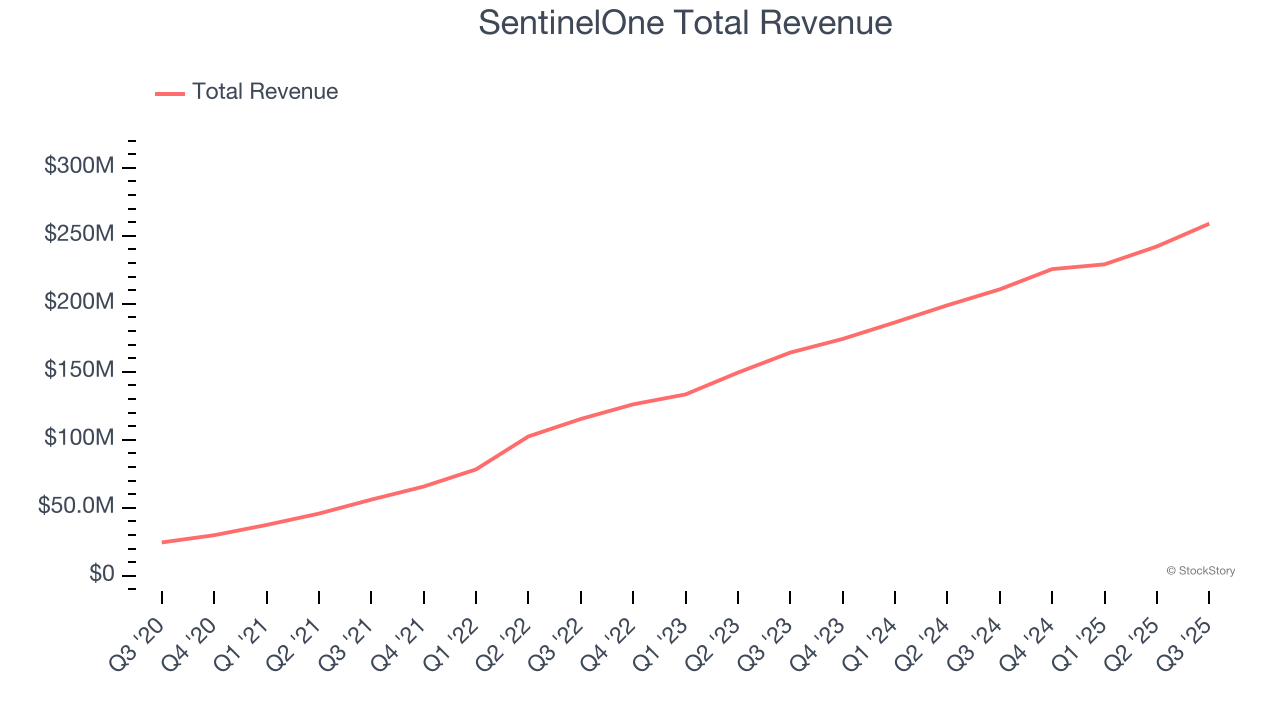
SentinelOne achieved the highest full-year guidance raise of the whole group. The company added 59 enterprise customers paying more than $100,000 annually to reach a total of 1,572. Investor expectations, however, were likely higher than Wall Street’s published projections, leaving some wishing for even better results (analysts’ consensus estimates are those published by big banks and advisory firms, not the investors who make buy and sell decisions). The stock is down 11.1% since reporting and currently trades at $15.20.
Best Q3: Qualys (NASDAQ: QLYS)
Originally developed to address the growing complexity of IT security in the cloud era, Qualys (NASDAQ: QLYS) provides a cloud-based platform that helps organizations identify, manage, and protect their IT assets from cyber threats across on-premises, cloud, and mobile environments.
Qualys reported revenues of $169.9 million, up 10.4% year on year, outperforming analysts’ expectations by 2.2%. The business had an exceptional quarter with EPS guidance for next quarter exceeding analysts’ expectations and an impressive beat of analysts’ EBITDA estimates.
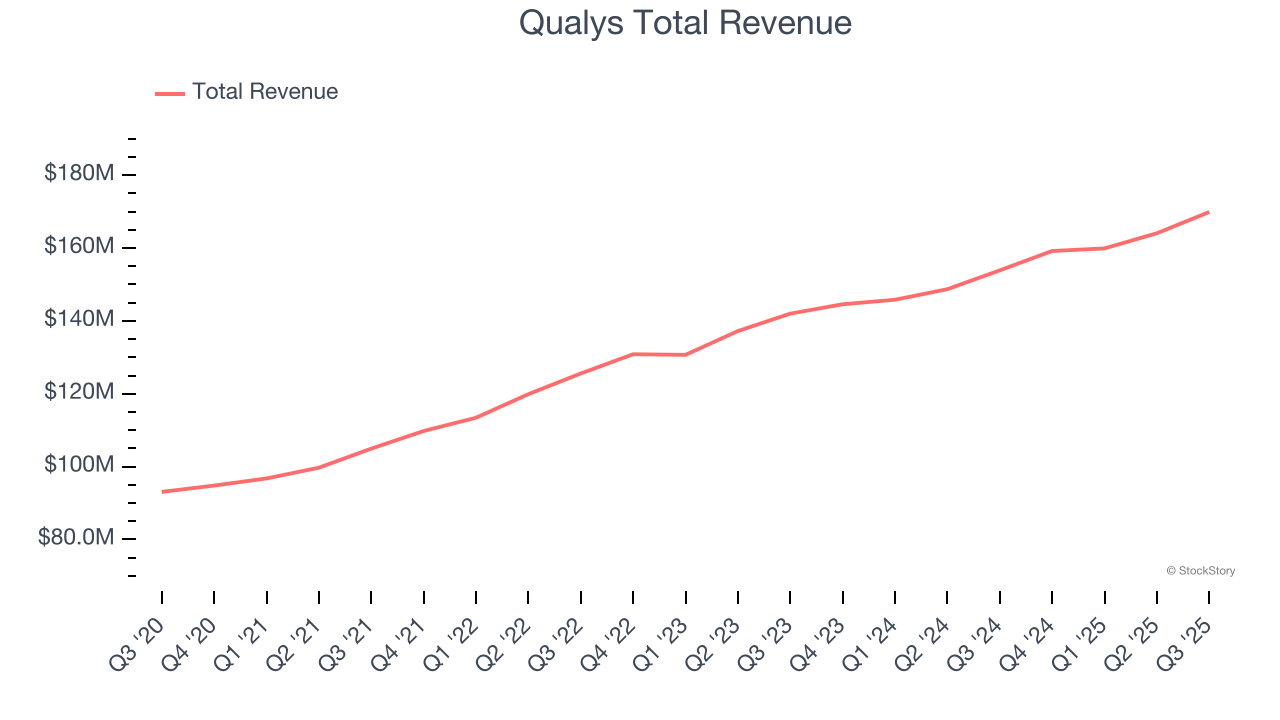
Qualys scored the biggest analyst estimates beat among its peers. The market seems happy with the results as the stock is up 11% since reporting. It currently trades at $134.60.
Is now the time to buy Qualys? Access our full analysis of the earnings results here, it’s free for active Edge members.
Weakest Q3: Varonis Systems (NASDAQ: VRNS)
Beginning with protecting Windows file shares in 2005 and evolving into a comprehensive security platform, Varonis Systems (NASDAQ: VRNS) provides data security software that helps organizations protect sensitive information, detect threats, and comply with privacy regulations.
Varonis Systems reported revenues of $161.6 million, up 9.1% year on year, falling short of analysts’ expectations by 2.7%. It was a softer quarter as it posted full-year revenue guidance slightly missing analysts’ expectations and revenue guidance for next quarter slightly missing analysts’ expectations.
Varonis Systems delivered the weakest performance against analyst estimates in the group. As expected, the stock is down 47.3% since the results and currently trades at $33.21.
Read our full analysis of Varonis Systems’s results here.
Rapid7 (NASDAQ: RPD)
With its name inspired by the need for quick responses to cyber threats, Rapid7 (NASDAQ: RPD) provides cybersecurity software and services that help organizations detect vulnerabilities, monitor threats, and respond to security incidents.
Rapid7 reported revenues of $218 million, up 1.5% year on year. This result topped analysts’ expectations by 0.9%. Taking a step back, it was a mixed quarter as it also recorded a solid beat of analysts’ EBITDA estimates but revenue guidance for next quarter slightly missing analysts’ expectations.
Rapid7 had the slowest revenue growth among its peers. The company lost 25 customers and ended up with a total of 11,618. The stock is down 12.2% since reporting and currently trades at $15.62.
Read our full, actionable report on Rapid7 here, it’s free for active Edge members.
Palo Alto Networks (NASDAQ: PANW)
Founded in 2005 by security visionary Nir Zuk who sought to reimagine firewall technology, Palo Alto Networks (NASDAQ: PANW) provides AI-powered cybersecurity platforms that protect organizations' networks, clouds, and endpoints from sophisticated threats.
Palo Alto Networks reported revenues of $2.47 billion, up 15.7% year on year. This print surpassed analysts’ expectations by 0.5%. Zooming out, it was a mixed quarter as it also produced a solid beat of analysts’ EBITDA estimates but a significant miss of analysts’ billings estimates.
The stock is down 6.8% since reporting and currently trades at $186.83.
Read our full, actionable report on Palo Alto Networks here, it’s free for active Edge members.
Market Update
As a result of the Fed’s rate hikes in 2022 and 2023, inflation has come down from frothy levels post-pandemic. The general rise in the price of goods and services is trending towards the Fed’s 2% goal as of late, which is good news. The higher rates that fought inflation also didn't slow economic activity enough to catalyze a recession. So far, soft landing. This, combined with recent rate cuts (half a percent in September 2024 and a quarter percent in November 2024) have led to strong stock market performance in 2024. The icing on the cake for 2024 returns was Donald Trump’s victory in the U.S. Presidential Election in early November, sending major indices to all-time highs in the week following the election. Still, debates around the health of the economy and the impact of potential tariffs and corporate tax cuts remain, leaving much uncertainty around 2025.
Want to invest in winners with rock-solid fundamentals? Check out our Top 5 Quality Compounder Stocks and add them to your watchlist. These companies are poised for growth regardless of the political or macroeconomic climate.
StockStory’s analyst team — all seasoned professional investors — uses quantitative analysis and automation to deliver market-beating insights faster and with higher quality.