IT services provider DXC Technology (NYSE: DXC) reported revenue ahead of Wall Street’s expectations in calendar Q3 2026 (fiscal Q2 2027), but revenue fell by 4% year on year to $3.03 billion. On the other hand, next quarter’s revenue guidance of $2.98 billion was less impressive, coming in 3.6% below analysts’ consensus estimates. Its non-GAAP profit of $0.67 per share was 22% above analysts’ consensus estimates.
For more on DXC, read our free full research report.
DXC (DXC) Q3 CY2026 highlights:
- Revenue $3.03 billion vs S&P analysts’ consensus estimates of $3.00 billion (4% year-on-year decline, 1.3% beat)
- Adjusted EPS $0.67 vs S&P analysts’ consensus estimates of $0.55 (22% beat)
- Revenue guidance The company lowered its full-year revenue guidance to $11.95 billion at the midpoint from $12.23 billion, a 2.3% decrease
- Adjusted EPS guidance Management lowered its full-year adjusted EPS guidance to $2.38 at the midpoint, a 10.4% decrease
- Operating margin 2.2%, down from 5.1% in the same quarter last year
- Free cash flow margin 3%, down from 7.6% in the same quarter last year
- Organic revenue fell 4% year on year (beat)
- Market capitalization $2.57 billion
"On the quarter, we delivered revenue, adjusted EBIT, and Non-GAAP diluted EPS above our expectations, while making progress with the agentic and AI-based solutions that we expect will contribute to future growth. The revenue ramp for agentic solutions is more clear in terms of average deal size, close cycle timing, and pace of follow-on work," said Raul Fernandez, CEO of DXC Technology. "While our core revenue recovery will take time, I am confident that our role operating mission-critical systems gives DXC a differentiated position as enterprises look to deploy AI at scale."
Revenue growth
Reviewing a company’s long-term revenue performance reveals insights into its quality. Any business can have short-term success, but a top-tier one grows for years.
With $12.36 billion in revenue over the past 12 months, DXC is larger than most business services companies and benefits from economies of scale, enabling it to gain more leverage on its fixed costs than smaller competitors. This also gives it the flexibility to offer lower prices. However, its scale is a double-edged sword because finding new avenues for growth becomes difficult when it already has a substantial market presence. For DXC to boost its revenue, it likely needs to adjust its prices, launch new offerings or expand in foreign markets.
DXC’s revenue declined by 6% per year over the last five years.
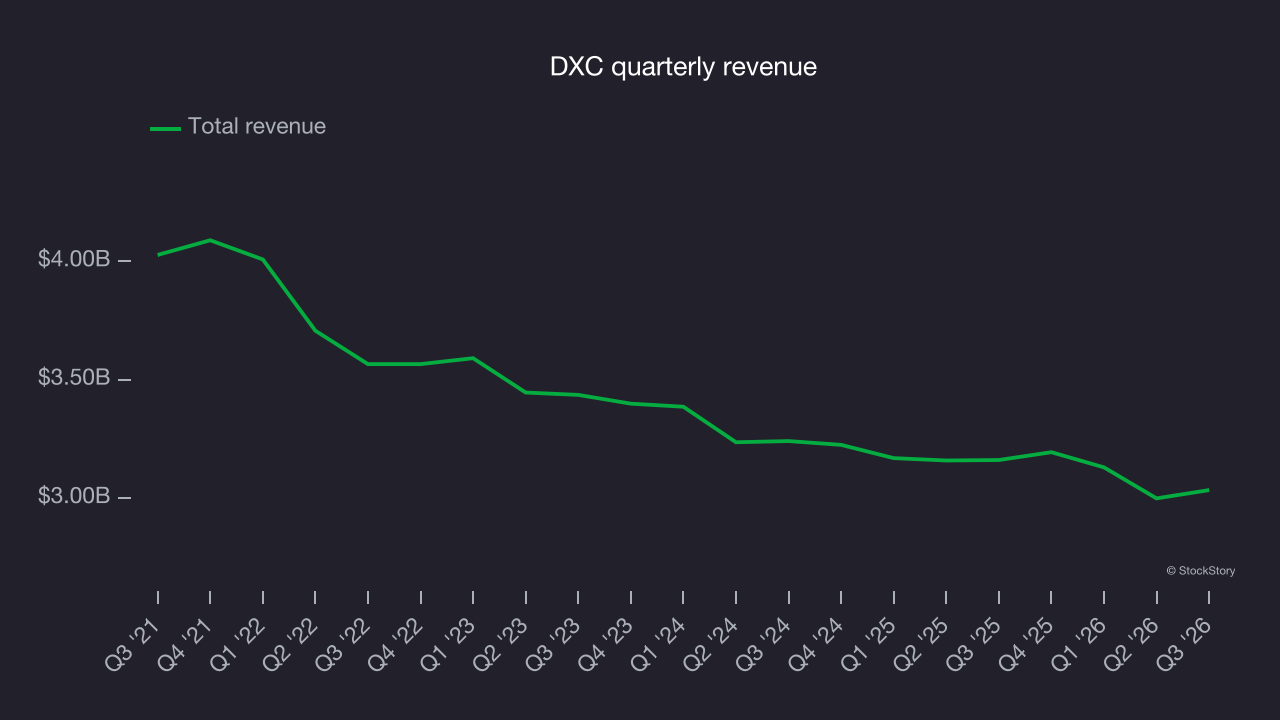
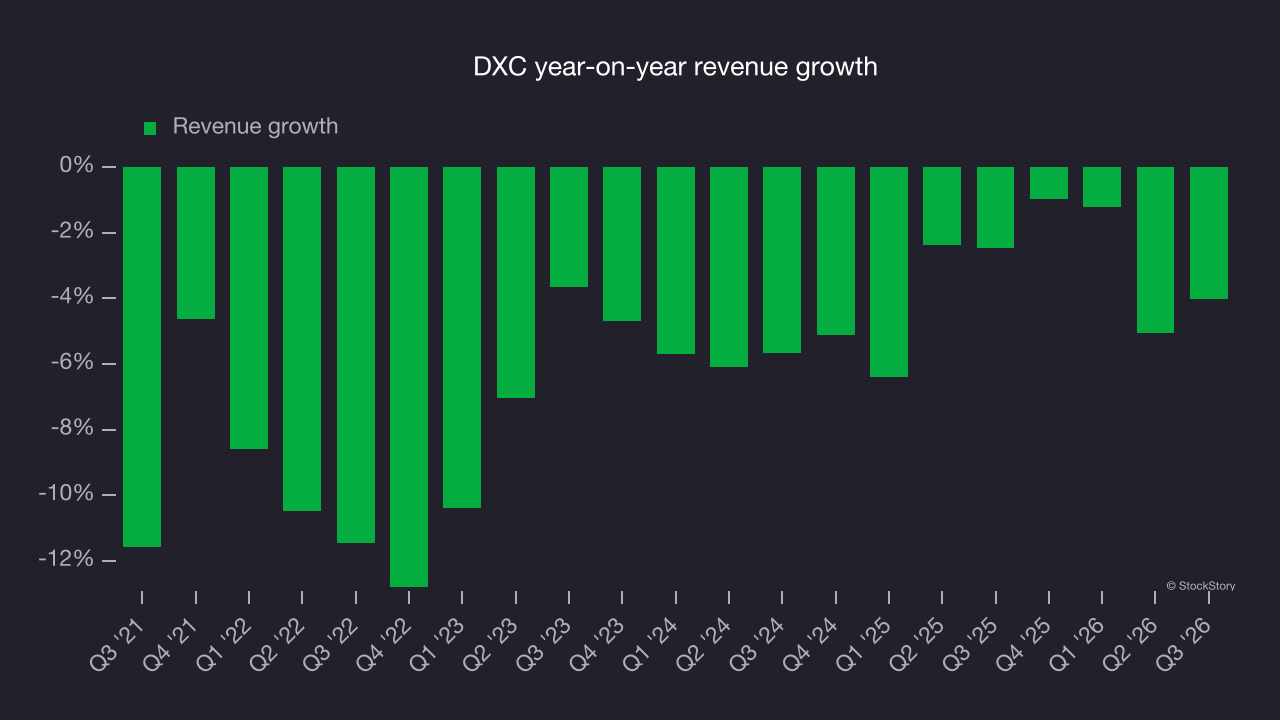
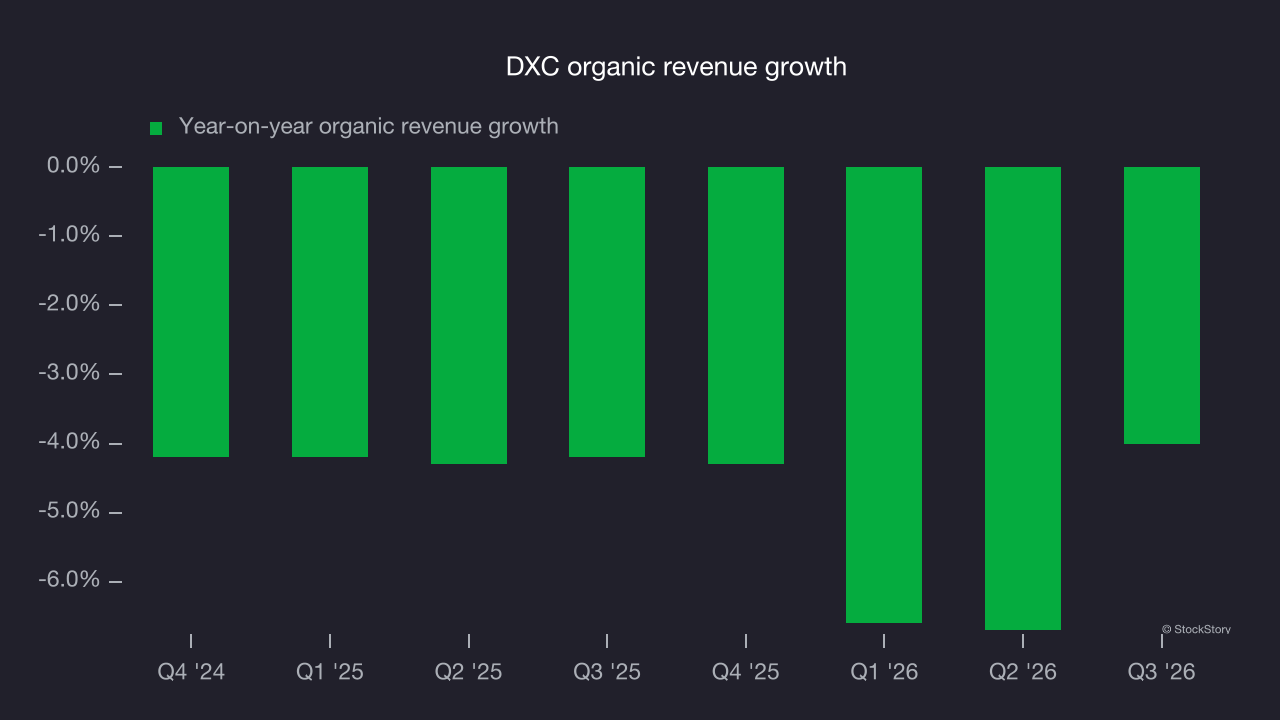
This quarter, DXC’s revenue fell by 4% year on year to $3.03 billion but beat Wall Street’s consensus estimates by 1.3%. Company management is currently guiding for a 6.7% year-on-year decline in revenue next quarter.
Looking further ahead, sell-side analysts expect revenue to decline by 2.7% over the next 12 months, according to S&P, similar to its two-year rate. This uninspiring projection indicates its newer products and services will not lead to better top-line performance yet.
Earnings per share
Revenue trends explain a company’s historical growth, but the long-term change in earnings per share (EPS) points to the profitability of that growth. For example, a company could inflate its revenue through excessive spending on advertising and promotions.
DXC’s EPS and revenue declined by 3.3% and 6% annually over the last five years. Companies with falling revenue and EPS warrant caution, as diminishing earnings could imply changing secular trends and preferences. If the tide turns unexpectedly, DXC’s low margin of safety could leave its stock price susceptible to large downswings.
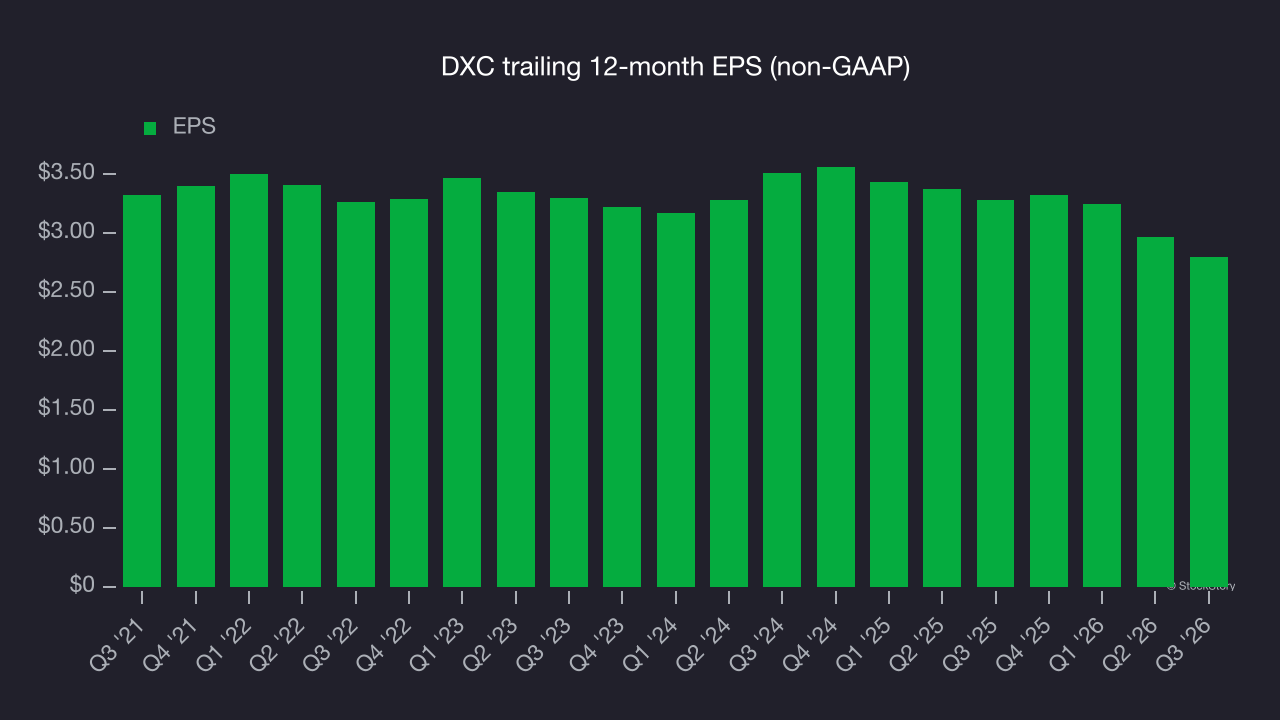
Like with revenue, we analyze EPS over a shorter period to see if we are missing a change in the business.
For DXC, its two-year annual EPS declines of 10.7% show it’s continued to underperform. These results were poor across both time frames.
In Q3, DXC reported adjusted EPS of $0.67, down from $0.84 in the same quarter last year. Despite falling year on year, this result easily cleared analysts’ consensus estimates. Over the next 12 months, Wall Street expects DXC’s full-year EPS to grow 1.5% from $2.80 to $2.84, according to S&P.
Key takeaways from DXC’s Q3 results
DXC’s earnings beat and narrow organic revenue beat were bright spots in a quarter that could have been better. EPS topped analysts’ consensus estimates and organic revenue narrowly exceeded Wall Street’s consensus, but full-year EPS guidance missed expectations and next-quarter revenue guidance fell short of Wall Street’s consensus. Shares plunged 15.4% to $12.86 immediately after the report.
DXC underperformed this quarter, but assessing whether that creates an investment opportunity requires a broader view. That decision should account for valuation, business quality and the latest earnings. For more on DXC, read our full research report here (it’s free).