Auto services provider Monro (NASDAQ: MNRO) met Wall Street’s revenue expectations in calendar Q3 2026 (fiscal Q2 2027), but revenue fell by 1.8% year on year to $283.6 million. Its non-GAAP loss of $0.01 per share was significantly below analysts’ consensus estimates.
For more on Monro, read our free full research report.
Monro (MNRO) Q3 CY2026 highlights:
- Revenue $283.6 million vs S&P analysts’ consensus estimates of $284.1 million (1.8% year-on-year decline, in line)
- Adjusted EPS -$0.01 vs S&P analysts’ consensus estimates of $0.05 (significant miss)
- Adjusted operating income $4.45 million vs analysts’ consensus estimates of $6.09 million (1.6% margin, 27% miss)
- Operating margin 0.9%, down from 4.4% in the same quarter last year
- Locations 1,114 at quarter end, down from 1,116 in the same quarter last year
- Same-store sales fell 1.8% year on year (1.1% in the same quarter last year)
- Market capitalization $447.1 million
“Our second quarter comparable store sales declined 1.8%, reflecting an operating environment which continued to challenge the full-service auto aftermarket. This was driven by lower store traffic, consumers that continued to defer higher-ticket spending decisions and traded-down to lower cost alternatives in tires, and our use of self-funded promotions to drive unit growth in our brake category. The effectiveness of our ConfiDrive courtesy inspection process helped us drive average repair order growth in the quarter, and it was a key contributor to the comparable store sales gains we saw in batteries and maintenance services. These results reinforce that Monro’s full-service model is a genuine competitive advantage, and that when we execute it well, customers respond. The ability to identify a customer’s vehicle needs in real time, communicate them clearly, and address them with quality and care is what distinguishes a full-service provider, and our results in these categories reflect that strength. The traction we’re seeing from our District Manager Toolkit continues to build. With the toolkit now deployed across a majority of our store network and our newly established operating efficiency team actively coaching and training in the field, we are seeing early but meaningful bottom-line improvement in a subset of our locations. Importantly, we maintained our marketing investment during the quarter, even as sales fell short of where we wanted them to be,” said Peter Fitzsimmons, President and Chief Executive Officer.
Revenue growth
A company’s long-term revenue performance is one signal of its overall quality. Any business can report a good quarter or two, but the best consistently grow over the long term.
With $1.14 billion in revenue over the past 12 months, Monro is a small retailer, which sometimes brings disadvantages compared to larger competitors benefiting from economies of scale and negotiating leverage with suppliers.
Monro’s demand was weak over the last three years. Its revenue fell by 4.2% annually as it closed stores.
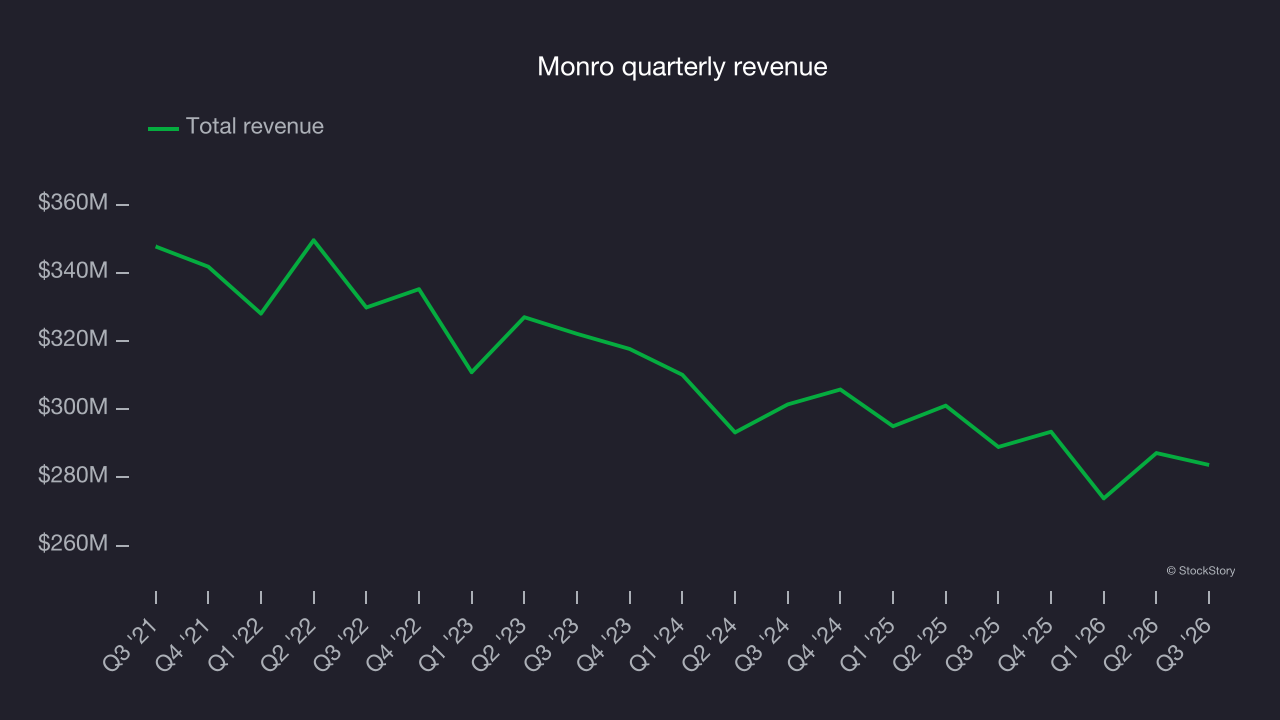
This quarter, Monro reported an uninspiring 1.8% year-on-year revenue decline to $283.6 million, in line with Wall Street’s consensus estimates.
Looking ahead, sell-side analysts expect revenue to grow 2.9% over the next 12 months, according to S&P. Although this projection suggests its newer products will improve revenue performance, it is still below the sector average.
Store performance
Number of stores
The number of stores a retailer operates is a critical driver of how quickly company-level revenue can grow.
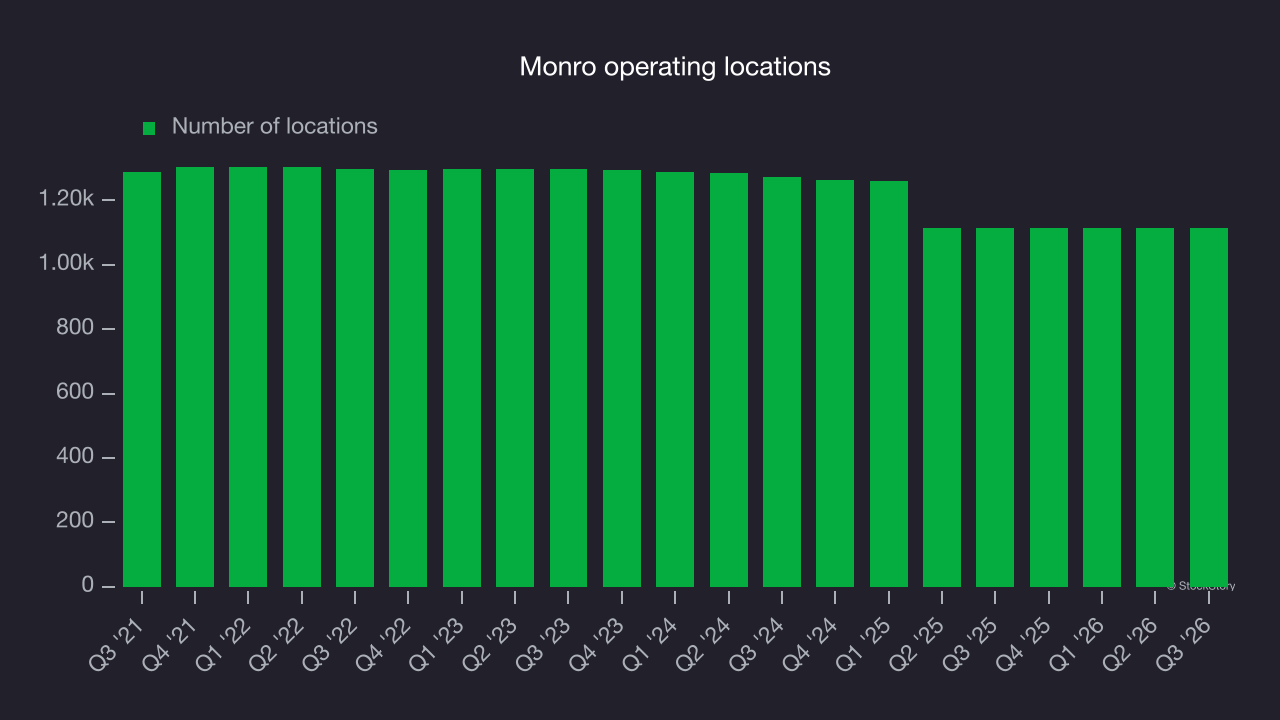
Monro listed 1,114 locations in the latest quarter and has generally reduced its store count over the last two years, averaging 6.7% annual declines.
When a retailer shutters stores, it usually means that brick-and-mortar demand is less than supply, and it is responding by closing underperforming locations to improve profitability.
Same-store sales
A company’s store base only shows part of the picture. When demand is high, it makes sense to open more. But when demand is low, it’s prudent to close some locations and use the money in other ways. Same-store sales provide a deeper understanding of this issue because the metric measures organic growth at brick-and-mortar shops open for at least a year.
Monro’s demand within its existing locations has barely increased over the last two years as its same-store sales were flat. This performance isn’t ideal, and Monro is attempting to boost same-store sales by closing stores (fewer locations sometimes lead to higher same-store sales).
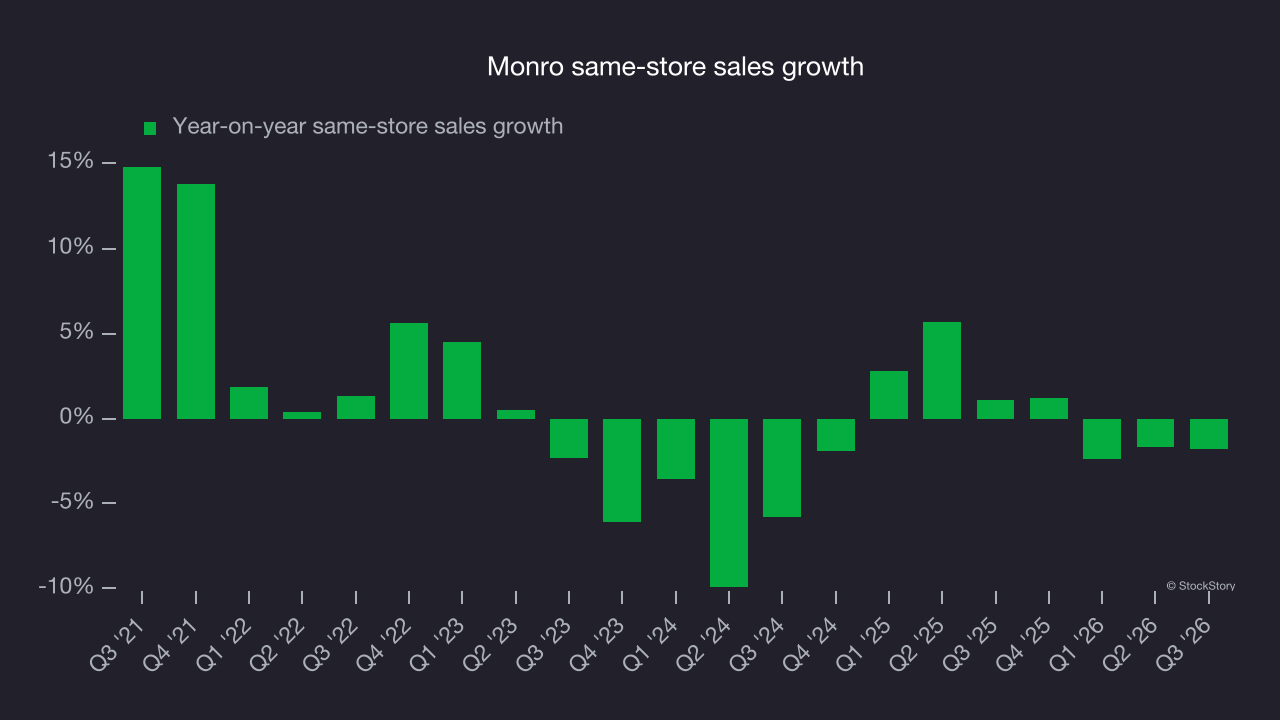
In the latest quarter, Monro’s same-store sales edged lower by 1.8% year on year. This decline was a reversal from its historical levels.
Key takeaways from Monro’s Q3 results
Monro’s quarter offered few positives: EPS missed estimates, and gross margin came in slightly below Wall Street’s consensus. Those shortfalls made for a weaker quarter overall. Shares tumbled 8.5% to $13.09 immediately after the report.
Monro’s latest quarter was underwhelming. One earnings report doesn’t define a company’s quality, though, so a broader view is needed to assess whether the stock is a buy at the current price. What happened in the latest quarter matters, but not as much as longer-term business quality and valuation, when deciding whether to invest in this stock. For more on Monro, read our full research report here (it’s free).