Semiconductor designer Power Integrations (NASDAQ: POWI) met Wall Street’s revenue expectations in Q3 2026, with revenue up 5.5% year on year to $125.5 million. On the other hand, next quarter’s revenue guidance of $122 million was less impressive, coming in 1.9% below analysts’ consensus estimates. Its non-GAAP profit of $0.46 per share was 10.8% above analysts’ consensus estimates.
For more on Power Integrations, read the full research report for free.
Power Integrations (POWI) Q3 2026 highlights:
- Revenue $125.5 million vs S&P analysts’ consensus estimates of $126 million (5.5% year-on-year growth, in line)
- Adjusted EPS $0.46 vs S&P analysts’ consensus estimates of $0.42 (10.8% beat)
- Adjusted operating income $26.88 million vs analysts’ consensus estimates of $23.17 million (21.4% margin, 16% beat)
- Revenue guidance $122 million at the midpoint for Q4 2026, below analysts’ consensus estimates of $124.4 million
- Operating margin 15.2%, up from -3.3% in the same quarter last year
- Free cash flow margin 29.1%, up from 20.3% in the same quarter last year
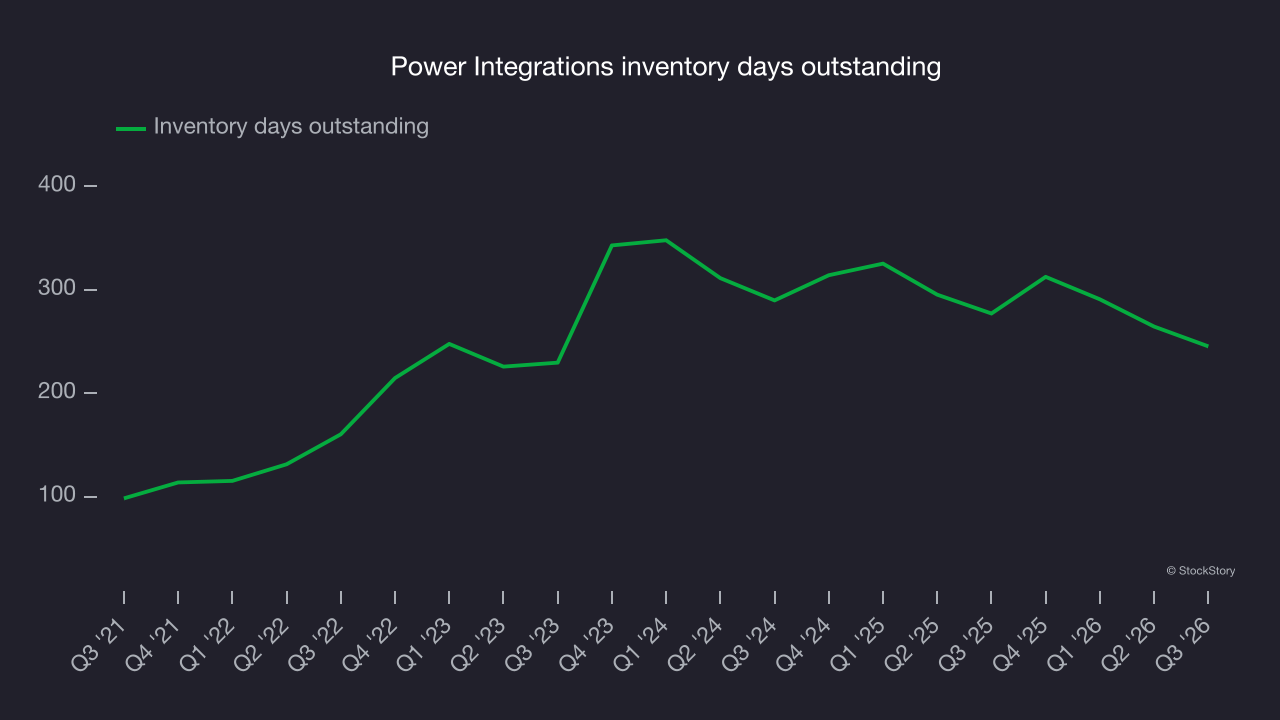
- Inventory days outstanding 245, down from 264 in the previous quarter
- Market capitalization $2.63 billion
Power Integrations CEO Jen Lloyd commented: "Revenue grew five percent over the prior quarter driven by PowiGaN™ products as well as continued strength in the industrial market, where revenue is up 13 percent year-to-date. We also delivered strong earnings growth in the quarter reflecting our continued focus on expense discipline and profitability. Power is becoming a critical constraint thanks to AI and electrification, calling for dramatic advances in efficiency and power density. Our high-voltage technology and system expertise are well aligned with these challenges, and we are excited about our product roadmap and the opportunities ahead to drive shareholder value."
Revenue growth
A company’s long-term performance is an indicator of its overall quality. Any business can experience short-term success, but top-performing ones sustain growth for years. Power Integrations struggled to consistently generate demand over the last five years as its revenue dropped at a 7.7% annual rate. This was below our standards and is a sign of poor business quality. Semiconductors are a cyclical industry, and long-term investors should be prepared for periods of high growth followed by periods of revenue contractions.
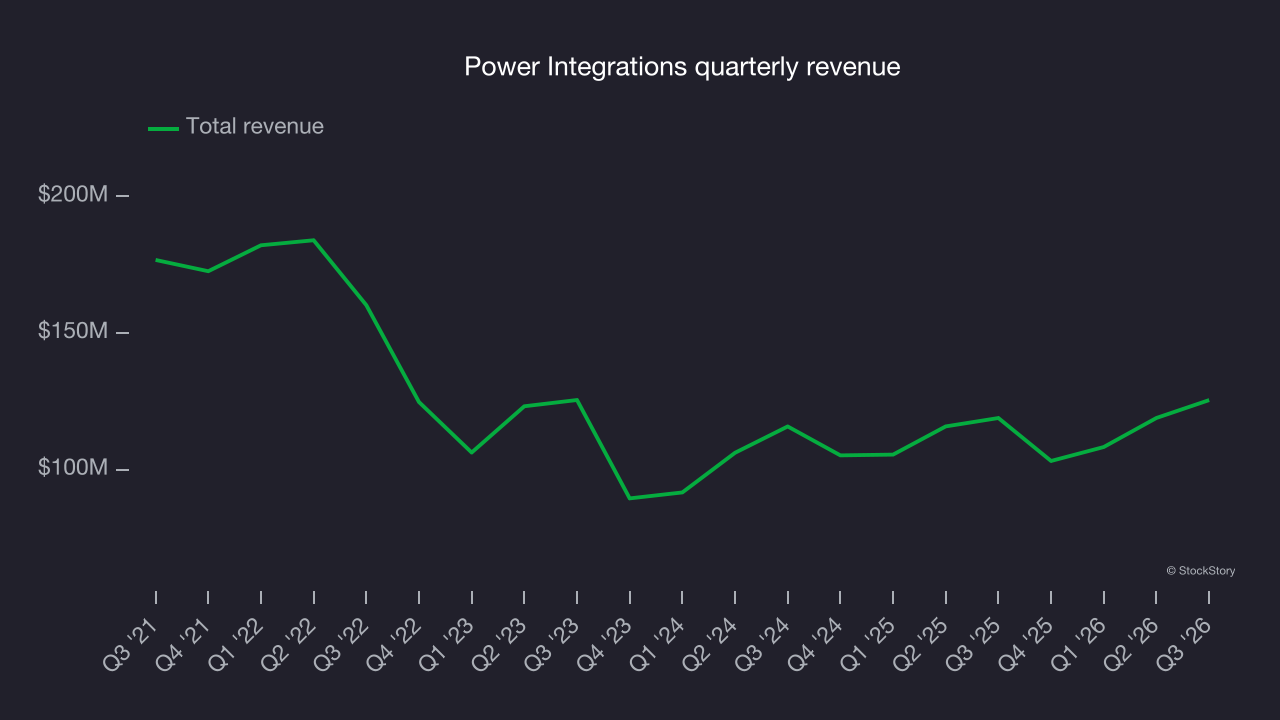
Long-term growth matters most, but within semiconductors, a half-decade historical view may miss new demand cycles or industry trends like artificial intelligence. Power Integrations’s annualized revenue growth of 6.3% over the last two years is above its five-year trend, a positive sign. 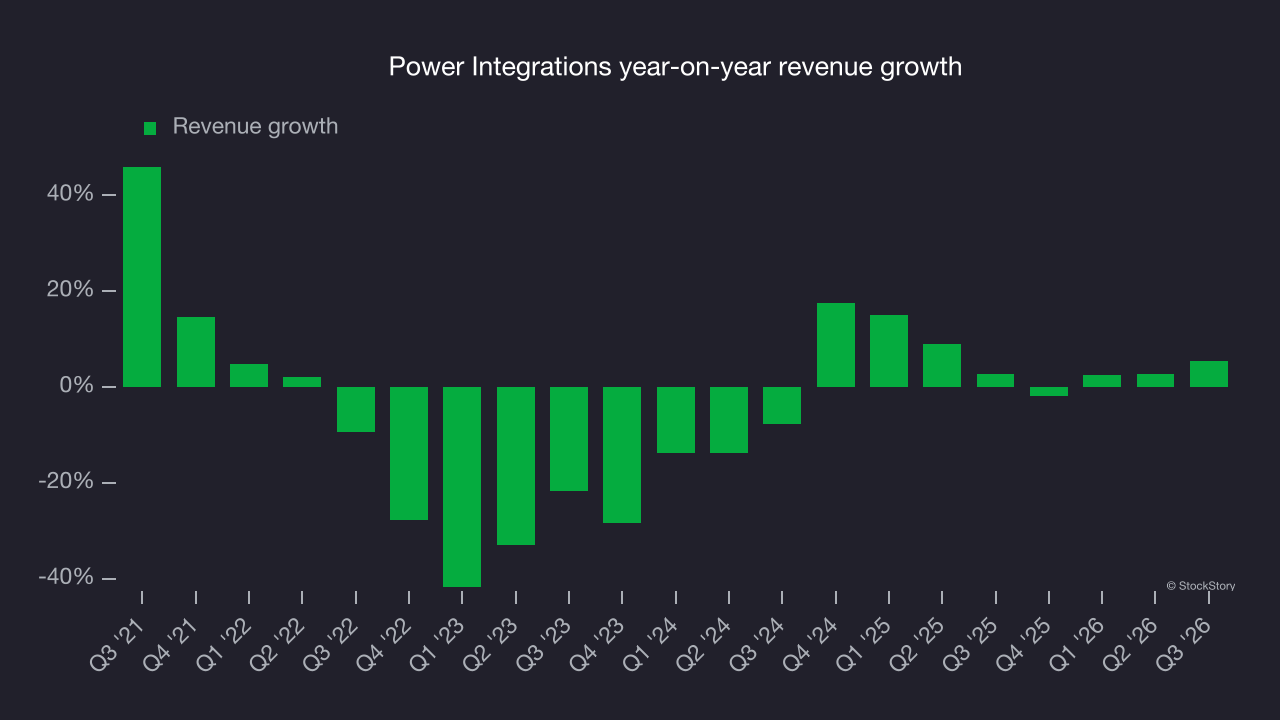
This quarter, Power Integrations grew its revenue by 5.5% year on year, and its $125.5 million in revenue was in line with Wall Street’s consensus estimates. Beyond meeting estimates, the company appears to be in the early stages of an upcycle as this was the third consecutive quarter of growth. A typical upcycle tends to last 8 to 10 quarters. Company management is currently guiding for an 18.2% year-on-year increase in revenue next quarter.
Looking further ahead, sell-side analysts expect revenue to grow 15.3% over the next 12 months, according to S&P. Although this projection suggests its newer products and services will drive better revenue growth, it is still below average for the sector.
Product demand & outstanding inventory
Days inventory outstanding, or DIO, is an important metric for chipmakers, as it reflects a business’s capital intensity and the cyclical nature of semiconductor supply and demand. In a tight supply environment, inventories tend to be stable, allowing chipmakers to exert pricing power. Steadily increasing DIO can be a warning sign that demand is weak, and if inventories continue to rise, the company may have to downsize production.
This quarter, Power Integrations’s DIO came in at 245, which is 7 days below its five-year average. At the moment, these numbers show no indication of an excessive inventory buildup.
Key takeaways from Power Integrations’s Q3 results
Power Integrations delivered a mixed quarter with some key positives: EPS beat analysts’ consensus estimates, and operating income topped Wall Street’s consensus by a wide margin. Revenue met Wall Street’s consensus estimates, but revenue guidance for next quarter fell short. Shares remained flat at $46.78 immediately after the release.
When deciding whether to buy Power Integrations, consider valuation, business quality and the latest earnings. Read the free full research report here for more on those factors.