Infrastructure engineering software company Bentley Systems (NASDAQ: BSY) met Wall Street’s revenue expectations in Q3 2026, with revenue rising 12.2% year on year to $421.5 million. Its non-GAAP profit of $0.36 per share was 8.9% above analysts’ consensus estimates.
For more on Bentley Systems, read our free full research report.
Bentley Systems (BSY) Q3 2026 highlights:
- Revenue $421.5 million vs S&P analysts’ consensus estimates of $420.7 million (12.2% year-on-year growth, in line)
- Adjusted EPS $0.36 vs S&P analysts’ consensus estimates of $0.33 (8.9% beat)
- Adjusted EBITDA $160.9 million vs analysts’ consensus estimates of $153.2 million (38.2% margin, 5% beat)
- Operating margin 29.1%, up from 22.5% in the same quarter last year
- Free cash flow margin 24.1%, up from 15.5% in the previous quarter
- Net revenue retention rate 110%, up from 109% in the previous quarter
- Annual recurring revenue $1.58 billion (12.6% year-on-year growth, beat)
- Billings $406.2 million at quarter end, up 11.8% year on year
- Market capitalization $13.54 billion
CEO Nicholas Cumins said, “We delivered another quarter of accelerated growth, driven by strength in Resources and continued momentum in Public Works & Utilities. The engineering firms we serve are benefiting from an unprecedented level of investment in infrastructure for AI. In parallel, Bentley is uniquely positioned to unlock the potential of AI for infrastructure. At our Year in Infrastructure Awards last month, nearly 70% of our finalists leveraged AI in their projects, demonstrating how our software used at machine speed can significantly expand engineering capability to deliver better, more resilient infrastructure.”
Revenue growth
A company’s long-term revenue performance can indicate its overall quality. Any business can post a good quarter or two, but the best consistently grow over the long haul. Over the last five years, Bentley Systems grew its revenue at a 12.4% compounded annual growth rate. Though this growth is acceptable on an absolute basis, revenue growth alone is not enough in the software sector, which can display significant earnings volatility. The bar for the sector is particularly high, reflecting the non-essential and hit-driven nature of the products and services offered. Additionally, the five-year growth period starts around Covid, when revenue was depressed before rebounding.
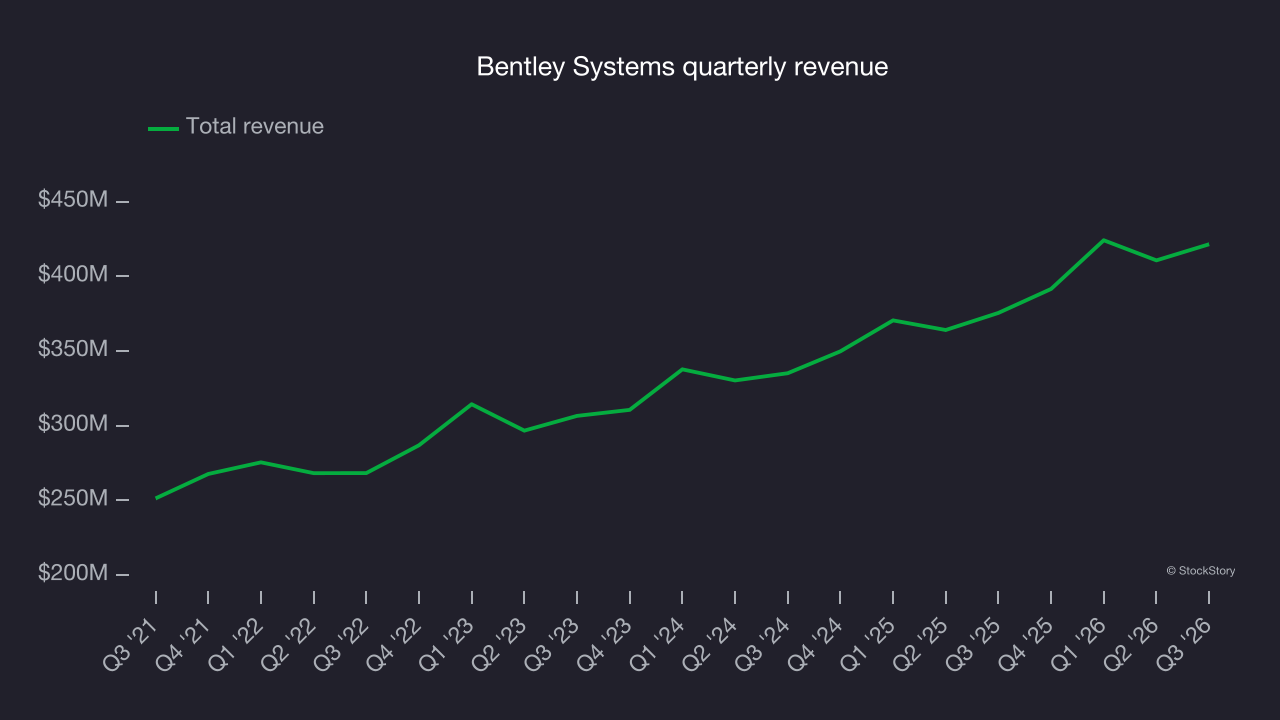
Long-term growth matters most, but within software, a half-decade historical view may miss recent innovations or disruptive industry trends. Bentley Systems’s annualized revenue growth of 12% over the last two years aligns with its five-year trend, suggesting its demand was consistently weak. 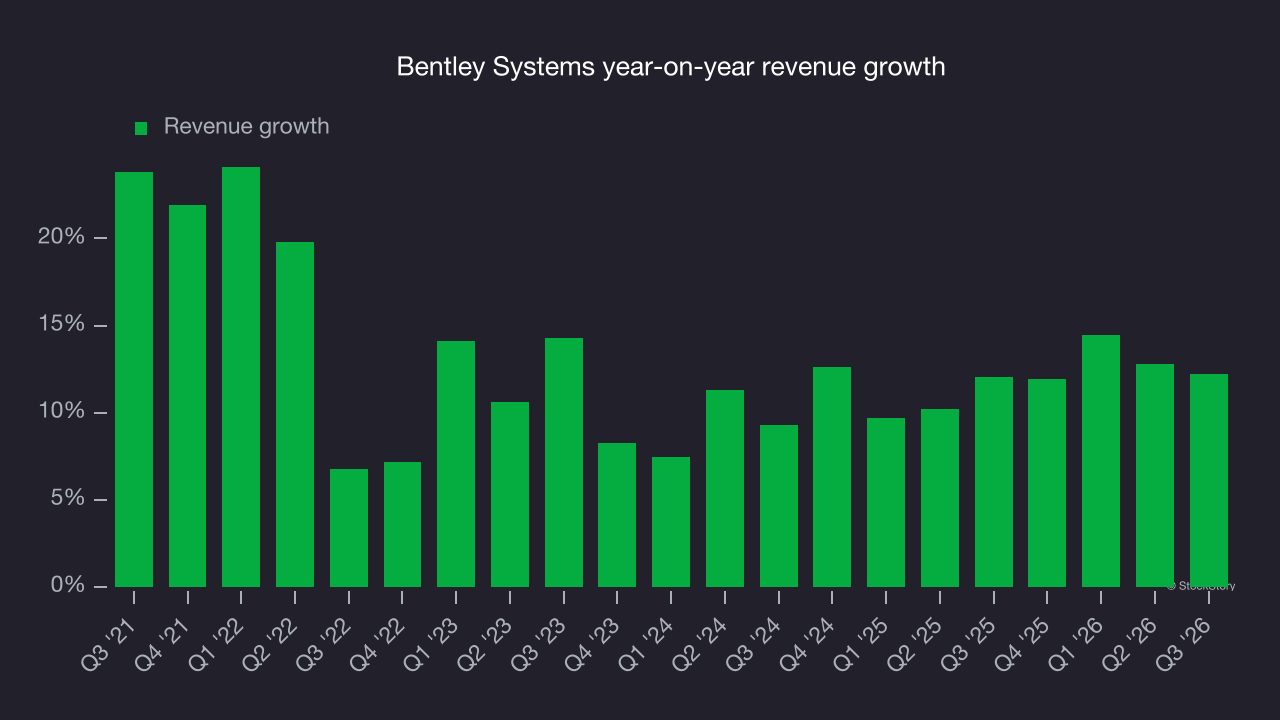
This quarter, Bentley Systems’s year-on-year revenue growth was 12.2%, and its $421.5 million of revenue was in line with Wall Street’s consensus estimates.
Looking ahead, sell-side analysts expect revenue to grow 10.8% over the next 12 months, according to S&P, similar to its two-year rate. This underwhelming projection indicates its products and services will see some demand headwinds.
Annual recurring revenue
While reported revenue for a software company can include low-margin items like implementation fees, annual recurring revenue, or ARR, is a sum of the next 12 months of contracted revenue purely from software subscriptions, the high-margin, predictable revenue streams central to the value of software-as-a-service businesses.
Bentley Systems’s ARR came in at $1.58 billion in Q3, and over the last four quarters, its growth was underwhelming as it averaged 12.8% year-on-year increases. This performance mirrored its total revenue and suggests that increasing competition is causing challenges in securing longer-term commitments. 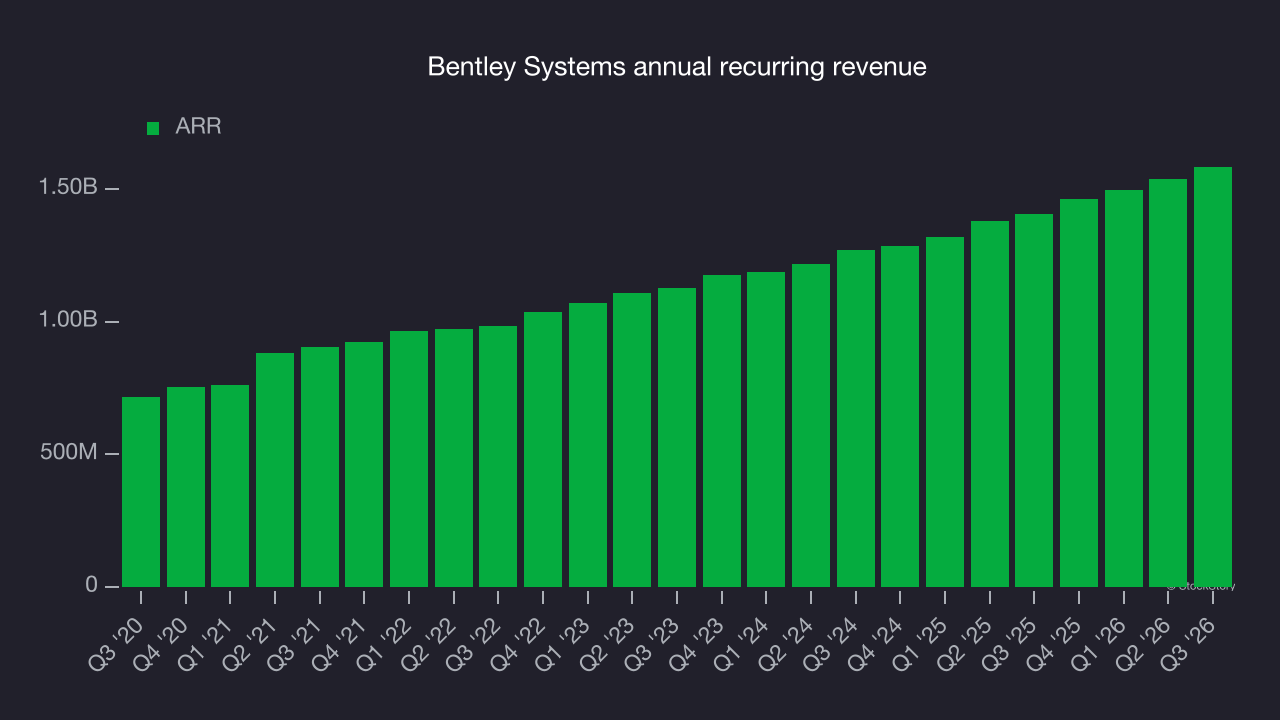
Customer retention
An advantage of the software-as-a-service business model, and one reason software companies trade at high valuation multiples, is that customers typically spend more on a company’s products and services over time.
Bentley Systems’s net revenue retention rate, a key performance metric measuring how much money existing customers from a year ago are spending today, was 110% in Q3. This means Bentley Systems would’ve grown its revenue by 10% even if it didn’t win any new customers over the last 12 months.
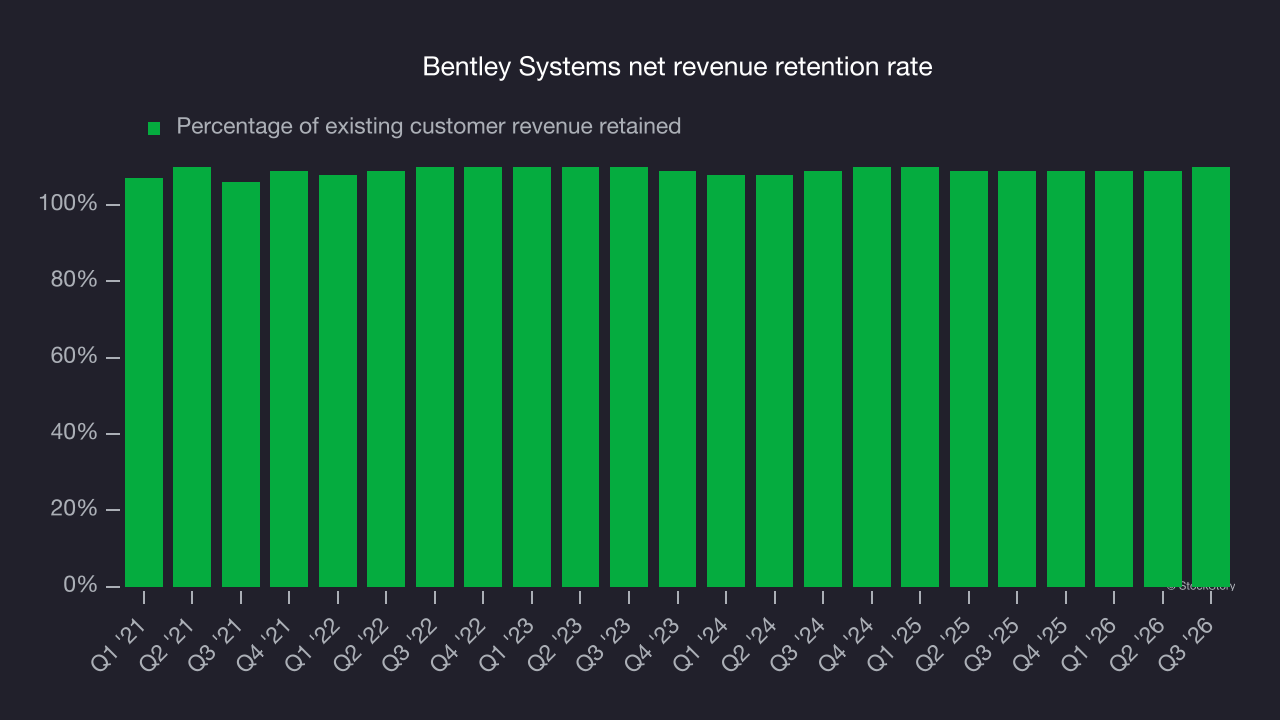
Bentley Systems has a decent net retention rate, indicating that its customers not only tend to stay but also get increasing value from its software over time.
Key takeaways from Bentley Systems’s Q3 results
Bentley Systems delivered some key positives in Q3, led by adjusted operating income that came in well above analysts’ consensus estimates. Annual recurring revenue also topped Wall Street’s consensus, but billings fell slightly short of expectations. Shares edged higher 1.2% to $44.18 immediately after the results.
Bentley Systems may have had a good quarter, but that alone doesn’t make it a good investment. What happened in the latest quarter matters, but not as much as longer-term business quality and valuation when deciding whether to invest in this stock. For more on Bentley Systems, read the full research report here (it’s free).