Outdoor lifestyle and equipment company Clarus (NASDAQ: CLAR) announced better-than-expected revenue in Q3 2026, with revenue up 2.7% year on year to $71.22 million. The company’s full-year revenue guidance of $253 million at the midpoint came in 0.9% above analysts’ consensus estimates. Its non-GAAP profit of $0.15 per share was significantly above analysts’ consensus estimates.
For more on Clarus, read our free full research report.
Clarus (CLAR) Q3 2026 highlights:
- Revenue $71.22 million vs S&P analysts’ consensus estimates of $66.84 million (2.7% year-on-year growth, 6.6% beat)
- Adjusted EPS $0.15 vs S&P analysts’ consensus estimates of $0.05 (significant beat)
- Adjusted EBITDA $6.82 million vs analysts’ consensus estimates of $2.91 million (9.6% margin, significant beat)
- Revenue guidance The company lifted its revenue guidance for the full year to $253 million at the midpoint from $250 million, a 1.2% increase
- EBITDA guidance $16 million at the midpoint for the full year, above analysts’ consensus estimates of $12.45 million
- Operating margin 4.7%, up from -2.6% in the same quarter last year
- Market capitalization $169.2 million
Management Commentary “We delivered strong third quarter results, reflecting the tangible progress we continue to make against our strategic priorities,” said Warren Kanders, Clarus’ executive chairman. “Our efforts to simplify the business, sharpen our product focus and improve operating efficiency are translating into stronger financial performance including gross margins north of 40% at both segments, driving significant net income and adjusted EBITDA growth year-over-year. This improvement in underlying profitability, which also reflects the recovery of previously paid IEEPA tariffs, underscores the benefits of our reduced cost structure and prioritization of our highest-volume and highest-margin products. Supported by continued positive momentum across our Outdoor and Adventure segments, we are pleased to raise our full-year guidance, reflecting our confidence in business fundamentals and constructive outlook for the remainder of 2026.”
Revenue growth
A company’s long-term performance is an indicator of its overall quality. Even a poor business can perform well for one or two quarters, but a high-quality one grows for years. Over the last five years, Clarus’s demand was weak and its revenue declined by 5.2% per year. That fell short of our standards and points to poor business quality.
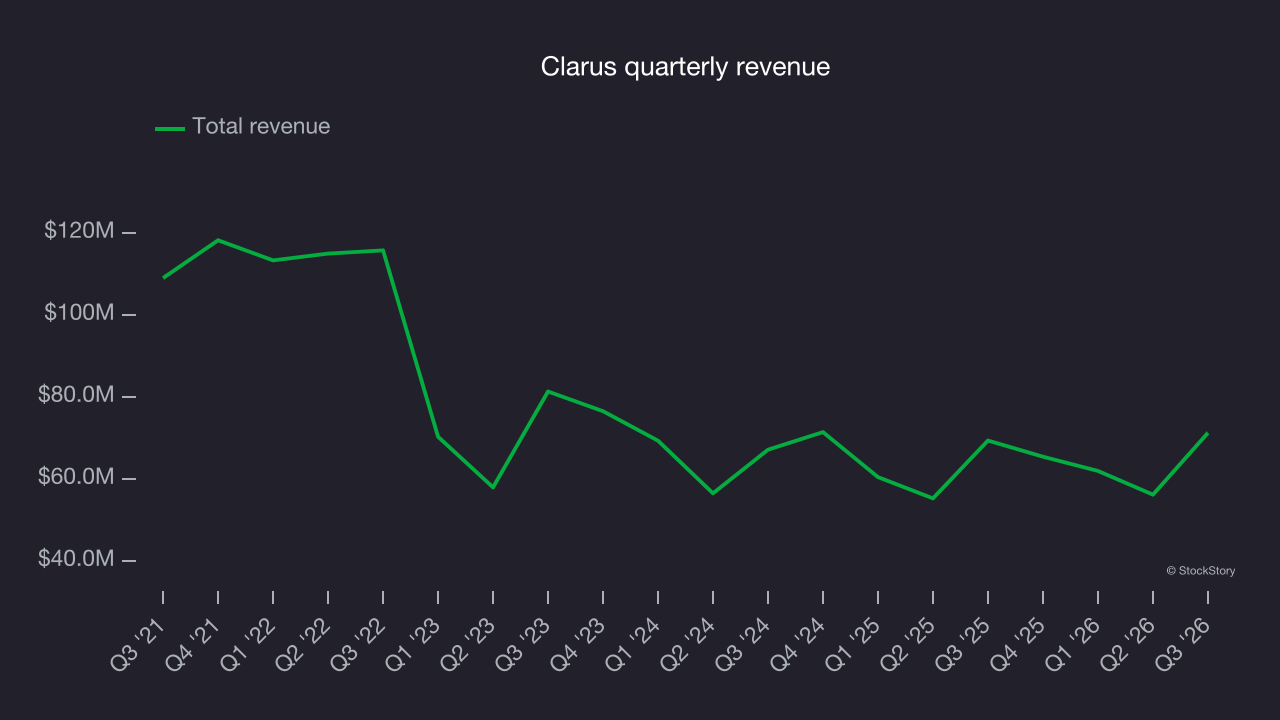
Long-term growth matters most, but within consumer discretionary, a stretched historical view may miss a company riding a successful new product or trend. Clarus’s annualized revenue declines of 2.8% over the last two years suggest its demand continued shrinking. 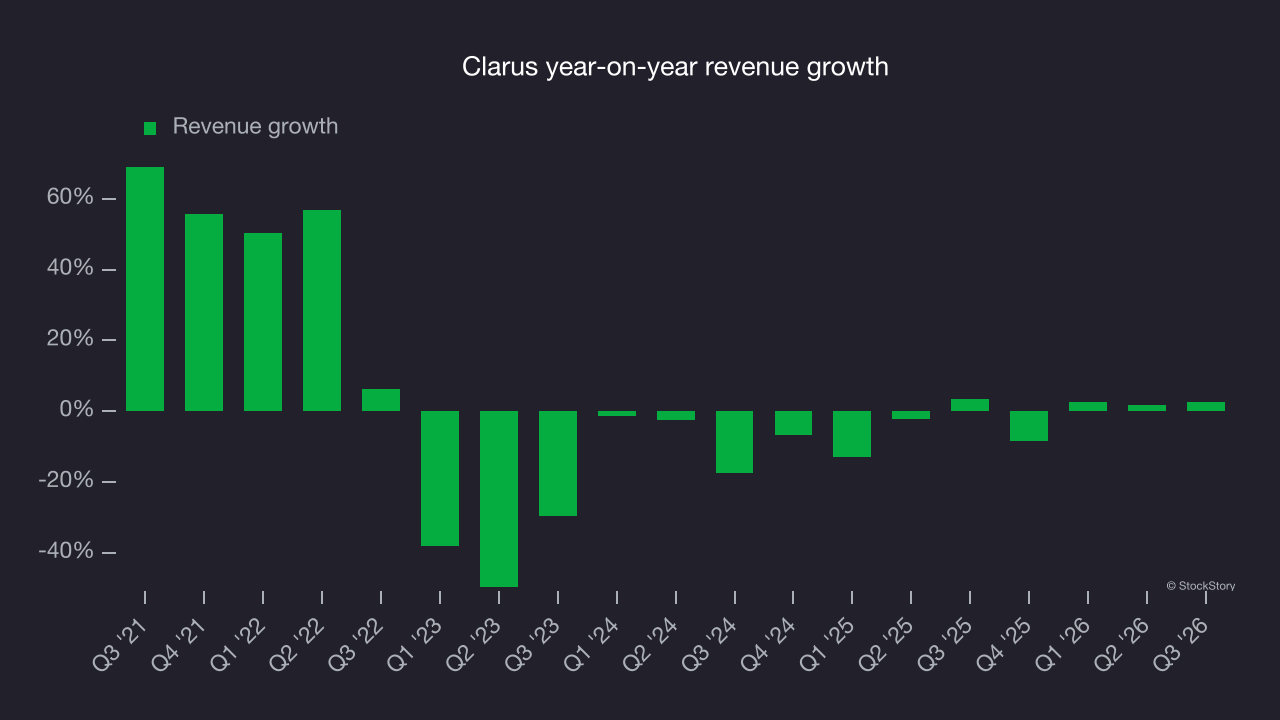
This quarter, Clarus reported modest year-on-year revenue growth of 2.7% but beat Wall Street’s consensus estimates by 6.6%.
Looking ahead, sell-side analysts expect revenue to remain flat over the next 12 months, according to S&P. Although this projection implies its newer products and services will fuel better top-line performance, it is still below average for the sector.
Operating margin
Clarus’s operating margin has been trending up over the last 12 months, but it still averaged negative 4.5% over the last two years. This is due to its large expense base and inefficient cost structure.
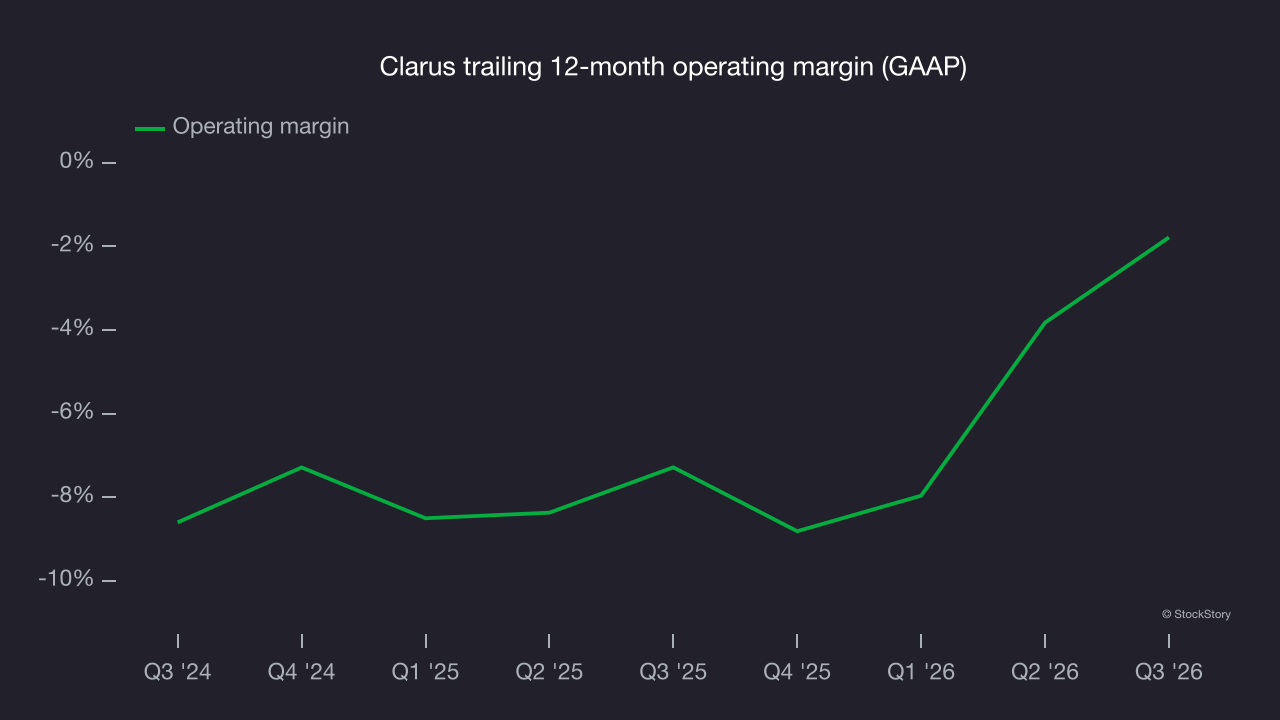
In Q3, Clarus generated an operating margin of 4.7%, up 7.3 percentage points year on year. This increase was a positive development and shows it was more efficient.
Earnings per share
Revenue trends explain a company’s historical growth, but the long-term change in earnings per share, or EPS, points to the profitability of that growth – for example, a company could inflate its revenue through excessive spending on advertising and promotions.
Clarus’s EPS declined by 20.1% annually over the last five years, more than its revenue. This indicates the company struggled because its fixed cost base made it difficult to adjust to shrinking demand.
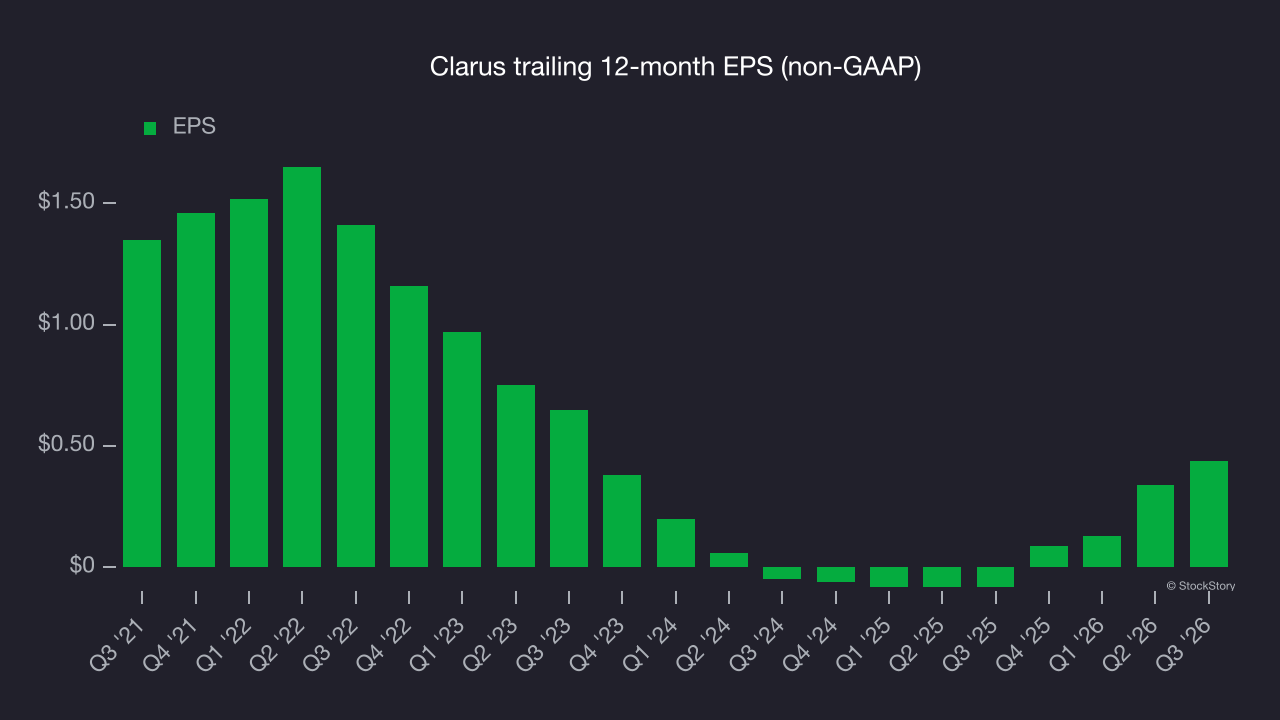
In Q3, Clarus reported adjusted EPS of $0.15, up from $0.05 in the same quarter last year. EPS came in well above analysts’ consensus estimates, a positive result for shareholders. Over the next 12 months, Wall Street expects Clarus’s full-year EPS to shrink by 64.4% from $0.44 to $0.16, according to S&P.
Key takeaways from Clarus’s Q3 results
Clarus’s wide EBITDA beat stood out in Q3, with EPS also topping analysts’ consensus estimates. Those results gave the quarter some important positives. Shares surged 6.5% to $4.51 immediately after the release.
Clarus reported solid earnings, but one quarter doesn’t necessarily make the stock a buy. To assess the investment, it’s important to consider its valuation, business quality and latest quarterly results. For more on Clarus, read the full research report here (it’s free).