Real estate technology company Compass (NYSE: COMP) met Wall Street’s revenue expectations in Q3 2026, with revenue up 111% year on year to $3.90 billion. On the other hand, next quarter’s revenue guidance of $3.25 billion was less impressive, coming in 5.5% below analysts’ consensus estimates. Its GAAP profit of $0.07 per share was 76.7% above analysts’ consensus estimates.
For more on Compass, read our full research report, available free.
Compass (COMP) Q3 2026 highlights:
- Revenue $3.90 billion vs S&P analysts’ consensus estimates of $3.90 billion (111% year-on-year growth, in line)
- EPS (GAAP) $0.07 vs analysts’ consensus estimates of $0.04 (76.7% beat)
- Adjusted EBITDA $306 million vs analysts’ consensus estimates of $279.2 million (7.9% margin, 9.6% beat)
- Revenue guidance $3.25 billion at the midpoint for Q4 2026, below analysts’ consensus estimates of $3.44 billion
- EBITDA guidance $115 million at the midpoint for Q4 2026, below analysts’ consensus estimates of $170.1 million
- Operating margin 2.2%, up from -0.4% in the same quarter last year
- Free cash flow margin 6.2%, up from 4% in the same quarter last year
- Transactions increased by 72,232 year on year
- Market capitalization $7.61 billion
Revenue growth
Examining a company’s long-term performance can provide clues about its quality. Any business can deliver a good quarter or two, but the best consistently grow over the long term. Over the last five years, Compass grew its revenue at a 15.9% compounded annual growth rate. Though this growth is acceptable on an absolute basis, revenue growth alone is not enough to assess the consumer discretionary sector, which can display significant earnings volatility. The bar for the sector is particularly high, reflecting the non-essential and hit-driven nature of the products and services offered. Additionally, the five-year growth period starts around Covid, when revenue was depressed before rebounding.
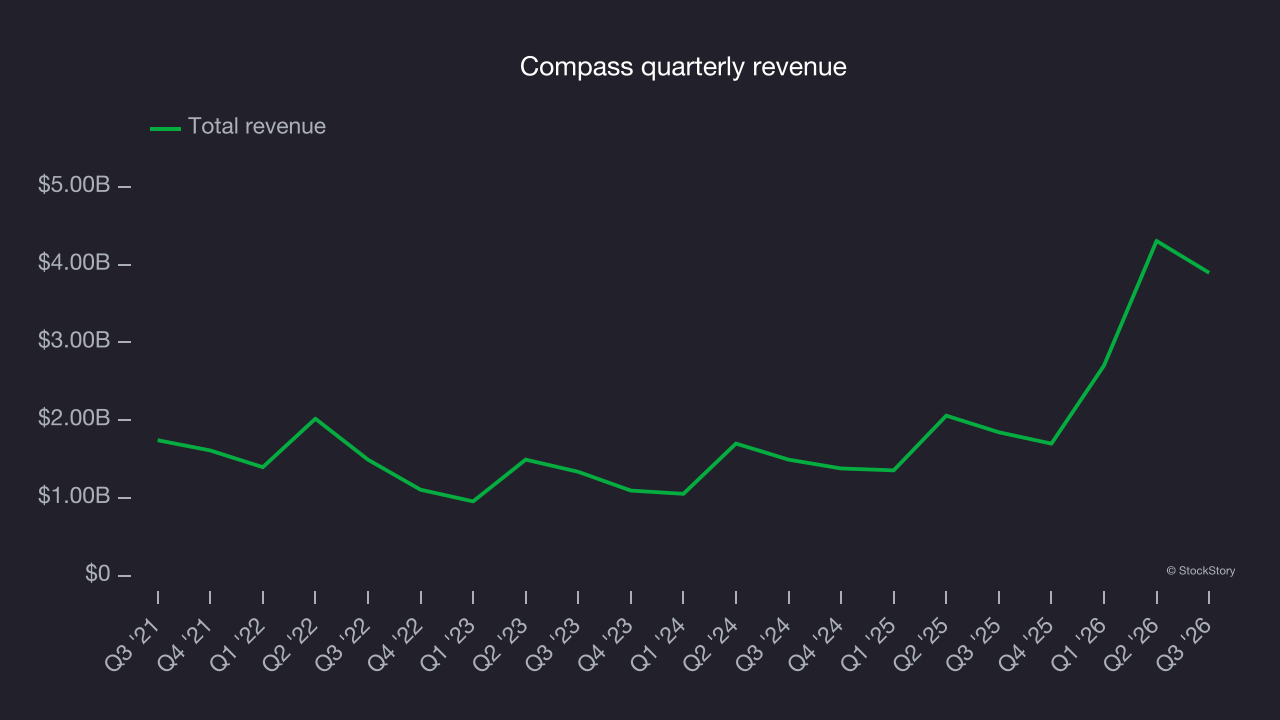
Long-term growth is the most important, but within consumer discretionary, product cycles are short and revenue can be hit-driven due to rapidly changing trends and consumer preferences. Compass’s annualized revenue growth of 53.6% over the last two years is above its five-year trend, suggesting its demand recently accelerated. 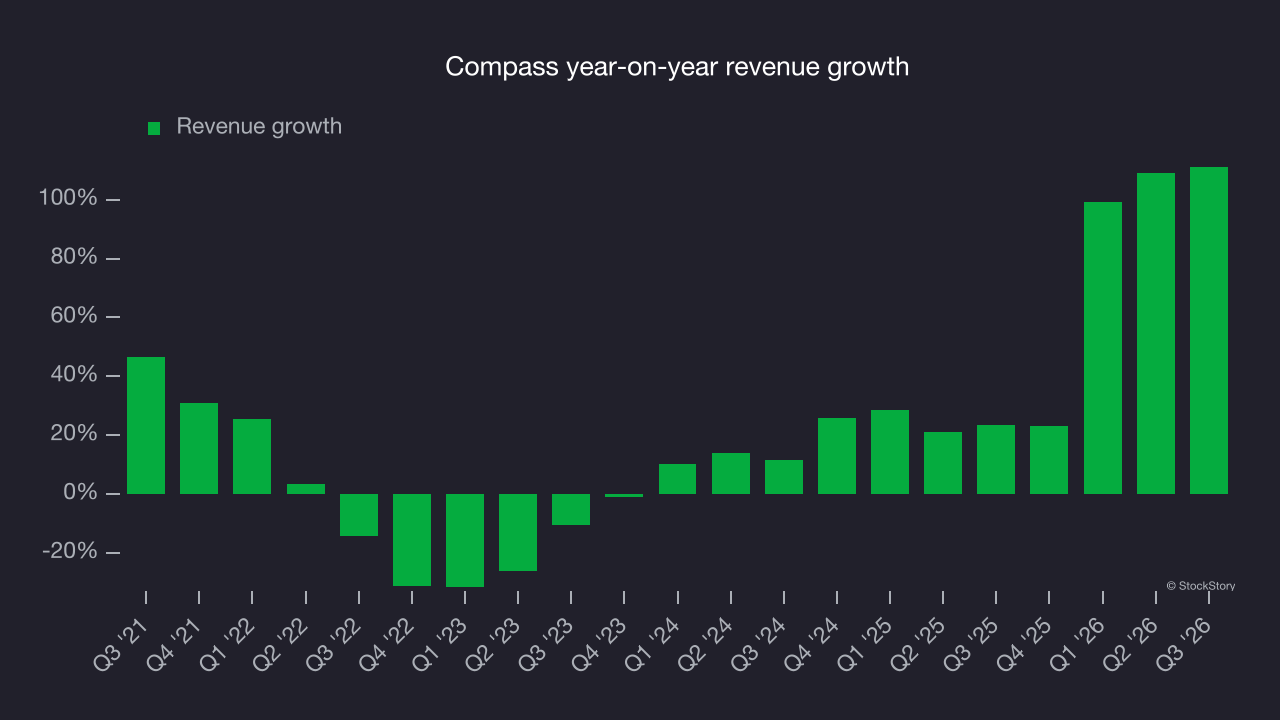
Compass also discloses its number of transactions, which reached 140,118 in the latest quarter. Over the last two years, Compass’s transactions averaged 54.1% year-on-year growth. This was in line with revenue growth during the same period, indicating that the company’s monetization was fairly consistent. 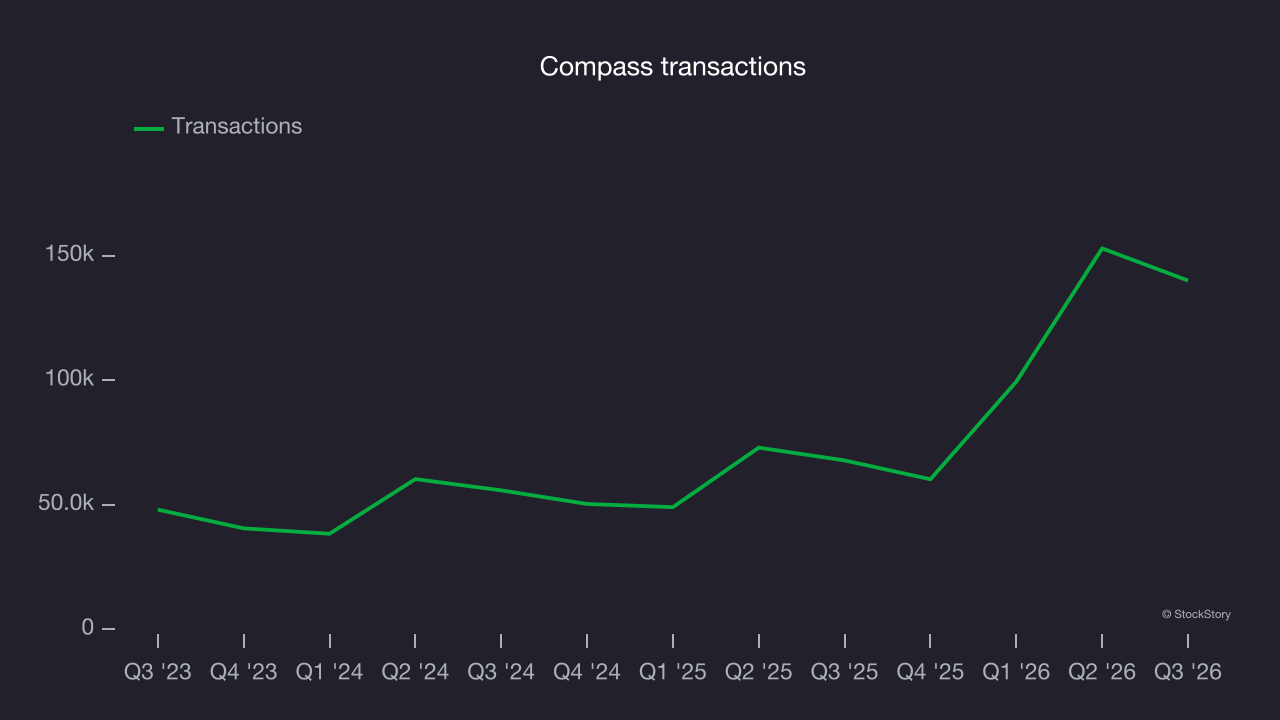
This quarter, Compass’s year-on-year revenue growth of 111% was strong, and its $3.90 billion of revenue was in line with Wall Street’s consensus estimates. Management is guiding for a 91.2% year-on-year increase in revenue next quarter.
Looking further ahead, sell-side analysts expect revenue to grow 19.4% over the next 12 months, according to S&P, a deceleration versus the last two years. Its growth trajectory remains attractive given its scale and implies the market is forecasting success for its products and services.
Operating margin
Compass’s operating margin has generally stayed the same over the last 12 months, averaging negative 1.3% over the last two years. Unprofitable consumer discretionary companies that fail to narrow their losses or grow revenue rapidly deserve extra scrutiny. For the time being, it’s unclear if Compass’s business model is sustainable.
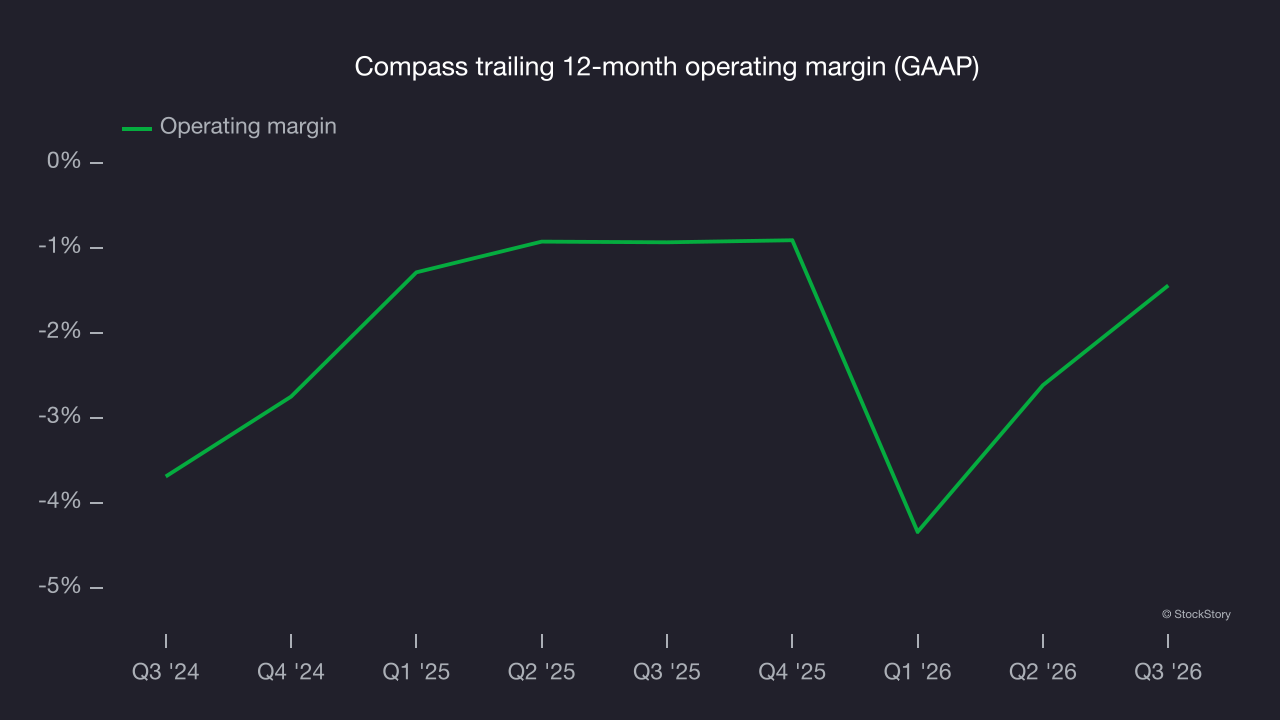
This quarter, Compass generated an operating margin of 2.2%, up 2.6 percentage points year on year. This increase was a positive development and shows it was more efficient.
Earnings per share
We track the long-term change in earnings per share (EPS) for the same reason as long-term revenue growth. Compared to revenue, however, EPS highlights whether a company’s growth is profitable.
Compass’s full-year EPS turned positive over the last five years. That improvement is a positive sign and marks a critical point in the company’s development.
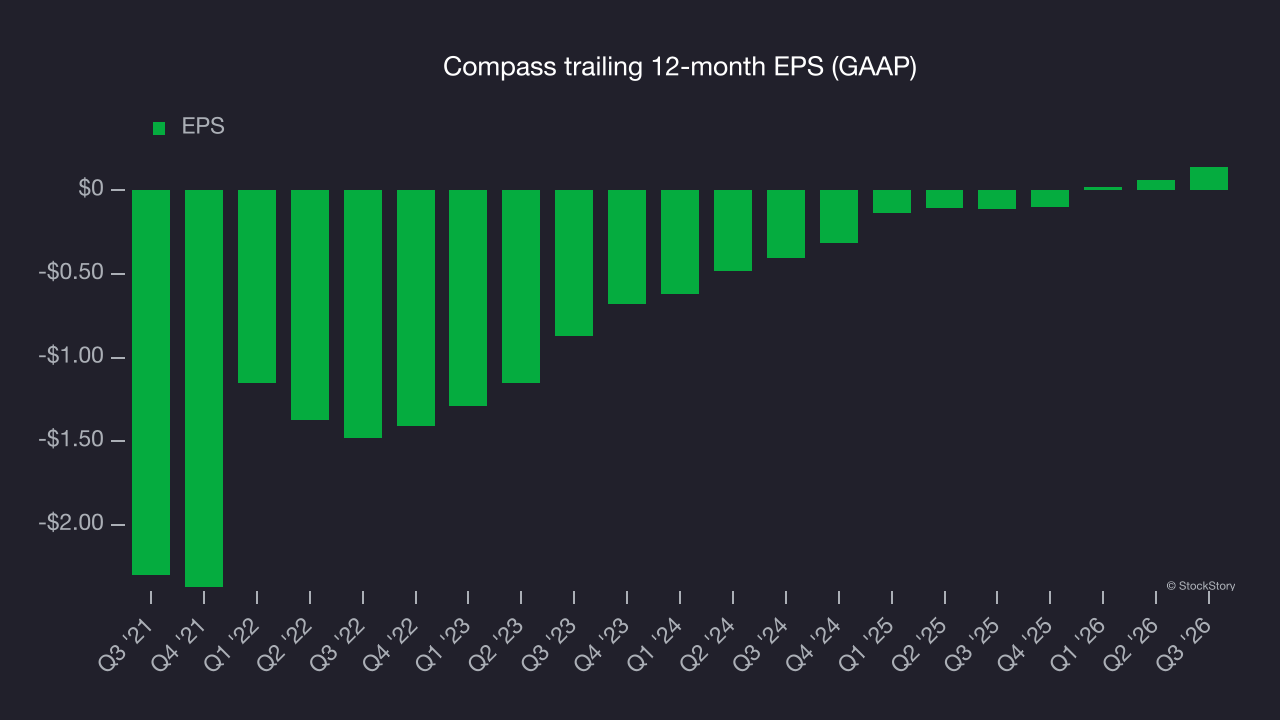
In Q3, Compass reported EPS of $0.07, up from negative $0.01 in the same quarter last year. EPS came in well above analysts’ consensus estimates, a positive result for shareholders. Over the next 12 months, Wall Street expects Compass’s full-year EPS to shrink by 68.8% from $0.14 to $0.04, according to S&P.
Key takeaways from Compass’s Q3 results
Compass’s outlook made this a weaker quarter: Both EBITDA and revenue guidance for next quarter fell short of Wall Street’s consensus estimates. The quarterly results were better, with EPS and EBITDA beating analysts’ consensus estimates. Shares remained flat at $9.25 immediately after the report.
Is Compass a buy at its current price? The latest quarter is only one piece of the longer-term business quality picture. Quality, when combined with valuation, can help determine if the stock is a buy. Read the full research report here (it’s free).