
Foodservice packaging supplier Karat Packaging (NASDAQ: KRT) reported Q1 CY2026 results exceeding the market’s revenue expectations, with sales up 12.9% year on year to $116.9 million. On the other hand, next quarter’s revenue guidance of $135.1 million was less impressive, coming in 3% below analysts’ estimates. Its non-GAAP profit of $0.34 per share was 6.3% above analysts’ consensus estimates.
Is now the time to buy Karat Packaging? Find out by accessing our full research report, it’s free.
Karat Packaging (KRT) Q1 CY2026 Highlights:
- Revenue: $116.9 million vs analyst estimates of $113 million (12.9% year-on-year growth, 3.5% beat)
- Adjusted EPS: $0.34 vs analyst estimates of $0.32 (6.3% beat)
- Adjusted EBITDA: $12.49 million vs analyst estimates of $11.17 million (10.7% margin, 11.8% beat)
- Revenue Guidance for Q2 CY2026 is $135.1 million at the midpoint, below analyst estimates of $139.3 million
- Operating Margin: 7.2%, in line with the same quarter last year
- Free Cash Flow Margin: 5.4%, down from 6.4% in the same quarter last year
- Market Capitalization: $592.5 million
“We started 2026 with a robust quarter, with year‑over‑year sales increasing almost 13 percent as momentum built throughout the quarter, accelerating from weather-impacted modest progress in January to growth exceeding 20 percent in March,” said Alan Yu, Chief Executive Officer.
Company Overview
Founded as Lollicup, Karat Packaging (NASDAQ: KRT) distributes and manufactures environmentally-friendly disposable foodservice packaging solutions.
Revenue Growth
A company’s long-term performance is an indicator of its overall quality. Any business can put up a good quarter or two, but many enduring ones grow for years. Over the last five years, Karat Packaging grew its sales at a solid 9.4% compounded annual growth rate. Its growth beat the average industrials company and shows its offerings resonate with customers, a helpful starting point for our analysis.
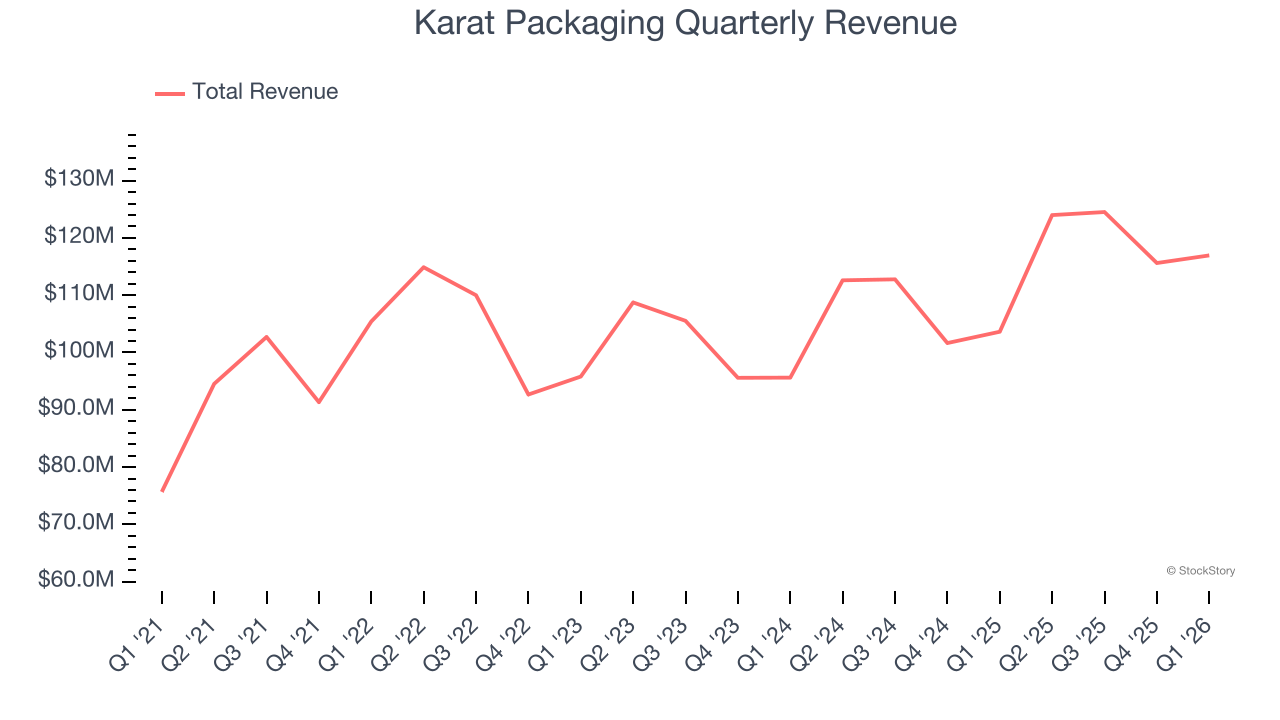
Long-term growth is the most important, but within industrials, a half-decade historical view may miss new industry trends or demand cycles. Karat Packaging’s annualized revenue growth of 8.9% over the last two years aligns with its five-year trend, suggesting its demand was stable. 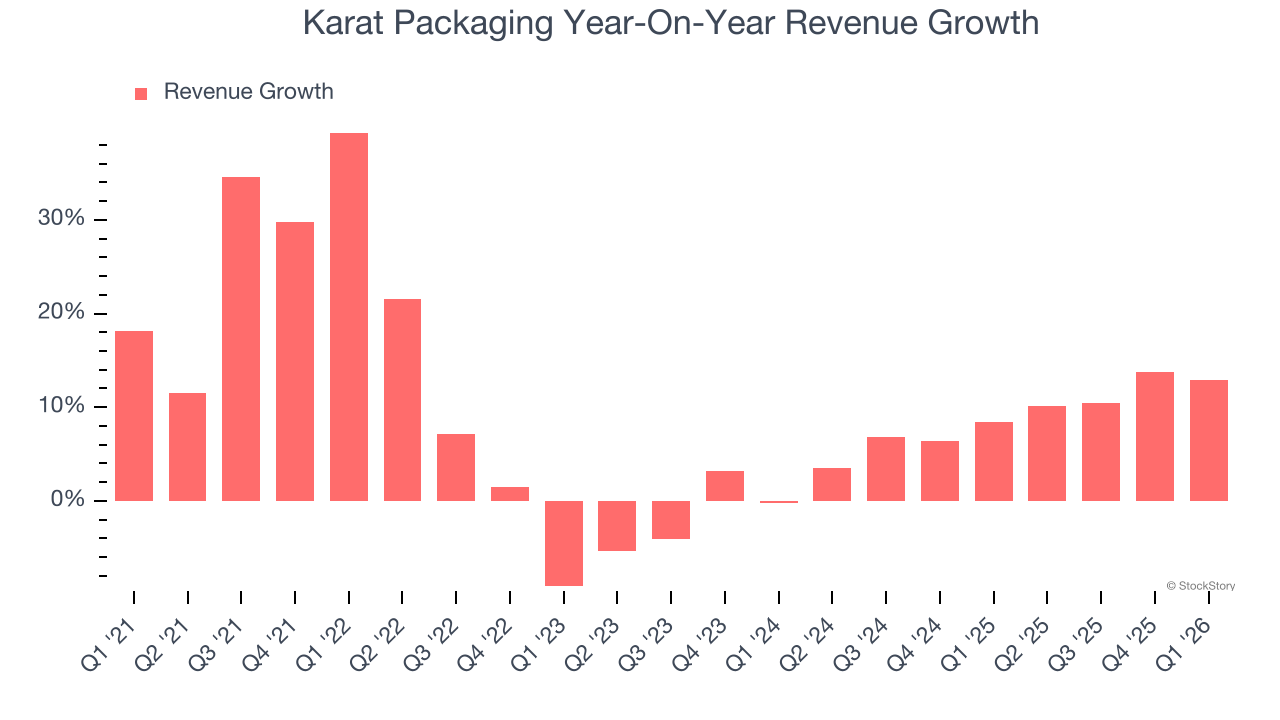
This quarter, Karat Packaging reported year-on-year revenue growth of 12.9%, and its $116.9 million of revenue exceeded Wall Street’s estimates by 3.5%. Company management is currently guiding for a 9% year-on-year increase in sales next quarter.
Looking further ahead, sell-side analysts expect revenue to grow 12.8% over the next 12 months, an improvement versus the last two years. This projection is healthy and suggests its newer products and services will fuel better top-line performance.
WHILE YOU’RE HERE: The Next Palantir? One satellite company captures images of every point on Earth. Every single day. The Pentagon wants it. Hedge funds are using it to beat earnings. You’ve probably never heard of it.
This is what the early days of Palantir looked like before it became a $437 billion giant. Same playbook. Different technology. If you missed Palantir, you need to see this. Claim The Stock Ticker for Free HERE.
Operating Margin
Operating margin is an important measure of profitability as it shows the portion of revenue left after accounting for all core expenses – everything from the cost of goods sold to advertising and wages. It’s also useful for comparing profitability across companies with different levels of debt and tax rates because it excludes interest and taxes.
Karat Packaging has done a decent job managing its cost base over the last five years. The company has produced an average operating margin of 8.7%, higher than the broader industrials sector.
Analyzing the trend in its profitability, Karat Packaging’s operating margin rose by 1.3 percentage points over the last five years, as its sales growth gave it operating leverage. Its expansion shows it’s one of the better Specialty Equipment Distributors companies as most peers saw their margins plummet.
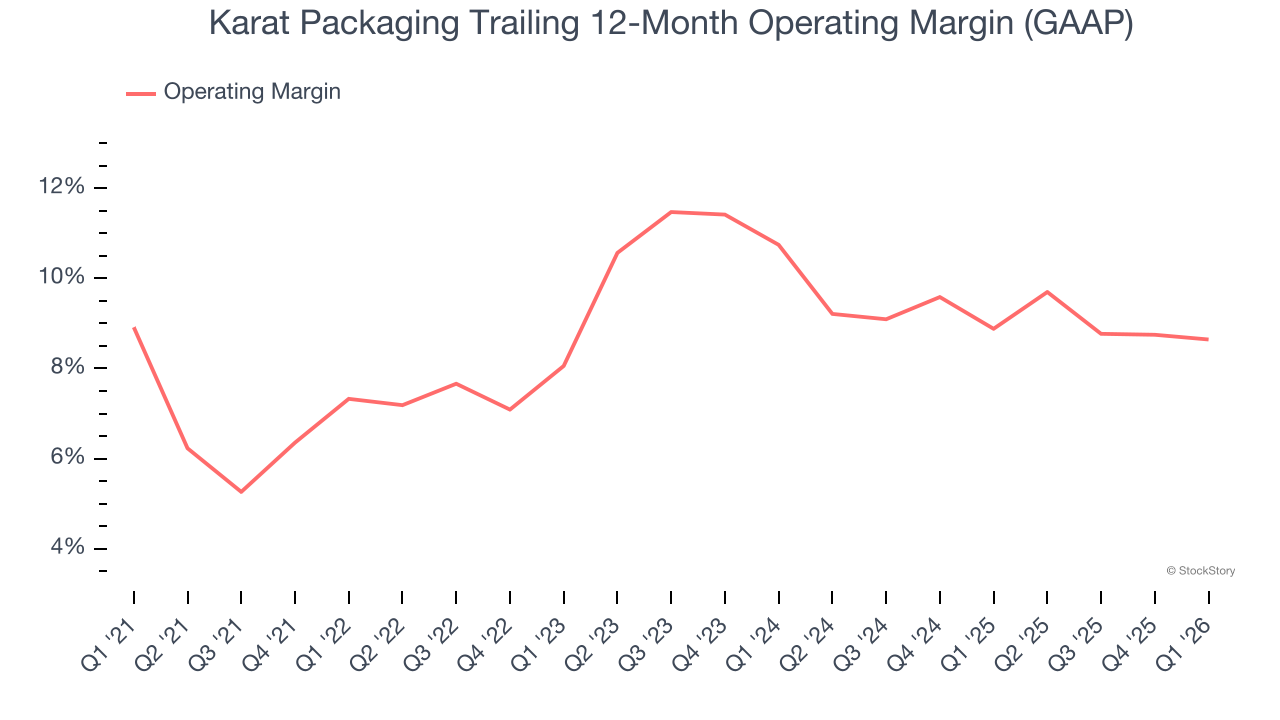
This quarter, Karat Packaging generated an operating margin profit margin of 7.2%, in line with the same quarter last year. This indicates the company’s cost structure has recently been stable.
Earnings Per Share
We track the long-term change in earnings per share (EPS) for the same reason as long-term revenue growth. Compared to revenue, however, EPS highlights whether a company’s growth is profitable.
Karat Packaging’s full-year EPS grew at a decent 8.4% compounded annual growth rate over the last four years, in line with the broader industrials sector.
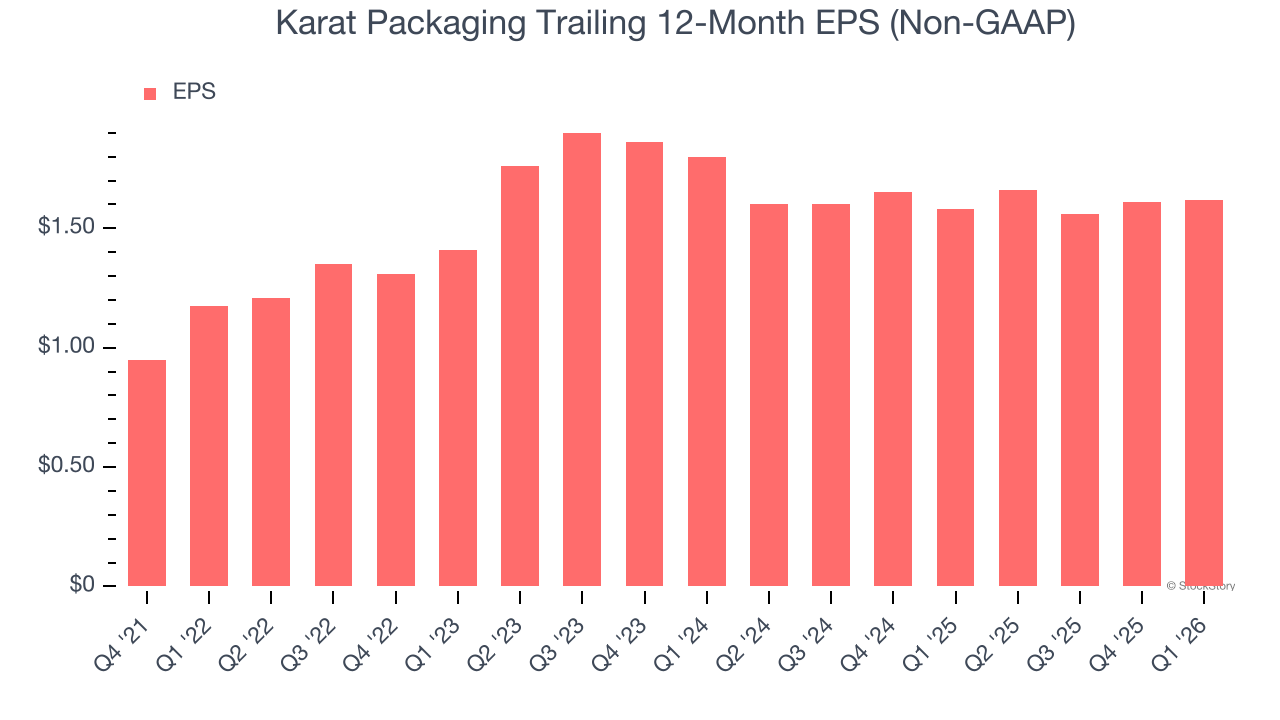
Like with revenue, we analyze EPS over a shorter period to see if we are missing a change in the business.
Sadly for Karat Packaging, its EPS declined by 5.2% annually over the last two years while its revenue grew by 8.9%. This tells us the company became less profitable on a per-share basis as it expanded.
Diving into the nuances of Karat Packaging’s earnings can give us a better understanding of its performance. While we mentioned earlier that Karat Packaging’s operating margin was flat this quarter, a two-year view shows its margin has declined. This was the most relevant factor (aside from the revenue impact) behind its lower earnings; interest expenses and taxes can also affect EPS but don’t tell us as much about a company’s fundamentals.
In Q1, Karat Packaging reported adjusted EPS of $0.34, up from $0.33 in the same quarter last year. This print beat analysts’ estimates by 6.3%. We also like to analyze expected EPS growth based on Wall Street analysts’ consensus projections, but there is insufficient data.
Key Takeaways from Karat Packaging’s Q1 Results
We were impressed by how significantly Karat Packaging blew past analysts’ EBITDA expectations this quarter. We were also excited its adjusted operating income outperformed Wall Street’s estimates by a wide margin. On the other hand, its revenue guidance for next quarter missed. Zooming out, we think this was a mixed print. The stock remained flat at $30.52 immediately after reporting.
Sure, Karat Packaging had a solid quarter, but if we look at the bigger picture, is this stock a buy? When making that decision, it’s important to consider its valuation, business qualities, as well as what has happened in the latest quarter. We cover that in our actionable full research report which you can read here (it’s free).