As the Q1 earnings season wraps, let’s dig into this quarter’s best and worst performers in the shelf-stable food industry, including Hain Celestial (NASDAQ: HAIN) and its peers.
As America industrialized and moved away from an agricultural economy, people faced more demands on their time. Packaged foods emerged as a solution offering convenience to the evolving American family, whether it be canned goods or snacks. Today, Americans seek brands that are high in quality, reliable, and reasonably priced. Furthermore, there's a growing emphasis on health-conscious and sustainable food options. Packaged food stocks are considered resilient investments. People always need to eat, so these companies can enjoy consistent demand as long as they stay on top of changing consumer preferences. The industry spans from multinational corporations to smaller specialized firms and is subject to food safety and labeling regulations.
The 15 shelf-stable food stocks we track reported a mixed Q1. As a group, revenues beat analysts’ consensus estimates by 0.6% while next quarter’s revenue guidance was 1.8% below.
Amidst this news, share prices of the companies have had a rough stretch. On average, they are down 7.7% since the latest earnings results.
Hain Celestial (NASDAQ: HAIN)
Sold in over 75 countries around the world, Hain Celestial (NASDAQ: HAIN) is a natural and organic food company whose products range from snacks to teas to baby food.
Hain Celestial reported revenues of $338.4 million, down 13.3% year on year. This print fell short of analysts’ expectations by 3%. Overall, it was a softer quarter for the company with a significant miss of analysts’ organic revenue estimates.
“Third quarter results reflect improving execution and financial discipline as we continued to strengthen our foundation and advance our turnaround strategy. Strong cash generation and debt reduction materially improved our financial position, while the completion of the North American snacks divestiture further enhances our margin and cash flow profile going forward. In North America, our core business remains resilient, and we are making progress in addressing stranded costs. Our near-term priorities remain the same: optimize cash, strengthen the balance sheet, improve profitability, and stabilize sales, while our five actions to win position Hain for sustainable, profitable growth,” stated Alison Lewis, President and CEO.
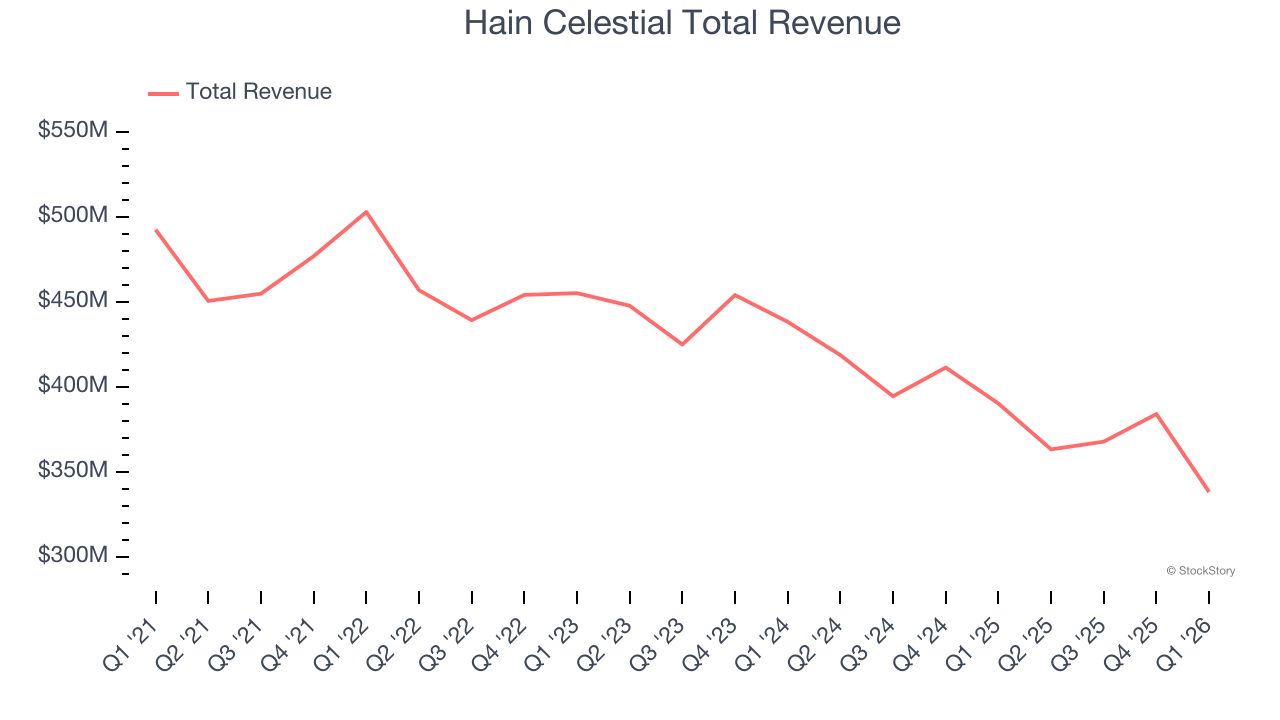
Hain Celestial delivered the slowest revenue growth of the whole group. Interestingly, the stock is up 24.7% since reporting and currently trades at $0.82.
Read our full report on Hain Celestial here, it’s free.
Best Q1: Hershey (NYSE: HSY)
Best known for its milk chocolate bar and Hershey's Kisses, Hershey (NYSE: HSY) is an iconic company known for its chocolate products.
Hershey reported revenues of $3.10 billion, up 10.6% year on year, outperforming analysts’ expectations by 2.4%. The business had a very strong quarter with an impressive beat of analysts’ EBITDA and organic revenue estimates.
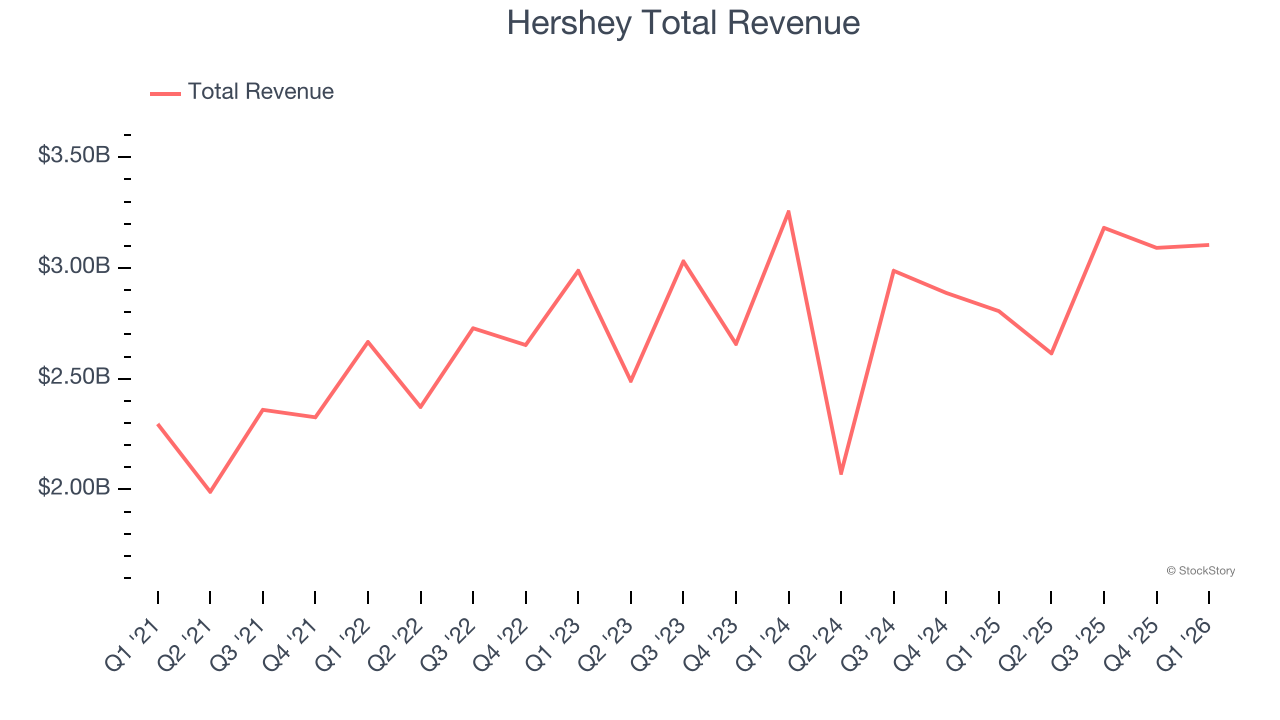
Although it had a fine quarter compared to its peers, the market seems unhappy with the results as the stock is down 1.8% since reporting. It currently trades at $185.75.
Is now the time to buy Hershey? Access our full analysis of the earnings results here, it’s free.
Weakest Q1: BellRing Brands (NYSE: BRBR)
Spun out of Post Holdings in 2019, Bellring Brands (NYSE: BRBR) offers protein shakes, nutrition bars, and other products under the PowerBar, Premier Protein, and Dymatize brands.
BellRing Brands reported revenues of $598.7 million, up 1.8% year on year, falling short of analysts’ expectations by 1.7%. It was a disappointing quarter as it posted full-year EBITDA guidance missing analysts’ expectations and a significant miss of analysts’ adjusted operating income estimates.
As expected, the stock is down 46.1% since the results and currently trades at $9.35.
Read our full analysis of BellRing Brands’s results here.
McCormick (NYSE: MKC)
The classic red Heinz ketchup bottle’s competitor, McCormick (NYSE: MKC) sells food-flavoring products like condiments, spices, and seasoning mixes.
McCormick reported revenues of $1.87 billion, up 16.7% year on year. This print surpassed analysts’ expectations by 5.1%. It was a strong quarter as it also put up a solid beat of analysts’ revenue estimates and an impressive beat of analysts’ EBITDA estimates.
McCormick achieved the fastest revenue growth among its peers. The stock is down 13% since reporting and currently trades at $46.75.
Read our full, actionable report on McCormick here, it’s free.
Mondelez (NASDAQ: MDLZ)
Founded as Nabisco in 1903, Mondelez (NASDAQ: MDLZ) is a packaged snacks powerhouse best known for its Oreo, Cadbury, Toblerone, Ritz, and Trident brands.
Mondelez reported revenues of $10.08 billion, up 8.2% year on year. This number beat analysts’ expectations by 3%. Overall, it was a strong quarter as it also produced a solid beat of analysts’ EBITDA and organic revenue estimates.
The stock is up 3.9% since reporting and currently trades at $60.83.
Read our full, actionable report on Mondelez here, it’s free.
Market Update
Late in 2025 into early 2026, there was hand-wringing around artificial intelligence. For software companies, the fear was that AI would erode pricing power and compress margins as new tools made it easier to replicate what once required expensive enterprise platforms. Crypto investors had their own version of the same anxiety: if AI agents could trade, allocate capital, and manage wallets autonomously, what exactly was the long-term value of today’s crypto infrastructure?
These concerns triggered a noticeable rotation away from these sectors and into safer havens. But markets rarely dwell on one narrative for long. Spring 2026 came, and the focus shifted abruptly from technological disruption to geopolitical risk. The US’ conflict with Iran became the dominant driver of market psychology, and when geopolitics takes center stage, the script changes quickly. Investors stop debating growth rates and start worrying about oil supply, inflation, and global stability.
Want to invest in winners with rock-solid fundamentals? Check out our Strong Momentum Stocks and add them to your watchlist. These companies are poised for growth regardless of the political or macroeconomic climate.
StockStory’s analyst team — all seasoned professional investors — uses quantitative analysis and automation to deliver market-beating insights faster and with higher quality.