As the Q2 earnings season comes to a close, it’s time to take stock of this quarter’s best and worst performers in the general industrial machinery industry, including Crane (NYSE: CR) and its peers.
Automation that increases efficiency and connected equipment that collects analyzable data have been trending, creating new demand for general industrial machinery companies. Those who innovate and create digitized solutions can spur sales and speed up replacement cycles, but all general industrial machinery companies are still at the whim of economic cycles. Consumer spending and interest rates, for example, can greatly impact the industrial production that drives demand for these companies’ offerings.
The 12 general industrial machinery stocks we track reported a strong Q2. As a group, revenues beat analysts’ consensus estimates by 2.6% while next quarter’s revenue guidance was 3.3% below.
Amidst this news, share prices of the companies have had a rough stretch. On average, they are down 5.9% since the latest earnings results.
Crane (NYSE: CR)
Based in Connecticut, Crane (NYSE: CR) is a diversified manufacturer of engineered industrial products, including fluid handling, and aerospace technologies.
Crane reported revenues of $724.7 million, up 25.6% year on year. This print exceeded analysts’ expectations by 2.3%. Overall, it was a very strong quarter for the company with full-year EPS guidance beating analysts’ expectations and an impressive beat of analysts’ EBITDA estimates.
Alex Alcala, Crane's President and Chief Executive Officer, stated: "We delivered record quarterly results which exceeded our expectations, reflecting strong execution across the company. Aerospace & Advanced Technologies generated better-than-expected growth, demand at Process Flow Technologies remained stable, and all four recent acquisitions are performing ahead of plan. Combined with 5% core sales growth and strong operating leverage across all businesses, these results underscore the quality of our portfolio and the effectiveness of our operating model."
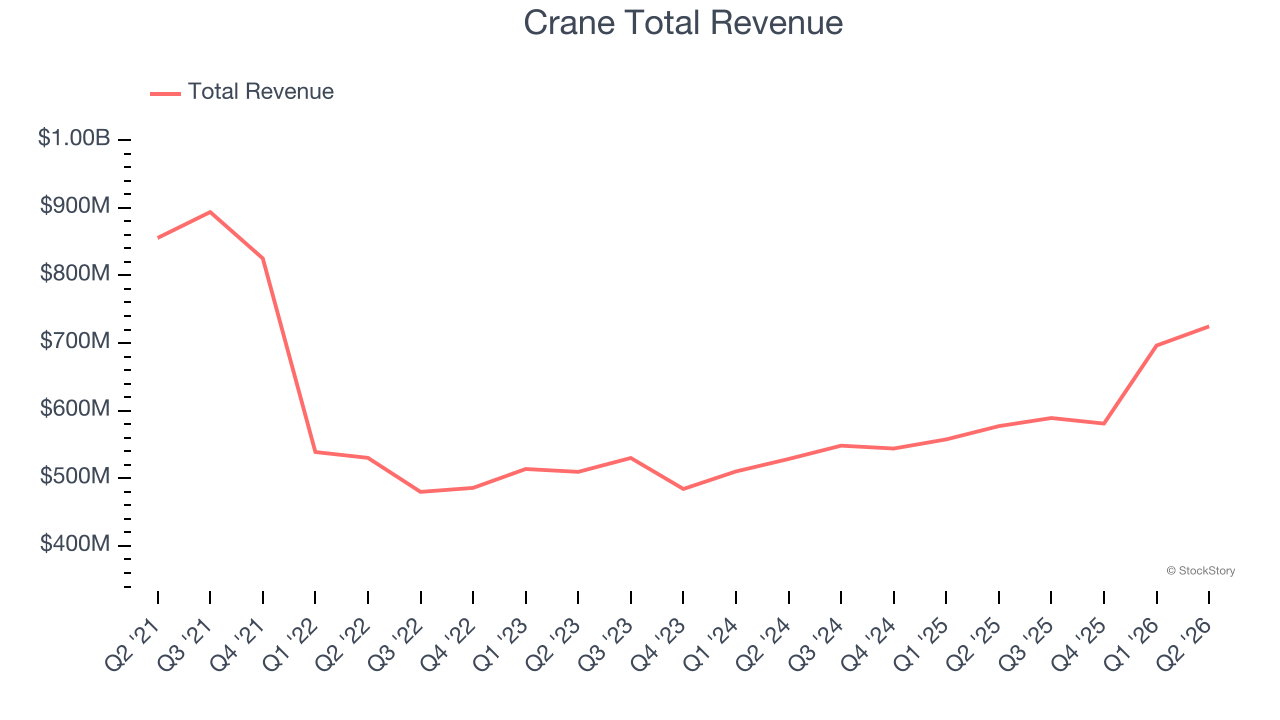
Investor expectations, however, were likely higher than Wall Street’s published projections, leaving some wishing for even better results (analysts’ consensus estimates are those published by big banks and advisory firms, not the investors who make buy and sell decisions). The stock is down 10.8% since reporting and currently trades at $201.95.
We think Crane is a good business, but is it a buy today? Read our full report here, it’s free.
Best Q2: Columbus McKinnon (NASDAQ: CMCO)
With 19 different brands across the globe, Columbus McKinnon (NASDAQ: CMCO) offers material handling equipment for the construction, manufacturing, and transportation industries.
Columbus McKinnon reported revenues of $531.5 million, up 125% year on year, outperforming analysts’ expectations by 5.9%. The business had an incredible quarter with a beat of analysts’ EPS and EBITDA estimates.
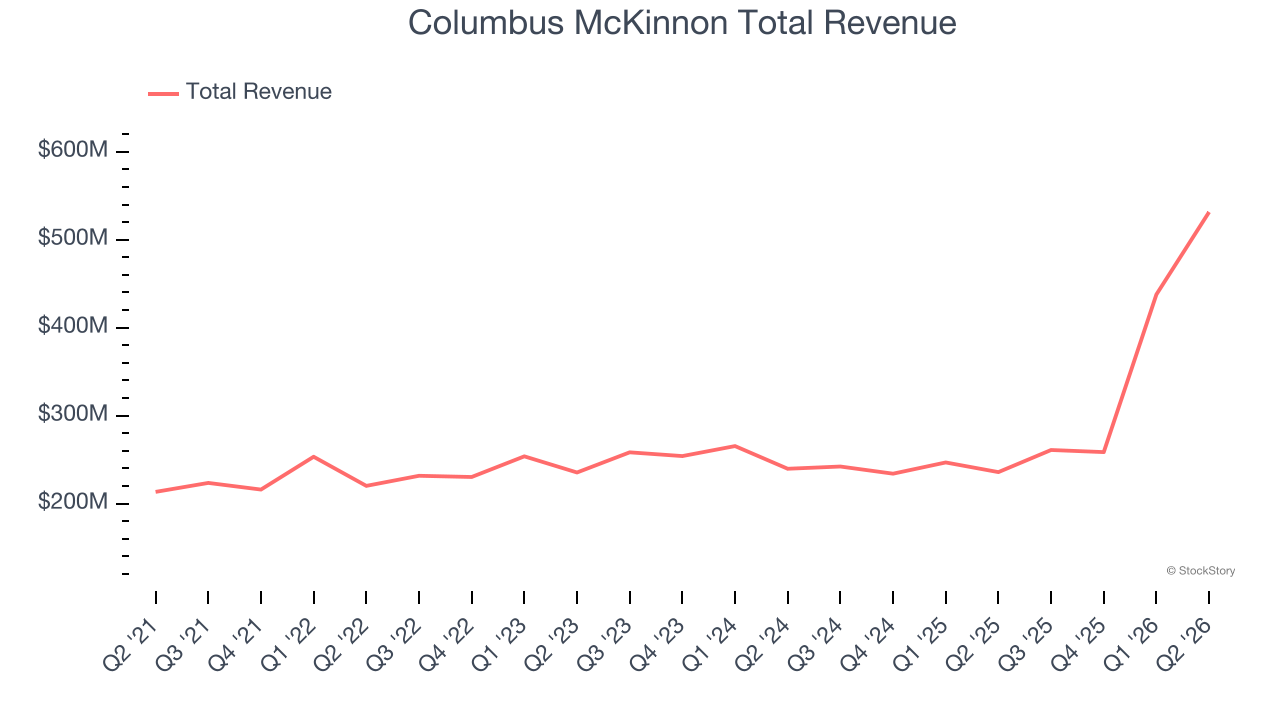
Columbus McKinnon delivered the fastest revenue growth in the group. The market seems happy with the results as the stock is up 21.4% since reporting. It currently trades at $17.75.
Is now the time to buy Columbus McKinnon? Access our full analysis of the earnings results here, it’s free.
Weakest Q2: Albany (NYSE: AIN)
Founded in 1895, Albany (NYSE: AIN) is a global textiles and materials processing company, specializing in machine clothing for paper mills and engineered composite structures for aerospace and other industries.
Albany reported revenues of $329.5 million, up 5.8% year on year, falling short of analysts’ expectations by 3.1%. It was a slower quarter, leaving some shareholders looking for more.
Albany delivered the weakest performance against analyst estimates of the whole group. As expected, the stock is down 4.3% since the results and currently trades at $60.28.
Read our full analysis of Albany’s results here.
L.B. Foster (NASDAQ: FSTR)
Founded with a $2,500 loan, L.B. Foster (NASDAQ: FSTR) is a provider of products and services for the transportation and energy infrastructure sectors, including rail products, construction materials, and coating solutions.
L.B. Foster reported revenues of $138.6 million, down 3.5% year on year. This number surpassed analysts’ expectations by 3%. Overall, it was a very strong quarter as it also logged an impressive beat of analysts’ EBITDA estimates and full-year EBITDA guidance exceeding analysts’ expectations.
L.B. Foster achieved the highest full-year guidance raise among its peers. The stock is down 8.9% since reporting and currently trades at $37.60.
Read our full, actionable report on L.B. Foster here, it’s free.
GE Aerospace (NYSE: GE)
One of the original 12 companies on the Dow Jones Industrial Average, General Electric (NYSE: GE) is a multinational conglomerate providing technologies for various sectors including aviation, power, renewable energy, and healthcare.
GE Aerospace reported revenues of $12.63 billion, up 24.5% year on year. This print beat analysts’ expectations by 6%. It was an exceptional quarter as it also put up full-year EPS guidance exceeding analysts’ expectations and a beat of analysts’ EPS estimates.
GE Aerospace pulled off the biggest analyst estimate beat in the group. The stock is down 10.1% since reporting and currently trades at $323.81.
Read our full, actionable report on GE Aerospace here, it’s free.
Market Update
Over the past year, investors have been forced to repeatedly answer the same question: what is the market’s biggest risk? The answer has changed several times, and each shift has reshaped market leadership.
Late in 2025 and early 2026, artificial intelligence became the market’s primary uncertainty. Investors questioned whether AI would erode software pricing power and weaken competitive moats as AI made it easier to replicate once-differentiated products.
By the spring, technology took a back seat to geopolitics. The U.S. conflict with Iran briefly became the market’s dominant narrative, raising concerns about oil prices, inflation, and global growth. But as energy markets remained orderly and fears of a prolonged supply disruption faded, investors quickly turned their focus back to fundamentals.
Want to invest in winners with rock-solid fundamentals? Check out our Top 5 Quality Compounder Stocks and add them to your watchlist. These companies are poised for growth regardless of the political or macroeconomic climate.