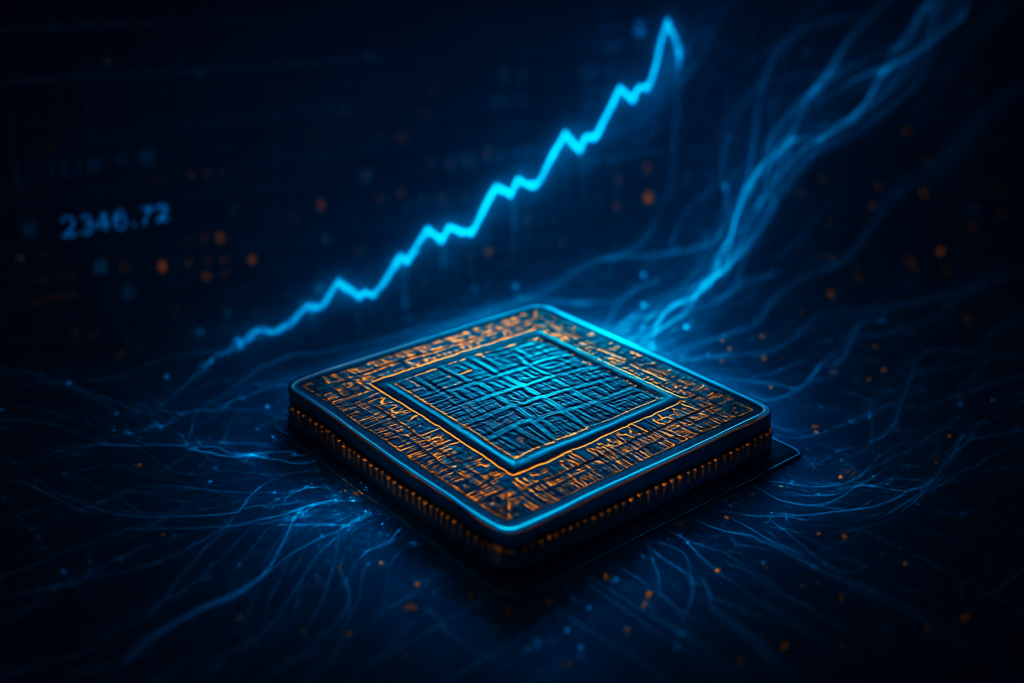
The landscape of the global semiconductor industry shifted dramatically on January 2, 2026, as Shanghai Biren Technology (HKG: 6082) made its highly anticipated debut on the Hong Kong Stock Exchange. In a stunning display of investor confidence that defied ongoing geopolitical tensions, Biren’s shares skyrocketed by as much as 119% during intraday trading, eventually closing its first day up 76% from its offering price of HK$19.60. The IPO, which raised approximately HK$5.58 billion (US$717 million), was oversubscribed by retail investors a staggering 2,348 times, marking the most explosive tech debut in the region since the pre-2021 era.
This landmark listing is more than just a financial success story; it represents a pivotal moment in China’s quest for silicon sovereignty. As US export controls continue to restrict access to high-end hardware from NVIDIA (NASDAQ: NVDA), Biren’s BR100 chip has emerged as the definitive domestic alternative. The massive capital infusion from the IPO is expected to accelerate Biren’s production scaling and R&D, providing a homegrown foundation for the next generation of Chinese large language models (LLMs) and autonomous systems.
The BR100: Engineering Around the Sanction Wall
The technical centerpiece of Biren’s market dominance is the BR100 series, a high-performance general-purpose GPU (GPGPU) designed specifically for large-scale AI training and inference. Built on the proprietary "BiLiren" architecture, the BR100 utilizes an advanced 7nm process and a sophisticated "chiplet" (multi-chip module) design. This approach allows Biren to bypass the reticle limits of traditional monolithic chips, packing 77 billion transistors into a single package. The BR100 delivers peak performance of 1024 TFLOPS in BF16 precision and features 64GB of HBM2E memory with 2.3 TB/s bandwidth.
While NVIDIA’s newer Blackwell and Hopper architectures still hold a raw performance edge in global markets, the BR100 has become the "workhorse" of Chinese data centers. Industry experts note that Biren’s software stack, BIRENSU, has achieved high compatibility with mainstream AI frameworks like PyTorch and TensorFlow, significantly lowering the migration barrier for developers who previously relied on NVIDIA’s CUDA. This technical parity in real-world workloads has led many Chinese research institutions to conclude that the BR100 is no longer just a "stopgap" solution, but a competitive platform capable of sustaining China’s AI ambitions indefinitely.
A Market Reshaped by "Buy Local" Mandates
The success of Biren’s IPO is fundamentally reshaping the competitive dynamics between Western chipmakers and domestic Chinese firms. For years, NVIDIA (NASDAQ: NVDA) enjoyed a near-monopoly in China’s AI sector, but that dominance is eroding under the weight of trade restrictions and Beijing’s aggressive "buy local" mandates. Reports from early January 2026 suggest that the Chinese government has issued guidance to domestic tech giants to pause or reduce orders for NVIDIA’s H200 chips—which were briefly permitted under specific licenses—to protect and nurture newly listed domestic champions like Biren.
This shift provides a strategic advantage to Biren and its domestic peers, such as the Baidu (NASDAQ: BIDU) spin-off Kunlunxin and Shanghai Iluvatar CoreX. These companies now enjoy a "captive market" where demand is guaranteed by policy rather than just performance. For major Chinese cloud providers and AI labs, the Biren IPO offers a degree of supply chain security that was previously unthinkable. By securing billions in capital, Biren can now afford to outbid competitors for limited domestic fabrication capacity at SMIC (HKG: 0981), further solidifying its position as the primary gatekeeper of China's AI infrastructure.
The Vanguard of a New AI Listing Wave
Biren’s explosive debut is the lead domino in what is becoming a historic wave of Chinese AI and semiconductor listings in Hong Kong. Following Biren’s lead, the first two weeks of January 2026 saw a flurry of activity: the "AI Tiger" MiniMax Group surged 109% on its debut, and the Tsinghua-linked Zhipu AI raised over US$550 million. This trend signals that international investors are still hungry for exposure to the Chinese AI market, provided those companies can demonstrate a clear path to bypassing US technological bottlenecks.
This development serves as a stark comparison to previous AI milestones. While the 2010s were defined by software-driven growth and mobile internet dominance, the mid-2020s are being defined by the "Hardware Renaissance." The fact that Biren was added to the US Entity List in 2023—an action meant to stifle its growth—has ironically served as a catalyst for its public success. By forcing the company to pivot to domestic foundries and innovate in chiplet packaging, the sanctions inadvertently created a battle-hardened champion that is now too well-capitalized to be easily suppressed.
Future Horizons: Scaling and the HBM Challenge
Looking ahead, Biren’s primary challenge will be scaling production to meet the insatiable demand of China’s "War of a Thousand Models." While the IPO provides the necessary cash, the company remains vulnerable to potential future restrictions on High-Bandwidth Memory (HBM) and advanced lithography tools. Analysts predict that Biren will use a significant portion of its IPO proceeds to secure long-term HBM supply contracts and to co-develop next-generation 2.5D packaging solutions with SMIC (HKG: 0981) and other domestic partners.
In the near term, the industry is watching for the announcement of the BR200, which is rumored to utilize even more aggressive chiplet configurations to bridge the gap with NVIDIA’s 2026 product roadmap. Furthermore, there is growing speculation that Biren may begin exporting its hardware to "Global South" markets that are wary of US tech hegemony, potentially creating a secondary global ecosystem for AI hardware that operates entirely outside of the Western sphere of influence.
A New Chapter in the Global AI Race
The blockbuster IPO of Shanghai Biren Technology marks a definitive end to the era of undisputed Western dominance in AI hardware. With a 119% surge and billions in new capital, Biren has proven that the combination of state-backed demand and private market enthusiasm can overcome even the most stringent export controls. As of January 13, 2026, the company stands as a testament to the resilience of China’s semiconductor ecosystem and a warning to global competitors that the "silicon curtain" has two sides.
In the coming weeks, the market will be closely monitoring the performance of other upcoming AI listings, including the expected spin-off of Baidu’s (NASDAQ: BIDU) Kunlunxin. If these debuts mirror Biren’s success, 2026 will be remembered as the year the center of gravity for AI hardware investment began its decisive tilt toward the East. For now, Biren has set the gold standard, proving that in the high-stakes world of artificial intelligence, independence is the ultimate competitive advantage.
This content is intended for informational purposes only and represents analysis of current AI developments.
TokenRing AI delivers enterprise-grade solutions for multi-agent AI workflow orchestration, AI-powered development tools, and seamless remote collaboration platforms.
For more information, visit https://www.tokenring.ai/.