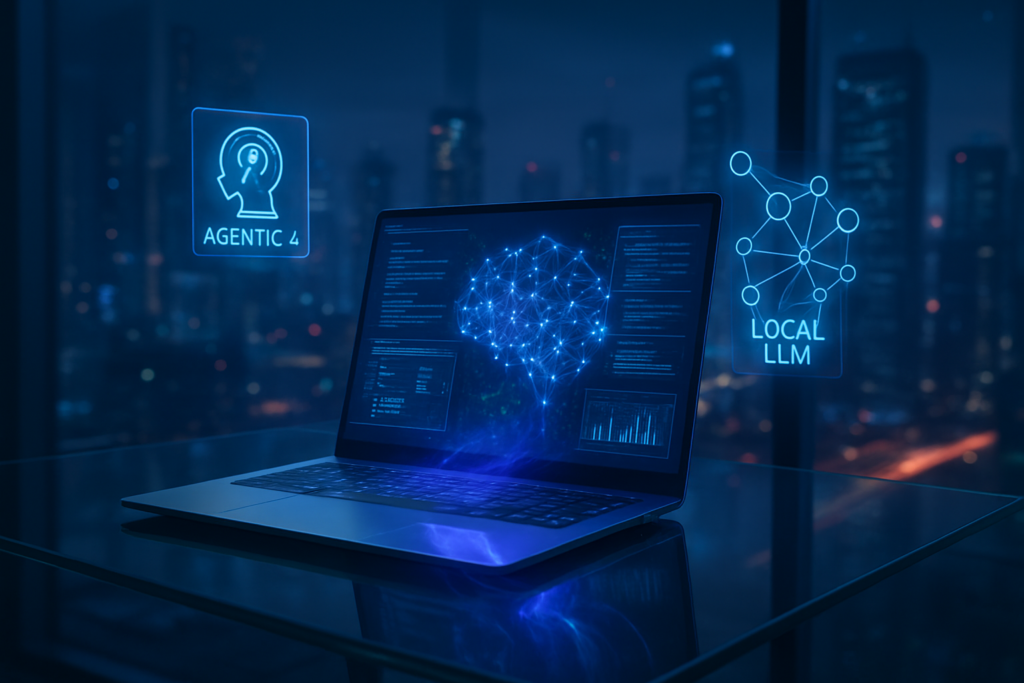
The landscape of personal computing has undergone a seismic shift in early 2026, transitioning from a "cloud-first" paradigm to one defined by "On-Device AI." At the heart of this transformation is the arrival of hardware capable of running sophisticated Large Language Models (LLMs) entirely within the confines of a laptop’s chassis. This evolution, showcased prominently at CES 2026, marks the end of the era where artificial intelligence was a remote service and the beginning of an era where it is a local, private, and instantaneous utility.
The immediate significance of this shift cannot be overstated. By decoupling AI from the data center, tech giants are finally delivering on the promise of "Sovereign AI"—tools that respect user privacy by design and function without an internet connection. With the launch of flagship silicon from Intel and Qualcomm, the "AI PC" has moved past its experimental phase to become the new standard for productivity, offering agentic capabilities that can manage entire workflows autonomously.
The Silicon Powerhouse: Panther Lake and Snapdragon X2
The technical backbone of this revolution lies in the fierce competition between Intel (NASDAQ: INTC) and Qualcomm (NASDAQ: QCOM). Intel’s newly released Panther Lake (Core Ultra Series 3) processors, built on the cutting-edge 18A manufacturing process, have set a new benchmark for integrated performance. The platform boasts a staggering 170 total TOPS (Trillions of Operations Per Second), with a dedicated NPU 5 architecture delivering 50 TOPS specifically for AI tasks. This represents a massive leap from the previous generation, allowing for the simultaneous execution of multiple Small Language Models (SLMs) without taxing the CPU or GPU.
Qualcomm has countered with its Snapdragon X2 Elite series, which maintains a lead in raw NPU efficiency. The X2’s Hexagon NPU delivers a uniform 80 to 85 TOPS, optimized for high-throughput inference. Unlike previous years where Windows on ARM faced compatibility hurdles, the 2026 ecosystem is fully optimized. These chips enable "instant-on" AI, where models like Google (NASDAQ: GOOGL) Gemini Nano and Llama 3 (8B) remain resident in the system’s memory, responding to queries in under 50 milliseconds. This differs fundamentally from the 2024-2025 approach, which relied on "triage" systems that frequently offloaded complex tasks to the cloud, incurring latency and privacy risks.
The Battle for the Desktop: Galaxy AI vs. Gemini vs. Copilot
The shift toward local execution has ignited a high-stakes battle for the "AI Gateway" on Windows. Samsung Electronics (KRX:005930) has leveraged its partnership with Google to integrate Galaxy AI deeply into its Galaxy Book6 series. This integration allows for unprecedented cross-device continuity; for instance, a user can use "AI Select" to drag a live video feed from their phone into a Word document on their PC, where it is instantly transcribed and summarized locally. This ecosystem play positions Samsung as a formidable rival to Microsoft (NASDAQ: MSFT) and its native Copilot.
Meanwhile, Alphabet’s Google has successfully challenged Microsoft’s dominance by embedding Gemini directly into the Windows taskbar and the Chrome browser. The new "Desktop Lens" feature uses the local NPU to "see" and analyze screen content in real-time, providing context-aware assistance that rivals Microsoft’s controversial Recall feature. Industry experts note that this competition is driving a "features war," where the winner is determined by who can provide the most seamless local integration rather than who has the largest cloud-based model. This has created a lucrative market for PC manufacturers like Dell Technologies (NYSE: DELL), HP Inc. (NYSE: HPQ), and Lenovo Group (HKG:0992), who are now marketing "AI Sovereignty" as a premium feature.
Privacy, Latency, and the Death of the 8GB RAM Era
The wider significance of the 2026 AI PC lies in its impact on data privacy and hardware standards. For the first time, enterprise users in highly regulated sectors—such as healthcare and finance—can utilize advanced AI agents without violating HIPAA or GDPR regulations, as the data never leaves the local device. This "Privacy-by-Default" architecture is a direct response to the growing public skepticism regarding cloud-based data harvesting. Furthermore, the elimination of latency has transformed AI from a "chatbot" into a "copilot" that can assist with real-time video editing, live translation during calls, and complex code generation without the "thinking" delays of 2024.
However, this transition has also forced a radical change in hardware specifications. In 2026, 32GB of RAM has become the new baseline for any functional AI PC. Local LLMs require significant dedicated VRAM to remain "warm" and responsive, rendering the 8GB and even 16GB configurations of the past obsolete. While this has driven up the average selling price of laptops, it has also breathed new life into the PC market, which had seen stagnant growth for years. Critics, however, point to the "AI Divide," where those unable to afford these high-spec machines are left with inferior, cloud-dependent tools that offer less privacy and slower performance.
Looking Ahead: The Rise of Agentic Computing
The next two to three years are expected to see the rise of "Agentic Computing," where the PC is no longer just a tool but an autonomous collaborator. Experts predict that by 2027, on-device NPUs will exceed 300 TOPS, allowing for the local execution of models with 100 billion parameters. This will enable "Personalized AI" that learns a user’s specific voice, habits, and professional style with total privacy. We are also likely to see the emergence of specialized AI silicon designed for specific industries, such as dedicated "Creative NPUs" for 8K video synthesis or "Scientific NPUs" for local protein folding simulations.
The primary challenge moving forward will be energy efficiency. As local models grow in complexity, maintaining the "all-day battery life" that Qualcomm and Intel currently promise will require even more radical breakthroughs in chip architecture. Additionally, the software industry must catch up; while the hardware is ready for local AI, many legacy applications still lack the hooks necessary to take full advantage of the NPU.
A New Chapter in Computing History
The evolution of On-Device AI in 2026 represents a historical turning point comparable to the introduction of the graphical user interface (GUI) or the transition to mobile computing. By bringing the power of LLMs to the edge, the industry has solved the twin problems of privacy and latency that hindered AI adoption for years. The integration of Galaxy AI and Gemini on Intel and Qualcomm hardware has effectively democratized high-performance intelligence, making it a standard feature of the modern workstation.
As we move through 2026, the key metric for success will no longer be how many parameters a company’s cloud model has, but how efficiently that model can run on a user's lap. The "Sovereign AI PC" is not just a new product category; it is a fundamental redesign of how humans and machines interact. In the coming months, watch for a wave of "AI-native" software releases that will finally push these powerful new NPUs to their limits, forever changing the way we work, create, and communicate.
This content is intended for informational purposes only and represents analysis of current AI developments.
TokenRing AI delivers enterprise-grade solutions for multi-agent AI workflow orchestration, AI-powered development tools, and seamless remote collaboration platforms.
For more information, visit https://www.tokenring.ai/.