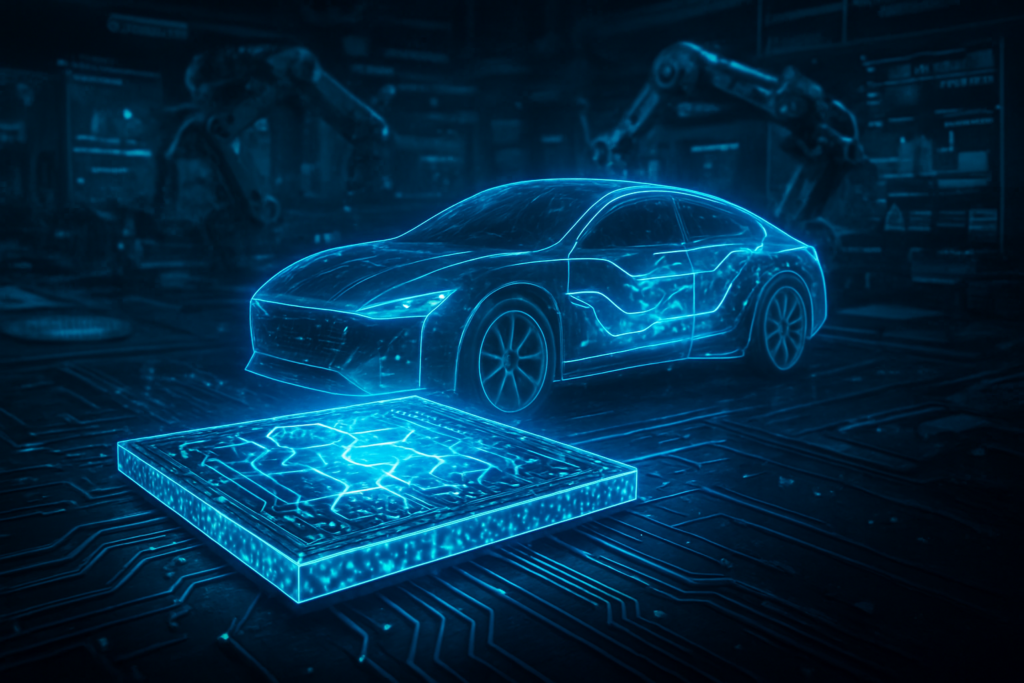
As of January 2026, the automotive industry has reached a decisive turning point in the electrification race. The shift toward 800-volt (800V) architectures is no longer a luxury hallmark of high-end sports cars but has become the benchmark for the next generation of mass-market electric vehicles (EVs). At the center of this tectonic shift is a surge in demand for Silicon Carbide (SiC) power semiconductors—chips that are more efficient, smaller, and more heat-tolerant than the traditional silicon that powered the first decade of EVs.
This demand surge has triggered a massive capacity race among global semiconductor leaders. Giants like STMicroelectronics (NYSE: STM) and Infineon Technologies (OTC: IFNNY) are ramping up 200mm (8-inch) wafer production at a record pace to meet the requirements of automotive leaders. These chips are not merely hardware components; they are the critical enabler for the "software-defined vehicle" (SDV), allowing carmakers to offset the massive power consumption of modern AI-driven autonomous driving systems with unprecedented powertrain efficiency.
The Technical Edge: Efficiency, 200mm Wafers, and AI-Enhanced Yields
The move to 800V systems is fundamentally a physics solution to the problems of charging speed and range. By doubling the voltage from the traditional 400V standard, automakers can reduce current for the same power delivery, which in turn allows for thinner, lighter copper wiring and significantly faster DC charging. However, traditional silicon IGBTs (Insulated-Gate Bipolar Transistors) struggle at these higher voltages due to energy loss and heat. SiC MOSFETs, with their wider bandgap, achieve inverter efficiencies exceeding 99% and generate up to 50% less heat, permitting 10% smaller and lighter cooling systems.
The breakthrough for 2026, however, is not just the material but the manufacturing process. The industry is currently in the middle of a high-stakes transition from 150mm to 200mm (8-inch) wafers. This transition increases chip output per substrate by nearly 85%, which is vital for bringing SiC costs down to a level where mid-range EVs can compete with internal combustion engines. Furthermore, manufacturers have integrated advanced AI vision models and deep learning into their fabrication plants. By using Transformer-based vision systems to detect crystal defects during growth, companies like Wolfspeed (NYSE: WOLF) have increased yields to levels once thought impossible for this notoriously difficult material.
Initial reactions from the semiconductor research community suggest that the 2026 ramp-up of 200mm SiC marks the end of the "supply constraint era" for wide-bandgap materials. Experts note that the ability to grow high-quality SiC crystals at scale—once a bottleneck that held back the entire EV industry—has finally caught up with the aggressive production schedules of the world’s largest automakers.
Scaling for the Titans: STMicro and Infineon Lead the Capacity Charge
The competitive landscape for power semiconductors has reshaped itself around massive "mega-fabs." STMicroelectronics is currently leading the charge with its fully integrated Silicon Carbide Campus in Catania, Italy. This €5 billion facility, supported by the EU Chips Act, has officially reached high-volume 200mm production this month. ST’s vertical integration—controlling the process from raw SiC powder to finished power modules—gives it a strategic advantage in supply security for its anchor partners, including Tesla and Geely Auto.
Infineon Technologies is countering with its "Kulim 3" facility in Malaysia, which has been inaugurated as the world’s largest 200mm SiC power fab. Infineon’s "CoolSiC" technology is currently being deployed in the high-stakes launch of the Rivian (NASDAQ: RIVN) R2 platform and the continued expansion of Xiaomi’s EV lineup. By leveraging a "one virtual fab" strategy across its Malaysia and Villach, Austria locations, Infineon is positioning itself to capture a projected 30% of the global SiC market by the end of the decade.
Other major players, such as Onsemi (NASDAQ: ON), have focused on the 800V ecosystem through their EliteSiC platform. Onsemi has secured massive multi-year deals with Tier-1 suppliers like Magna, positioning itself as the "energy bridge" between the powertrain and the digital cockpit. Meanwhile, Wolfspeed remains a wildcard; after a 2025 financial restructuring, it has emerged as a leaner, substrate-focused powerhouse, recently announcing a 300mm wafer breakthrough that could leapfrog current 200mm standards by 2028.
The AI Synergy: Offsetting the 'Energy Tax' of Autonomy
Perhaps the most significant development in 2026 is the realization that SiC is the "secret weapon" for AI-driven autonomous driving. As vehicles move toward Level 3 and Level 4 autonomy, the power consumption of on-board AI processors—like NVIDIA (NASDAQ: NVDA) DRIVE Thor—and their associated sensors has reached critical levels, often consuming between 1kW and 2.5kW of continuous power. This "energy tax" could historically reduce an EV's range by as much as 20%.
The efficiency gains of SiC-based 800V powertrains provide a direct solution to this problem. By reclaiming energy typically lost as heat in the inverter, SiC can boost a vehicle's range by roughly 7% to 10% without increasing battery size. In effect, the energy saved by the SiC hardware is what "powers" the AI brains of the car. This synergy has made SiC a non-negotiable component for Software-Defined Vehicles (SDVs), where the cooling budget is increasingly allocated to the high-heat AI computers rather than the motor.
This trend mirrors the broader evolution of the technology landscape, where hardware efficiency is becoming the primary bottleneck for AI deployment. Just as data centers are turning to liquid cooling and specialized power delivery, the automotive world is using SiC to ensure that "smart" cars do not become "short-range" cars.
Future Horizons: 300mm Wafers and the Rise of GaN
Looking toward 2027 and beyond, the industry is already eyeing the next frontier. While 200mm SiC is the standard for 2026, the first pilot lines for 300mm (12-inch) SiC wafers are expected to be announced by year-end. This shift would provide even more dramatic cost reductions, potentially bringing SiC to the $25,000 EV segment. Additionally, researchers are exploring "hybrid" systems that combine SiC for the main traction inverter with Gallium Nitride (GaN) for on-board chargers and DC-DC converters, maximizing efficiency across the entire electrical architecture.
Experts predict that by 2030, the traditional silicon-based inverter will be entirely phased out of the passenger car market. The primary challenge remains the geopolitical concentration of the SiC supply chain, as both Europe and North America race to reduce reliance on Chinese raw material processing. The coming months will likely see more announcements regarding domestic substrate manufacturing as governments view SiC as a matter of national economic security.
A New Foundation for Mobility
The surge in Silicon Carbide demand in 2026 represents more than a simple supply chain update; it is the foundation for the next fifty years of transportation. By solving the dual challenges of charging speed and the energy demands of AI, SiC has cemented its status as the "silicon of the 21st century." The successful scale-up by STMicroelectronics, Infineon, and their peers has effectively decoupled EV performance from its previous limitations.
As we look toward the remainder of 2026, the focus will shift from capacity to integration. Watch for how carmakers utilize the "weight credit" provided by 800V systems to add more advanced AI features, larger interior displays, and more robust safety systems. The high-voltage era has officially arrived, and it is paved with Silicon Carbide.
This content is intended for informational purposes only and represents analysis of current AI and semiconductor developments.
TokenRing AI delivers enterprise-grade solutions for multi-agent AI workflow orchestration, AI-powered development tools, and seamless remote collaboration platforms.
For more information, visit https://www.tokenring.ai/.