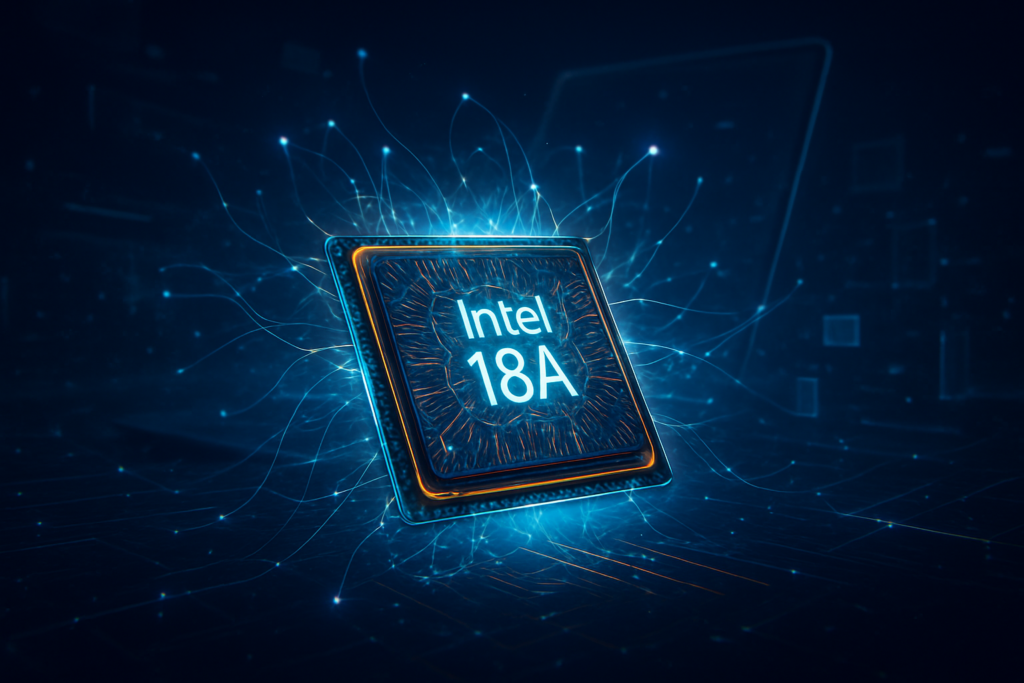
In a landmark announcement at CES 2026, Intel Corporation (NASDAQ: INTC) has officially unveiled its Core Ultra Series 3 processors, codenamed "Panther Lake." Representing a pivotal moment in the company’s history, Panther Lake marks the return of high-volume manufacturing to Intel’s own factories using the cutting-edge Intel 18A process node. This launch is not merely a generational refresh; it is a strategic strike aimed at reclaiming dominance in the rapidly evolving AI PC market, where local processing power and energy efficiency have become the primary battlegrounds.
The immediate significance of the Core Ultra Series 3 lies in its role as the premier silicon for the next generation of Microsoft (NASDAQ: MSFT) Copilot+ PCs. By integrating the new NPU 5 and the Xe3 "Celestial" graphics architecture, Intel is delivering a platform that promises "Arrow Lake-level performance with Lunar Lake-level efficiency." As the tech industry pivots from reactive AI tools to proactive "Agentic AI"—where digital assistants perform complex tasks autonomously—Intel’s Panther Lake provides the hardware foundation necessary to move these heavy AI workloads from the cloud directly onto the user's desk.
The 18A Revolution: Technical Mastery and NPU 5.0
At the heart of Panther Lake is the Intel 18A manufacturing process, a 1.8nm-class node that introduces two industry-leading technologies: RibbonFET and PowerVia. RibbonFET is Intel’s implementation of gate-all-around (GAA) transistor architecture, which allows for tighter control of electrical current and significantly reduced leakage. Supplementing this is PowerVia, the industry’s first implementation of backside power delivery. By moving power routing to the back of the wafer, Intel has decoupled power and signal wires, drastically reducing interference and allowing the "Cougar Cove" performance cores and "Darkmont" efficiency cores to run at higher frequencies with lower power draw.
The AI capabilities of Panther Lake are centered around the NPU 5, which delivers 50 trillion operations per second (TOPS) of dedicated AI throughput. While the NPU alone meets the strict requirements for Copilot+ PCs, the total platform performance—combining the CPU, GPU, and NPU—reaches a staggering 180 TOPS. This "XPU" approach allows Panther Lake to handle diverse AI tasks, from real-time language translation to complex generative image manipulation, with 50% more total throughput than the previous Lunar Lake generation. Furthermore, the Xe3 Celestial graphics architecture provides a 50% performance boost over its predecessor, incorporating XeSS 3 with Multi-Frame Generation to bring high-end AI gaming to ultra-portable laptops.
Initial reactions from the semiconductor industry have been overwhelmingly positive, with analysts noting that Intel appears to have finally closed the "efficiency gap" that allowed ARM-based competitors to gain ground in recent years. Technical experts have highlighted that the integration of the NPU 5 into the 18A node provides a 40% improvement in performance-per-area compared to NPU 4. This density allows Intel to pack more AI processing power into smaller, thinner chassis without the thermal throttling issues that plagued earlier high-performance mobile chips.
Shifting the Competitive Landscape: Intel’s Market Fightback
The launch of Panther Lake creates immediate pressure on competitors like Advanced Micro Devices, Inc. (NASDAQ: AMD) and Qualcomm Inc. (NASDAQ: QCOM). While Qualcomm's Snapdragon X2 Elite currently leads in raw NPU TOPS with its Hexagon processor, Intel is leveraging its massive x86 software ecosystem and the superior area efficiency of the 18A node to argue that Panther Lake is the more versatile choice for enterprise and consumer users alike. By bringing manufacturing back in-house, Intel also gains a strategic advantage in supply chain control, potentially offering better margins and availability than competitors who rely entirely on external foundries like TSMC.
Microsoft (NASDAQ: MSFT) stands as a major beneficiary of this development. The Core Ultra Series 3 is the "hero" platform for the 2026 rollout of "Agentic Windows," a version of the OS where AI agents can navigate the file system, manage emails, and automate workflows based on natural language commands. PC manufacturers such as Dell Technologies (NYSE: DELL), HP Inc. (NYSE: HPQ), and ASUS are already showcasing flagship laptops powered by Panther Lake, signaling a unified industry push toward a hardware-software synergy that prioritizes local AI over cloud dependency.
For the broader tech ecosystem, Panther Lake represents a potential disruption to the cloud-centric AI model favored by companies like Google and Amazon. By enabling high-performance AI locally, Intel is reducing the latency and privacy concerns associated with sending data to the cloud. This shift favors startups and developers who are building "edge-first" AI applications, as they can now rely on a standardized, high-performance hardware target across millions of new Windows devices.
The Dawn of Physical and Agentic AI
Panther Lake’s arrival marks a transition in the broader AI landscape from "Generative AI" to "Physical" and "Agentic AI." While previous generations focused on generating text or images, the Core Ultra Series 3 is designed to sense and interact with the physical world. Through its high-efficiency NPU, the chip enables laptops to use low-power sensors for gesture recognition, eye-tracking, and environmental awareness without draining the battery. This "Physical AI" allows the computer to anticipate user needs—dimming the screen when the user looks away or waking up as they approach—creating a more seamless human-computer interaction.
This milestone is comparable to the introduction of the Centrino platform in the early 2000s, which standardized Wi-Fi and mobile computing. Just as Centrino made the internet ubiquitous, Panther Lake aims to make high-performance AI an invisible, always-on utility. However, this shift also raises potential concerns regarding privacy and data security. With features like Microsoft’s "Recall" becoming more integrated into the hardware level, the industry must address how local AI models handle sensitive user data and whether the "always-sensing" capabilities of these chips can be exploited.
Compared to previous AI milestones, such as the first NPU-equipped chips in 2023, Panther Lake represents the maturation of the "AI PC" concept. It is no longer a niche feature for early adopters; it is the baseline for the entire Windows ecosystem. The move to 18A signifies that AI is now the primary driver of semiconductor innovation, dictating everything from transistor design to power delivery architectures.
The Road to Nova Lake and Beyond
Looking ahead, the success of Panther Lake sets the stage for "Nova Lake," the expected Core Ultra Series 4, which is rumored to further scale NPU performance toward the 100 TOPS mark. In the near term, we expect to see a surge in specialized software that takes advantage of the Xe3 Celestial architecture’s AI-enhanced rendering, potentially revolutionizing mobile gaming and professional creative work. Developers are already working on "Local LLMs" (Large Language Models) that are small enough to run entirely on the Panther Lake NPU, providing users with a private, offline version of ChatGPT.
The primary challenge moving forward will be the software-hardware "handshake." While Intel has delivered the hardware, the success of the Core Ultra Series 3 depends on how quickly developers can optimize their applications for NPU 5. Experts predict that 2026 will be the year of the "Killer AI App"—a software breakthrough that makes the NPU as essential to the average user as the CPU or GPU is today. If Intel can maintain its manufacturing lead with 18A and subsequent nodes, it may well secure its position as the undisputed leader of the AI era.
A New Chapter for Silicon and Intelligence
The launch of the Intel Core Ultra Series 3 "Panther Lake" is a definitive statement that the "silicon wars" have entered a new phase. By successfully deploying the 18A process and integrating a high-performance NPU, Intel has proved that it can still innovate at the bleeding edge of physics and computer science. The significance of this development in AI history cannot be overstated; it represents the moment when high-performance, local AI became accessible to the mass market, fundamentally changing how we interact with our personal devices.
In the coming weeks and months, the tech world will be watching for the first independent benchmarks of Panther Lake laptops in real-world scenarios. The true test will be whether the promised efficiency gains translate into the "multi-day battery life" that has long been the holy grail of x86 computing. As the first Panther Lake devices hit the market in late Q1 2026, the industry will finally see if Intel’s massive bet on 18A and the AI PC will pay off, potentially cementing the company’s legacy for the next decade of computing.
This content is intended for informational purposes only and represents analysis of current AI developments.
TokenRing AI delivers enterprise-grade solutions for multi-agent AI workflow orchestration, AI-powered development tools, and seamless remote collaboration platforms.
For more information, visit https://www.tokenring.ai/.