The awarding of the 2024 Nobel Prize in Physics to Geoffrey Hinton and John Hopfield was more than a tribute to two legendary careers; it was the moment the global scientific establishment officially recognized artificial intelligence as a fundamental branch of physical science. By honoring their work on artificial neural networks, the Royal Swedish Academy of Sciences signaled that the "black boxes" driving today’s digital revolution are deeply rooted in the laws of statistical mechanics and energy landscapes. This historic win effectively bridged the gap between the theoretical physics of the 20th century and the generative AI explosion of the 21st, validating decades of research that many once dismissed as a computational curiosity.
As we move into early 2026, the ripples of this announcement are still being felt across academia and industry. The prize didn't just celebrate the past; it catalyzed a shift in how we perceive the risks and rewards of the technology. For Geoffrey Hinton, often called the "Godfather of AI," the Nobel platform provided a global megaphone for his increasingly urgent warnings about AI safety. For John Hopfield, it was a validation of his belief that biological systems and physical models could unlock the secrets of associative memory. Together, their win underscored a pivotal truth: the tools we use to build "intelligence" are governed by the same principles that describe the behavior of atoms and magnetic spins.
The Physics of Thought: From Spin Glasses to Boltzmann Machines
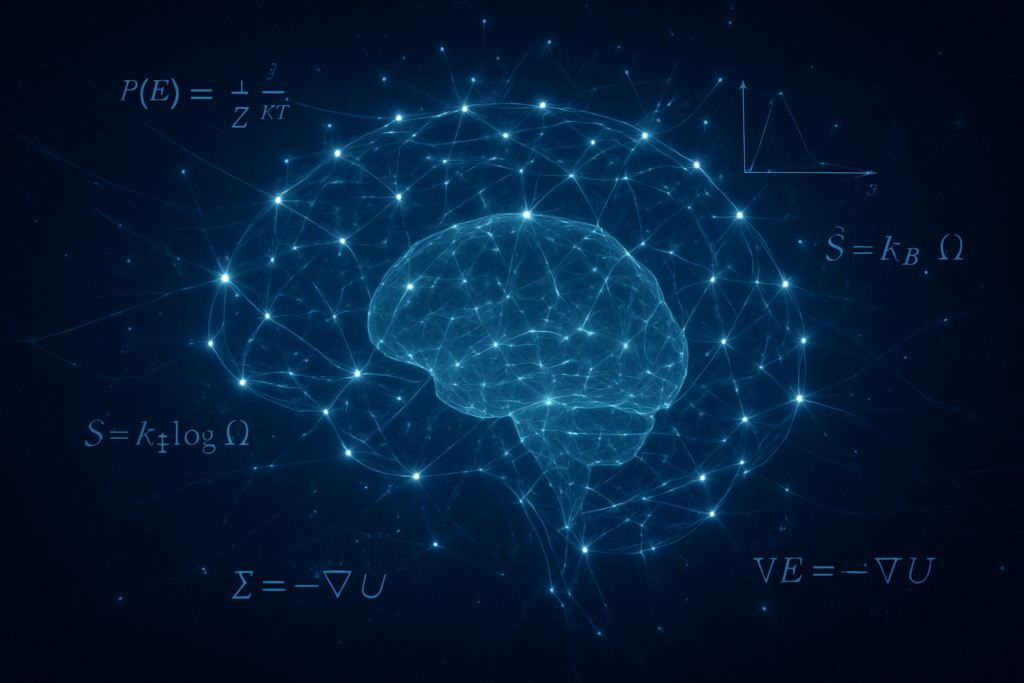
The technical foundation of the 2024 Nobel Prize lies in the ingenious application of statistical physics to the problem of machine learning. In the early 1980s, John Hopfield developed what is now known as the Hopfield Network, a type of recurrent neural network that serves as a model for associative memory. Hopfield drew a direct parallel between the way neurons fire and the behavior of "spin glasses"—physical systems where atomic spins interact in complex, disordered ways. By defining an "Energy Function" for his network, Hopfield demonstrated that a system of interconnected nodes could "relax" into a state of minimum energy, effectively recovering a stored memory from a noisy or incomplete input. This was a radical departure from the deterministic, rule-based logic that dominated early computer science, introducing a more biological, "energy-driven" approach to computation.
Building upon this physical framework, Geoffrey Hinton introduced the Boltzmann Machine in 1985. Named after the physicist Ludwig Boltzmann, this model utilized the Boltzmann distribution—a fundamental concept in thermodynamics that describes the probability of a system being in a certain state. Hinton’s breakthrough was the introduction of "hidden units" within the network, which allowed the machine to learn internal representations of data that were not directly visible. Unlike the deterministic Hopfield networks, Boltzmann machines were stochastic, meaning they used probability to find the most likely patterns in data. This capability to not only remember but to classify and generate new data laid the essential groundwork for the deep learning models that power today’s large language models (LLMs) and image generators.
The Royal Swedish Academy's decision to award these breakthroughs in the Physics category was a calculated recognition of AI's methodological roots. They argued that without the mathematical tools of energy minimization and thermodynamic equilibrium, the architectures that define modern AI would never have been conceived. Furthermore, the Academy highlighted that neural networks have become indispensable to physics itself—enabling discoveries in particle physics at CERN, the detection of gravitational waves, and the revolutionary protein-folding predictions of AlphaFold. This "Physics-to-AI-to-Physics" loop has become the dominant paradigm of scientific discovery in the mid-2020s.
Market Validation and the "Prestige Moat" for Big Tech
The Nobel recognition of Hinton and Hopfield acted as a massive strategic tailwind for the world’s leading technology companies, particularly those that had spent billions betting on neural network research. NVIDIA (NASDAQ: NVDA), in particular, saw its long-term strategy validated on the highest possible stage. CEO Jensen Huang had famously pivoted the company toward AI after Hinton’s team used NVIDIA GPUs to achieve a breakthrough in the 2009 ImageNet competition. The Nobel Prize essentially codified NVIDIA’s hardware as the "scientific instrument" of the 21st century, placing its H100 and Blackwell chips in the same historical category as the particle accelerators of the previous century.
For Alphabet Inc. (NASDAQ: GOOGL), the win was bittersweet but ultimately reinforcing. While Hinton had left Google in 2023 to speak freely about AI risks, his Nobel-winning work was the bedrock upon which Google Brain and DeepMind were built. The subsequent Nobel Prize in Chemistry awarded to DeepMind’s Demis Hassabis and John Jumper for AlphaFold further cemented Google’s position as the world's premier AI research lab. This "double Nobel" year created a significant "prestige moat" for Google, helping it maintain a talent advantage over rivals like OpenAI and Microsoft (NASDAQ: MSFT). While OpenAI led in consumer productization with ChatGPT, Google reclaimed the title of the undisputed leader in foundational scientific breakthroughs.
Other tech giants like Meta Platforms (NASDAQ: META) also benefited from the halo effect. Meta’s Chief AI Scientist Yann LeCun, a contemporary and frequent collaborator of Hinton, has long advocated for the open-source dissemination of these foundational models. The Nobel win validated the "FAIR" (Fundamental AI Research) approach, suggesting that AI is a public scientific good rather than just a proprietary corporate product. For investors, the prize provided a powerful counter-narrative to "AI bubble" fears; by framing AI as a fundamental scientific shift rather than a fleeting software trend, the Nobel Committee helped stabilize long-term market sentiment toward AI infrastructure and research-heavy companies.
The Warning from the Podium: Safety and Existential Risk
Despite the celebratory nature of the award, the 2024 Nobel Prize was marked by a somber and unprecedented warning from the laureates themselves. Geoffrey Hinton used his newfound platform to reiterate his fears that the technology he helped create could eventually "outsmart" its creators. Since his win, Hinton has become a fixture in global policy debates, frequently appearing before government bodies to advocate for strict AI safety regulations. By early 2026, his warnings have shifted from theoretical possibilities to what he calls the "2026 Breakpoint"—a predicted surge in AI capabilities that he believes will lead to massive job displacement in fields as complex as software engineering and law.
Hinton’s advocacy has been particularly focused on the concept of "alignment." He has recently proposed a radical new approach to AI safety, suggesting that humans should attempt to program "maternal instincts" into AI models. His argument is that we cannot control a superintelligence through force or "kill switches," but we might be able to ensure our survival if the AI is designed to genuinely care for the welfare of less intelligent beings, much like a parent cares for a child. This philosophical shift has sparked intense debate within the AI safety community, contrasting with more rigid, rule-based alignment strategies pursued by labs like Anthropic.
John Hopfield has echoed these concerns, though from a more academic perspective. He has frequently compared the current state of AI development to the early days of nuclear fission, noting that we are "playing with fire" without a complete theoretical understanding of how these systems actually work. Hopfield has spent much of late 2025 advocating for "curiosity-driven research" that is independent of corporate profit motives. He argues that if the only people who understand the inner workings of AI are those incentivized to deploy it as quickly as possible, society loses its ability to implement meaningful guardrails.
The Road to 2026: Regulation and Next-Gen Architectures
As we look toward the remainder of 2026, the legacy of the Hinton-Hopfield Nobel win is manifesting in the enforcement of the EU AI Act. The August 2026 deadline for the Act’s most stringent regulations is rapidly approaching, and Hinton’s testimony has been a key factor in keeping these rules on the books despite intense lobbying from the tech sector. The focus has shifted from "narrow AI" to "General Purpose AI" (GPAI), with regulators demanding transparency into the very "energy landscapes" and "hidden units" that the Nobel laureates first described forty years ago.
In the research world, the "Nobel effect" has led to a resurgence of interest in Energy-Based Models (EBMs) and Neuro-Symbolic AI. Researchers are looking beyond the current "transformer" architecture—which powers models like GPT-4—to find more efficient, physics-inspired ways to achieve reasoning. The goal is to create AI that doesn't just predict the next word in a sequence but understands the underlying "physics" of the world it is describing. We are also seeing the emergence of "Agentic Science" platforms, where AI agents are being used to autonomously run experiments in materials science and drug discovery, fulfilling the Nobel Committee's vision of AI as a partner in scientific exploration.
However, challenges remain. The "Third-of-Compute" rule advocated by Hinton—which would require AI labs to dedicate 33% of their hardware resources to safety research—has faced stiff opposition from startups and venture capitalists who argue it would stifle innovation. The tension between the "accelerationists," who want to reach AGI as quickly as possible, and the "safety-first" camp led by Hinton, remains the defining conflict of the AI industry in 2026.
A Legacy Written in Silicon and Statistics
The 2024 Nobel Prize in Physics will be remembered as the moment the "AI Winter" was officially forgotten and the "AI Century" was formally inaugurated. By honoring Geoffrey Hinton and John Hopfield, the Academy did more than recognize two brilliant minds; it acknowledged that the quest to understand intelligence is a quest to understand the physical universe. Their work transformed the computer from a mere calculator into a learner, a classifier, and a creator.
As we navigate the complexities of 2026, from the displacement of labor to the promise of new medical cures, the foundational principles of Hopfield Networks and Boltzmann Machines remain as relevant as ever. The significance of this development lies in its duality: it is both a celebration of human ingenuity and a stark reminder of our responsibility. The long-term impact of their work will not just be measured in the trillions of dollars added to the global economy, but in whether we can successfully "align" these powerful physical systems with human values. For now, the world watches closely as the enforcement of new global regulations and the next wave of physics-inspired AI models prepare to take the stage in the coming months.
This content is intended for informational purposes only and represents analysis of current AI developments.
TokenRing AI delivers enterprise-grade solutions for multi-agent AI workflow orchestration, AI-powered development tools, and seamless remote collaboration platforms.
For more information, visit https://www.tokenring.ai/.