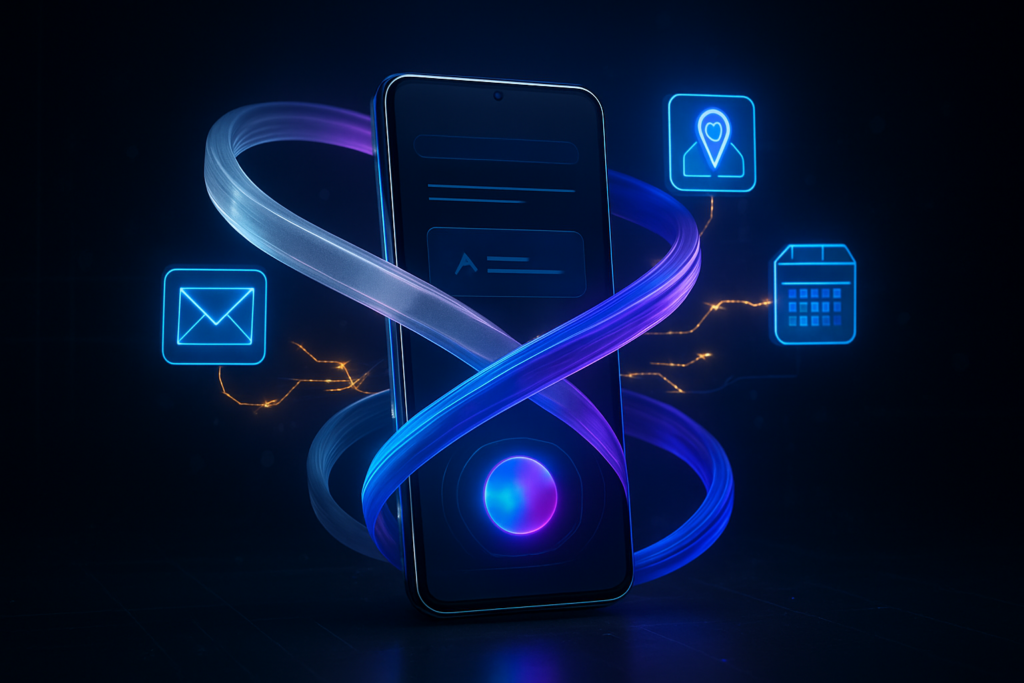
In a move that signals a tectonic shift in the artificial intelligence landscape, Apple (NASDAQ: AAPL) has announced the imminent release of a completely reimagined Siri, now powered by Google’s (Alphabet Inc. (NASDAQ: GOOGL)) Gemini models. Scheduled for rollout in March 2026 as part of the iOS 26.4 update, this "Siri 2.0" promises to finally deliver on the long-awaited dream of a truly agentic digital assistant. By integrating Gemini’s advanced reasoning capabilities directly into the core of its operating system, Apple is moving past the "wrapper" phase of AI and into a future where your phone doesn’t just respond to commands, but actively understands and manages your digital life.
The significance of this development cannot be overstated. For years, Siri has been criticized for lagging behind competitors like OpenAI’s ChatGPT and Google’s own native assistant. With iOS 26.4—a version number that reflects Apple’s new "year-matching" software nomenclature adopted in 2025—Apple is not just catching up; it is attempting to leapfrog the industry by marrying its world-class hardware-software integration with Google’s premier large language models (LLMs). This partnership transforms Siri from a simple voice-activated shortcut tool into a context-aware engine capable of complex reasoning, on-screen perception, and cross-application autonomy.
The Technical Transformation: Gemini at the Core
Under the hood, the new Siri is powered by a custom version of Google Gemini, integrated into what Apple calls the "Apple Foundation Model (AFM) version 10." This hybrid architecture leverages a staggering 1.2 trillion parameters, allowing Siri to process information with a level of nuance previously impossible on a mobile device. One of the most groundbreaking technical specifications is the inclusion of a "long-context window" capable of handling up to 1 million tokens. This allows Siri to maintain a massive "short-term memory" of a user's interactions across months of emails, text messages, and calendar events, enabling it to recall and synthesize information with human-like precision.
The defining technical feature of iOS 26.4 is "On-Screen Awareness." Utilizing the Neural Engine on Apple's latest silicon, Siri can now "see" and interpret the pixels on a user’s display in real-time. This differs from previous approaches that relied on developers manually tagging accessibility elements. Instead, the Gemini-powered vision system understands the visual context of an app, allowing a user to simply say, "Send this to Sarah," while looking at a photo, a PDF, or even a specific paragraph in a news article. Siri identifies the content, finds the most likely "Sarah" in the user's contacts, and executes the share through the appropriate messaging platform without the user needing to touch the screen.
Initial reactions from the AI research community have been overwhelmingly positive, particularly regarding Apple’s "Hybrid Execution Model." While simple tasks are handled locally on-device to ensure privacy and low latency, complex reasoning is offloaded to "Private Cloud Compute" (PCC). This system uses secure Apple Silicon servers that process data in a stateless environment, meaning data is never stored and is inaccessible even to Apple’s own engineers. Industry experts note that this approach solves the "intelligence-privacy trade-off" that has plagued previous cloud-based AI assistants.
Strategic Shifts: The Apple-Alphabet Alliance
This partnership represents a massive strategic pivot for both Apple and Alphabet Inc. (NASDAQ: GOOGL). For Apple, it is a pragmatic admission that building a world-class LLM from scratch is a secondary priority to providing a seamless user experience. By licensing Gemini, Apple reduces its execution risk and ensures that its hardware remains the premium platform for AI consumers. Meanwhile, for Google, securing the spot as the primary intelligence engine for over 2 billion active Apple devices is a monumental victory. This deal effectively sidelines OpenAI, which had previously been Apple's primary generative partner, and positions Google as the dominant backbone of the mobile AI era.
The competitive implications for the rest of the industry are stark. Samsung (KRX: 005930), which was an early adopter of Gemini for its Galaxy AI suite, now finds its software advantage significantly narrowed. Furthermore, the "Cross-App Control" feature in iOS 26.4 creates a formidable "moat" around the Apple ecosystem. Because Siri can now navigate between Mail, Calendar, and third-party apps like Uber or OpenTable to complete multi-step tasks (e.g., "Find my flight info and book an Uber for when I land"), users are less likely to seek out standalone AI apps that lack this level of system-level integration.
Startups in the AI agent space may find themselves in a precarious position as Apple moves into their territory. The ability for Siri to function as a "universal controller" for the iPhone reduces the need for third-party "wrapper" apps that attempt to automate phone tasks. However, many analysts believe this will also open new doors for developers who can now build "Siri-ready" apps that expose their internal functions to this new, more capable digital brain via enhanced App Intents.
The Privacy Paradox and the Rise of Agentic AI
The broader AI landscape is currently shifting from "Generative AI" (which creates content) to "Agentic AI" (which performs actions). The release of iOS 26.4 is perhaps the most significant milestone in this transition to date. By giving an AI model the ability to read a user's screen and control their apps, Apple is crossing a threshold that has long been a source of anxiety for privacy advocates. However, Apple is banking on its long-standing reputation for security and its transparent Private Cloud Compute architecture to mitigate these concerns.
Comparisons are already being drawn to the original 2011 launch of Siri, though the stakes are now much higher. While the original Siri was a novelty that struggled with basic voice recognition, the Gemini-powered version represents a shift toward "Personal Intelligence." The impact on society could be profound: as digital assistants become more capable of managing our schedules, communications, and logistical needs, the "cognitive load" of modern life may decrease. Yet, this also raises questions about our growing reliance on proprietary algorithms to manage our personal and professional lives.
Potential concerns remain regarding "AI hallucinations" in an agentic context. If Siri misunderstands a prompt and books the wrong flight or deletes an important email due to a reasoning error, the consequences are more severe than a simple chat bot giving a wrong answer. Apple has reportedly implemented a "Confirmation Layer" for high-stakes actions, requiring a biometric check through FaceID or TouchID before Siri can finalize financial transactions or delete sensitive data.
Looking Ahead: The Road to the A20 and Beyond
In the near term, the industry is closely watching the hardware requirements for these features. While iOS 26.4 will support devices as old as the iPhone 15 Pro (A17 Pro), the most fluid experience is expected on the iPhone 17 and the upcoming iPhone 18. Experts predict that the A20 chip, rumored to be built on a 2nm process by TSMC (NYSE: TSM), will feature integrated RAM and a specialized "Agentic Engine" to handle even more of the Gemini workload on-device, further reducing latency and enhancing privacy.
Looking further ahead, the next frontier for Siri is expected to be "Proactive Agency"—the ability for the assistant to anticipate needs without a prompt. For example, Siri might notice a flight delay in your emails and automatically offer to reschedule your dinner reservation and alert your car to start warming up. While these features are still in the experimental phase, the foundation being laid in iOS 26.4 makes them a mathematical certainty in the coming years. Challenges such as cross-platform compatibility and the standardization of "Agentic Protocols" will need to be addressed before these systems can operate flawlessly across different device ecosystems.
A Comprehensive Wrap-up
The arrival of a Gemini-powered Siri in iOS 26.4 marks a turning point in the history of personal computing. By combining Google’s most advanced AI models with Apple’s hardware prowess and commitment to privacy, the two tech giants have created a product that moves the needle from "cool tech" to "essential utility." The key takeaways are clear: Siri is finally becoming the assistant it was always meant to be, Apple has successfully navigated the AI "arms race" through a strategic alliance, and the era of the agentic smartphone has officially arrived.
As we look toward the March 2026 release, the tech world will be watching for the first public betas to see if the "On-Screen Awareness" and "Cross-App Control" live up to the hype. If successful, this update will not only cement Apple's dominance in the premium smartphone market but will also set the standard for how humans interact with technology for the next decade. The long-term impact will likely be measured by how seamlessly these tools integrate into our daily routines, potentially making the "manual" operation of a smartphone feel as archaic as a rotary phone within just a few years.
This content is intended for informational purposes only and represents analysis of current AI developments.
TokenRing AI delivers enterprise-grade solutions for multi-agent AI workflow orchestration, AI-powered development tools, and seamless remote collaboration platforms.
For more information, visit https://www.tokenring.ai/.