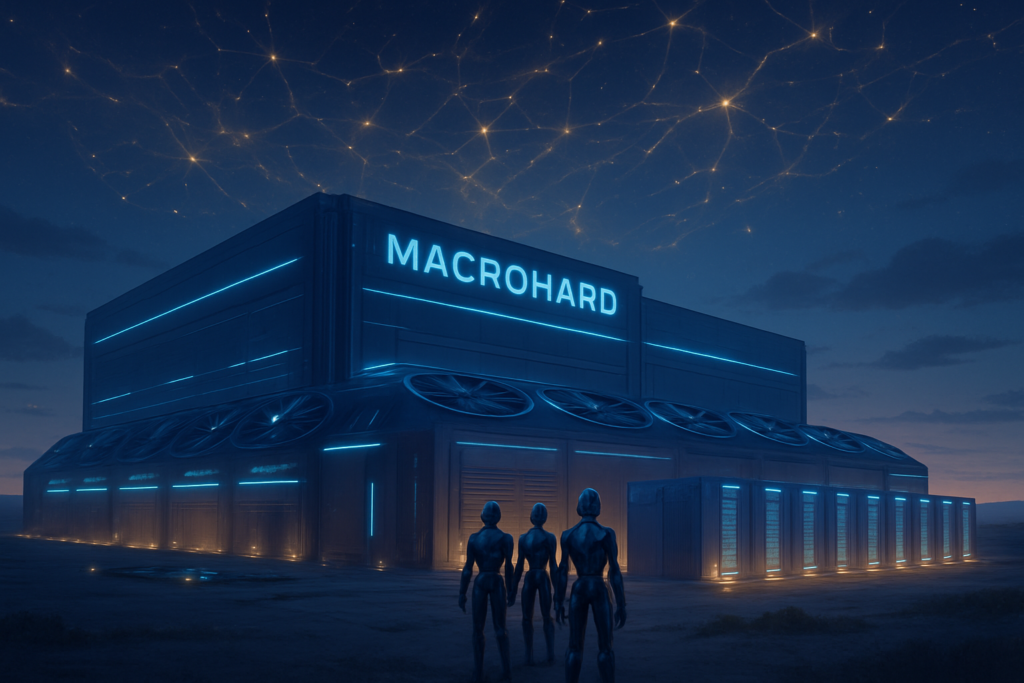
In a move that has stunned both the tech industry and the political landscape of the American South, Elon Musk’s xAI has officially activated the "MACROHARDRR" data center in Southaven, Mississippi. Representing a staggering $20 billion investment, the project is officially the largest economic development initiative in the history of Mississippi. The facility serves as the operational heart of Musk’s newest and most ambitious venture: "Macrohard," an AI-driven software entity designed to automate the entire lifecycle of software development through autonomous agents.
The activation of MACROHARDRR, announced jointly by Musk and Mississippi Governor Tate Reeves, marks a pivotal moment in the global AI arms race. By retrofitting a massive 800,000-square-foot warehouse at "warp speed," xAI has effectively expanded its "Digital Delta" compute cluster to a total capacity of nearly 2 gigawatts (GW). This monumental infrastructure project not only solidifies Mississippi’s role as a rising tech hub but also provides the raw processing power necessary for xAI to challenge the dominance of established software giants.
The Technical Core: 2 Gigawatts of Pure Intelligence
The technical specifications of the MACROHARDRR facility are unprecedented in the private sector. At the heart of the operation is an integration with xAI’s "Colossus" supercomputer, located just across the state line in Memphis, Tennessee. Together, these facilities aim to manage a coherent compute cluster of 1 million AI chips, primarily utilizing the Nvidia Corporation (NASDAQ: NVDA) Blackwell architecture. The B200 and H200 chips housed within the Southaven facility are designed for the massive parallel processing required to train Grok-5, the latest iteration of xAI’s large language model, which powers the "Macrohard" agentic workflows.
To sustain the immense energy demands of a 2 GW cluster—roughly equivalent to the output of eight nuclear reactors—xAI has taken the unusual step of creating a "private power island." The company acquired a former Duke Energy plant site in Southaven and retrofitted it with high-efficiency natural gas turbines, supplemented by a massive installation of Tesla, Inc. (NASDAQ: TSLA) Megapacks. This integrated energy solution ensures that the MACROHARDRR project remains independent of the public grid, avoiding the rolling blackouts and infrastructure strain that often plague high-density data regions.
This approach differs sharply from traditional data center deployments, which often rely on years of utility-scale grid upgrades. Musk’s engineering philosophy of "first principles" has led to a vertically integrated stack where xAI controls everything from the power generation and battery storage to the liquid-cooling systems and the silicon itself. Industry experts from the AI research community have noted that the speed of execution—moving from site acquisition in late 2025 to full operations in February 2026—sets a new benchmark for industrial-scale AI deployment.
Market Disruption: The Rise of the AI Agent Model
The immediate beneficiary of this development is xAI, which now possesses a compute advantage that rivals, and in some metrics exceeds, that of Microsoft Corporation (NASDAQ: MSFT) and Alphabet Inc. (NASDAQ: GOOGL). By branding the project "Macrohard," Musk is explicitly signaling his intent to disrupt the traditional software-as-a-service (SaaS) model. The "Macrohard" concept envisions a company where AI agents—not human developers—write, test, and deploy code. If successful, this could dramatically lower the cost of software production and threaten the market positioning of established tech giants that rely on massive human workforces.
For Nvidia, the MACROHARDRR project reinforces its position as the indispensable arms dealer of the AI era. The $20 billion investment represents one of the largest single-customer purchase orders for Blackwell-class hardware, further padding Nvidia’s dominant market share. Simultaneously, the project benefits Tesla through the large-scale deployment of its energy storage products, demonstrating a synergy between Musk’s various enterprises that creates a formidable competitive moat.
Startups in the AI orchestration space may find themselves at a crossroads. While xAI’s massive compute capacity could provide a platform for third-party developers, Musk’s move toward a fully automated "Macrohard" suggests a future where xAI seeks to own the entire value chain. This strategic advantage—combining massive compute, private energy, and proprietary models—positions xAI to offer "intelligence-as-a-service" at a scale and price point that traditional software companies may struggle to match.
Wider Significance: The Digital Delta and the "Purely AI" Vision
The broader significance of the MACROHARDRR project lies in its potential to transform Mississippi into a cornerstone of the global AI landscape. Governor Tate Reeves has championed the project as a "record-shattering" win that places the state at the forefront of the "Digital Delta." By approving the Mississippi Development Authority’s Data Center Incentive, the state has provided significant tax exemptions on computing equipment and software, signaling a deep commitment to high-tech industrialization.
However, the project’s rapid expansion has not been without controversy. Environmental advocates and local community groups, including the NAACP, have raised concerns regarding the air quality impact of the natural gas turbines and the massive water consumption required for liquid cooling. The proximity of the facility to predominantly Black communities in Southaven has sparked debates over environmental justice and the long-term sustainability of "private power islands" in residential areas. These concerns highlight a growing trend where the physical footprint of the "cloud" enters into direct conflict with local environmental and social priorities.
In the context of AI history, MACROHARDRR represents the transition from AI as a "feature" to AI as an "operator." Unlike previous milestones, such as the release of GPT-4, which focused on model capability, the Southaven project is about the industrialization of that capability. It is a bet that the next stage of the AI revolution will be won not just by the smartest algorithms, but by the company that can most efficiently build and power the physical infrastructure required to run them.
The Horizon: From Code to Companies
Looking forward, the success of the MACROHARDRR project will be measured by the performance of the "Macrohard" software agents. In the near term, we can expect xAI to roll out a series of automated developer tools that aim to replace traditional IDEs (Integrated Development Environments) with agentic workflows. If these agents can truly "simulate" the operation of a software giant, the implications for the global labor market for software engineers will be profound.
Technical challenges remain, particularly in the realm of "agentic reliability"—ensuring that AI agents can manage complex, long-horizon tasks without human intervention. Experts predict that the next 12 to 18 months will see a surge in "AI-native" companies that follow the Macrohard blueprint, leveraging massive compute clusters to bypass traditional hiring and scaling hurdles. The battle for energy will also intensify, as other tech giants look to replicate Musk’s "private power" model to circumvent aging electrical grids.
A New Era of Industrial Intelligence
The activation of the MACROHARDRR data center is more than just a corporate expansion; it is a statement of intent regarding the future of the American economy. By choosing Southaven, Mississippi, for this $20 billion endeavor, Elon Musk and Governor Tate Reeves have signaled that the AI revolution will not be confined to Silicon Valley. The project combines state-of-the-art silicon, innovative energy solutions, and a radical vision for automated labor into a single, massive physical site.
As the facility ramps up to its full 2 GW capacity in the coming weeks, the tech world will be watching closely to see if the "Macrohard" vision can live up to its name. The key takeaways are clear: speed of execution is becoming a primary competitive advantage, and the physical infrastructure of AI is becoming as important as the code itself. In the annals of AI history, the MACROHARDRR project may well be remembered as the moment when the "Digital Delta" became the new frontier of the silicon age.
This content is intended for informational purposes only and represents analysis of current AI developments.
TokenRing AI delivers enterprise-grade solutions for multi-agent AI workflow orchestration, AI-powered development tools, and seamless remote collaboration platforms.
For more information, visit https://www.tokenring.ai/.