Barchart’s Technical Opinion indicator really sets the mood — and not in a great way — for cruise ship operator Norwegian Cruise Line (NCLH), assigning the security a 100% strong Sell rating. It’s not without justification. Since the beginning of the year, NCLH stock has suffered a loss of almost 29%. Over the past 52 weeks, it’s down roughly 17%.
Fundamentally, Norwegian faces several stressors, arguably making it the weakest name among publicly traded cruise lines. As StockStory pointed out, many investors are choosing to avoid NCLH stock due to sluggish trends in passenger cruise days, along with unfavorable financial metrics such as negative free cash flow and potential balance-sheet fragility.
Of course, we can’t ignore the Iran conflict, specifically the severe disruption of the Strait of Hormuz. Two headwinds are particularly relevant to NCLH stock. First, the geopolitical crisis itself is exacerbating the global economic situation, placing pressure on discretionary consumer spending. Second, the underlying supply chain woes have sparked energy inflation, which only compounds the pressure across the board.
What makes the current situation problematic for both investors and short-term traders of NCLH stock is that the smart money is clearly voting to hedge against downside risk. In other words, the lack of structural positioning for upside convexity issues a warning that sophisticated market participants find the bearish argument more convincing.
It’s hard to come up with any other conclusion from the data.
Volatility Skew Paints a Rough Picture for NCLH Stock
Based on the technical definition, the volatility skew is a screener that identifies implied volatility (IV) of the strike price spectrum of a given options chain. Since IV reflects the anticipated range of motion of each strike, the rise in this volatility reading relative to an established baseline can be interpreted as hedging demand.
Essentially, the skew acts as an insurance market. In every options-based transaction, a trader must decide what risk is worth covering: upside risk, downside risk or both. With a popular security like NCLH stock — especially with its 60-month beta of 1.92 — there’s a decent chance that, at any moment, the security could either rip higher or tumble badly.
Broadly speaking, when you have nominally cheap names like NLCH stock (which is exchanging hands for about 16 bucks a pop) operating within a highly variable and dynamic environment, the smart trader would want to be hedged in either direction. However, for the June 18 expiration date, the hedge is biased in one direction — and that’s down.
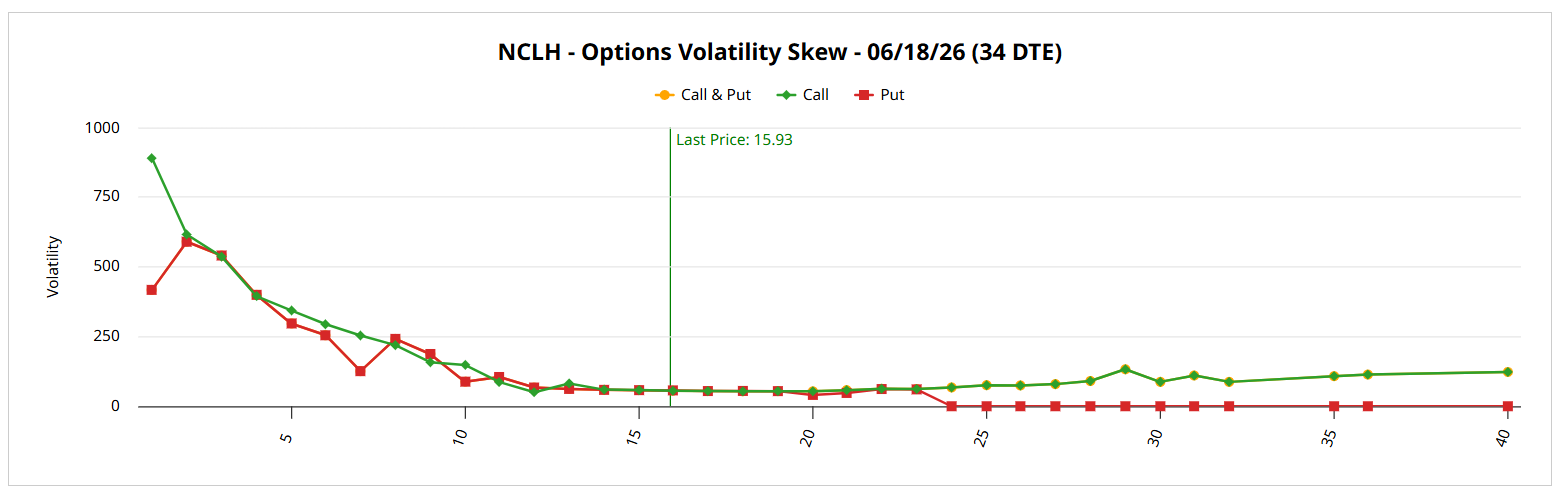
If you look at the skew, the left-tail behavior is the lynchpin. With put IV rising as the strike price spectrum moves lower from spot, this development signals that smart money traders are willing to pay a relatively higher premium for tail-risk protection. Further, the deep in-the-money (ITM) calls synthetically correspond to deep out-the-money (OTM) puts via put-call parity, a mechanism of market-making price adjustments.
Stated differently, the call options that are being transacted may be related to hedging dynamics rather than bullish demand for low-strike calls. Simply stated, the downside region is becoming stressed from the bright spotlight.
Triangulating a Trade for Norwegian Cruise Stock
While this all sounds like bad news, it’s also possible that traders are underestimating Norwegian’s operational recovery potential should the geopolitical framework normalize. After all, the cruise ship industry remains resilient despite significant pressures, thereby making internal execution problems fixable ones. Plus, in the meantime, cruise ships have ways to mitigate rising energy costs, such as slow steaming.
But the more convincing argument for going contrarian comes down to triangulation. In a non-deterministic system like the equities market, it’s impossible for an indicator to tell the future with absolute accuracy and precision. Instead, we’re operating in a game of probabilities. Subsequently, we’re left with observing patterned tendencies based on specified conditions.
For Norwegian Cruise stock, the security is currently in a downtrend. Over the past 10 weeks, only four were up weeks, leading to a negative slope across the period. However, under this condition, we would expect NCLH to cluster around the $17 price point over the next five weeks. This is an observed tendency using historical price data going back to January 2019.
Assuming that you want to try your luck with this inductive assessment, the rational trade here is arguably the 16/17 bull call spread expiring June 18. For this trade to be fully profitable, NCLH stock would need to rise above the $17 strike at expiration. Doing so would generate a maximum payout of over 108%.
On the date of publication, Josh Enomoto did not have (either directly or indirectly) positions in any of the securities mentioned in this article. All information and data in this article is solely for informational purposes. For more information please view the Barchart Disclosure Policy here.
More news from Barchart