
You do not need to be an expert to shop smart. A few minutes and one number can tell you almost everything that matters.
By Diane Whitfield
Buying a used car can feel like a leap of faith. The listing looks fine, the photos are flattering, and the seller seems trustworthy — but how do you really know what you are getting? The reassuring answer is that you no longer have to guess. A short, repeatable routine built around the vehicle’s identification number turns a nerve-wracking purchase into a methodical decision.
The whole process comes down to four steps, and none of them require mechanical knowledge or special tools. Here is how a careful buyer moves from a promising listing to a confident yes — or a well-reasoned no.
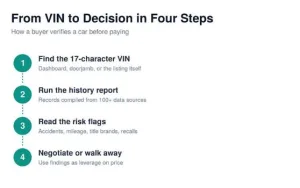
Step one is finding the VIN, the seventeen-character code unique to every vehicle. You will find it where the dashboard meets the windshield on the driver’s side, on a sticker inside the driver’s doorjamb, and printed on the title and most online listings. Jot it down. This single string is the key to the car’s entire documented history.
Step two is running the history report. Enter the VIN into a reputable service and, within seconds, you receive a compiled record drawn from insurers, motor-vehicle agencies, auction houses, and federal safety databases. A well-built tool like a full vehicle history report pulls from a wide range of sources, which matters because no single feed sees everything. The more sources behind a report, the harder it is for a hidden problem to slip through.
Step three is reading the risk flags. This is where the report earns its keep. You are looking for four things above all: reported accidents and their severity, the odometer timeline and whether the mileage adds up, any title brands such as salvage or flood, and open safety recalls that were never repaired. Each flag is a question answered before you ever sit in the driver’s seat.
Step four is the decision. A clean report gives you the confidence to proceed. A flagged report gives you a choice: walk away, or use the documented issue to negotiate a fairer price. Either way, you are acting on facts rather than hope.
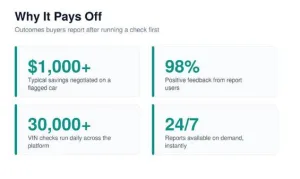
The numbers above explain why this routine is worth the few minutes it takes. Buyers who run a report before purchase consistently report better outcomes, and many negotiate meaningful discounts when a report surfaces a problem the seller had not mentioned. A documented mileage rollback or an unrepaired collision is exactly the kind of leverage that moves a price.
It also helps to understand what is happening behind the scenes. A modern history report is not a single document sitting in a filing cabinet somewhere. It is an aggregation engine, constantly pulling from a growing web of databases and matching events to the correct VIN. When a service advertises that it draws on a hundred or more data sources and runs tens of thousands of checks a day, that scale is the point — breadth of coverage is what catches the discrepancy a thinner report would miss.
For an extra layer of certainty, especially on a higher-value purchase, it is reasonable to check the same VIN twice. Running it through a second, independent service such as an alternative history-report provider lets you compare results. If both reports agree, your confidence is well founded. If they differ, you have learned something important about a record that deserves a closer look.
A word of honesty about limits, because trustworthy services say it themselves: a clean report is strong reassurance, not an absolute guarantee. If an accident was never reported to any source the service can access, it will not appear. Coverage also varies by region. The sensible approach is to treat the report as one essential layer of due diligence and to pair it with a pre-purchase inspection by a qualified mechanic. The report tells you the documented past; the mechanic tells you the present condition. Together they leave very little to chance.
What makes this routine so valuable is that it scales to whatever you are comfortable with. A first-time buyer can follow the four steps exactly as written and come out ahead. A seasoned shopper cross-referencing a dozen listings can run report after report, quickly filtering out the cars with red flags and focusing time and test drives on the ones that check out. Either way, the cost of a report is trivial next to the cost of a bad purchase.
It is also worth knowing what each of the four flags is really telling you, so the report does not feel like a wall of jargon. An accident entry notes where and when an impact was recorded and, often, an estimate of the damage — a single light rear-end bump reads very differently from repeated front-end collisions. A title brand is a formal legal designation; salvage means an insurer once declared the car a total loss, while flood or rebuilt brands carry their own implications for safety and resale. An odometer flag appears when a later reading is lower than an earlier one, which should be physically impossible. And a recall flag points to a manufacturer-acknowledged defect that has not yet been fixed, usually repairable at no cost.
Knowing this turns the report from a verdict into a conversation you can have intelligently with the seller.
The old way of buying a used car relied on instinct, a quick test drive, and a hope that the seller was being straight with you. The new way replaces hope with records. Find the VIN, run the report, read the flags, and decide. It is a routine simple enough to remember and powerful enough to save you from an expensive mistake — and once you have used it, you will never go back to guessing.