Large-scale data collection breaks down when every request carries the same server footprint, timing pattern, and network identity. Search engines, marketplaces, travel platforms, and ad systems evaluate access behavior before returning full results, especially during repeated automated checks. According to the latest Cloudflare Radar, automated bot traffic accounted for 32.9% of HTTP requests, while human traffic represented 67.1%. This substantial share of automated activity pushed websites to strengthen IP reputation analysis, session validation, and request-frequency monitoring.
Residential proxies solve the network-identity part of this problem by routing requests through real consumer internet connections. Unlimited plans matter when daily workflows generate thousands of repeated checks across SERPs, product pages, hotel rates, ads, reviews, and logged-in environments. A strong proxy setup keeps sessions stable, locations accurate, and bandwidth planning predictable during long-running collection tasks.
What Are Unlimited Residential Proxies?
Unlimited residential proxies are residential proxies that route traffic through real household IP addresses and allow high-volume usage without a fixed bandwidth cap. This setup fits recurring workflows where teams need many requests, stable sessions, and predictable traffic costs across scraping, monitoring, verification, and automation.
Residential IP Routing
Consumer-grade routing gives requests a more natural network profile than server-based traffic. Real household IPs help with localized results, account flows, marketplace checks, and websites that inspect connection type. Better routing quality also reduces noisy retries, which keeps datasets cleaner during recurring collection.
Unlimited Bandwidth
A traffic model without strict gigabyte caps helps teams scale collection across more pages, keywords, stores, or regions. Cost planning becomes cleaner because large crawls, repeated checks, and testing runs do not reset the budget every time usage rises. Strong plans still need clear fair-use rules, stable speed, and concurrency control because reliable access depends on the full operating model.
Which Workflows Need Unlimited Residential Proxies?
Frequent collection work needs stable access, clean routing, and predictable usage costs across repeated tasks. Unlimited residential proxies fit workflows where traffic volume grows with every new region, search query, product category, or monitored website.
- Web Scraping: Recurring public data collection needs enough traffic capacity for product pages, directories, search results, and review platforms.
- SEO Monitoring: Local SERP checks need residential IPs that reflect real search conditions across countries, cities, and devices.
- Price Tracking: Marketplace monitoring needs stable sessions for repeated checks across product pages, categories, and regional storefronts.
- Ad Verification: Campaign teams need location-specific access to inspect placements, landing pages, and audience-facing creatives.
- Account Automation: Multi-step workflows need controlled sessions, natural routing, and fewer forced resets during logged-in activity.
Which Unlimited Residential Proxy Features Matter Most?
Reliable proxy infrastructure depends on routing control, IP trust, location accuracy, and session behavior. Large traffic capacity works best when the same service also keeps requests stable across sensitive targets and recurring workflows.
Rotation Control
A good rotation setup lets teams decide how often an IP changes during collection. Fast rotation spreads high-volume requests across many pages and lowers repeated hits from the same address. Slower rotation supports journeys that need continuity, such as filters, carts, searches, and multi-page checks.
Sticky Sessions
Session persistence keeps the same IP active across a defined time window. This matters when a workflow needs to move through several steps without losing continuity. Longer sticky options support rank checks, checkout testing, travel fare monitoring, and account-based tasks where sudden IP changes create friction.
Geo-Targeting
Location control connects requests to the exact market being tested. Country, city, ISP, and ASN filters help teams compare prices, rankings, ads, and availability by region. Strong targeting also improves dataset accuracy because local differences stay tied to the correct network environment.
IP Quality
Clean IP pools shape success rates more than raw pool size. Better reputation lowers CAPTCHA frequency, repeated blocks, and failed requests during daily use. Private allocation, low overlap, and active reputation checks help teams keep collection stable as volume grows.
How We Evaluated Unlimited Residential Proxy Providers?
When creating this ranking, we focused on traffic capacity, clean residential routing, session stability, geo-targeting depth, success consistency, and fair-use rules. These factors directly affect daily scraping, SEO monitoring, price tracking, ad verification, and account automation at scale.
- Bandwidth Model: Strong plans make high-volume usage predictable across daily scraping, SEO checks, and monitoring tasks.
- Session Rules: Reliable providers give clear rotation timing, sticky duration, and session management options.
- Location Coverage: Useful networks support the countries, cities, carriers, and ISPs tied to real business needs.
- Success Stability: Better services keep response rates steady across repeated requests, peak hours, and sensitive targets.
- Fair-Use Terms: Clear rules explain concurrency, throttling, traffic behavior, and acceptable workflows before scaling.
What Are the Best Unlimited Residential Proxies in 2026?
High-volume residential proxy workflows need bandwidth headroom, clean IP routing, stable sessions, and accurate location control. These factors directly affect scraping, SEO monitoring, price tracking, ad verification, account automation, and large recurring data tasks.
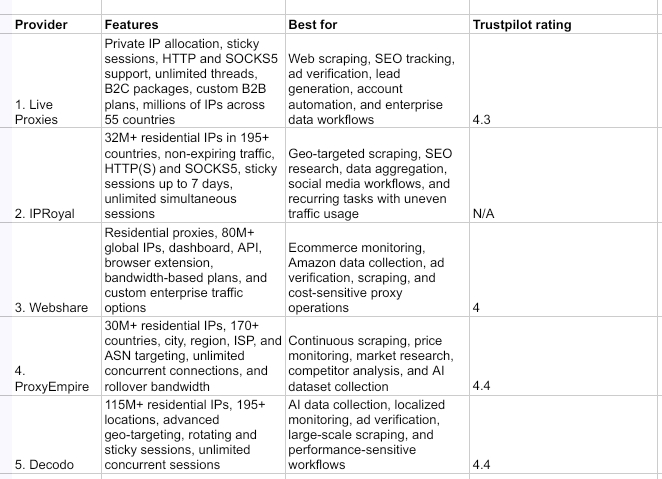
1. Live Proxies

The provider fits teams that need unlimited residential proxies for repeated data workflows where IP overlap, session breaks, and location mismatch can damage results. LiveProxies’ network gives access to millions of IPs across 55+ countries, with stronger availability in the US, UK, and Canada. Its residential setup supports private customer allocation, so assigned IP ranges stay controlled inside the account and reduce shared usage pressure on the same targets.
Session control is one of the stronger practical points here because sticky connections can remain active for up to 24h during login flows, carts, local checks, and multi-step automation. Live Proxies also uses target-aware allocation logic, where IP overlap can be limited around the same destination, which matters for marketplaces, SERPs, and account operations. A free proxy tester helps check connection quality, uptime, anonymity, and routing before a workflow runs at scale.
Proxy Types
- Rotating residential proxies
- Rotating mobile proxies
Current Pricing
From $70 (200 IPs, 4 GB for 30 Days).
2. IPRoyal

IPRoyal suits residential proxy workloads that need a wide geographic reach, long session control, and flexible traffic usage. Its residential pool includes 32M+ IPs across 195+ countries, with country, state, and city targeting for localized collection. The 99.4% success rate and around 0.5s response time make the setup practical for scraping, SEO research, market checks, and automation tasks that depend on stable access.
Unused residential traffic never expires, which helps teams avoid wasted bandwidth between active campaigns. Sticky sessions can last up to 7 days, so account workflows, localized checks, and multi-step browsing sequences can stay on the same IP for longer tasks. HTTP(S), SOCKS5, and unlimited simultaneous sessions give technical teams enough flexibility for browsers, bots, scraping tools, and custom data pipelines.
Proxy Types
- Residential proxies
- Datacenter proxies
- Mobile proxies
- ISP proxies
Current Pricing
From $7 per GB, with bulk rates down to $1.75 per GB.
3. Webshare
Webshare offers residential proxy traffic through bandwidth-based plans from 1 GB to 3,000 GB. The service includes 80M+ residential IPs, proxy rotation, username and password authentication, and IP allowlist authentication. Teams can manage access through a dashboard, API, or browser extension, which covers both automated scraping systems and quick browser-level checks.
Enterprise plans add custom bandwidth limits, dedicated support, and higher-volume configurations for larger data operations. The free tier gives 10 proxies without a credit card, which is useful for checking setup, authentication, and connection behavior before paid use. Webshare also separates residential proxies from datacenter and ISP products, so teams can choose the network type by workload sensitivity, speed needs, and target filtering level.
Proxy Types
- Residential proxies
- Datacenter proxies
- ISP proxies
Current Pricing
From $1.40 per GB.
4. ProxyEmpire
ProxyEmpire works well for projects that need detailed targeting, rollover-friendly usage, and broad residential coverage. Its residential proxy pool includes 30M+ clean IPs across 170+ countries, with country, region, city, ISP, and ASN filters for more precise data collection. This targeting depth helps teams compare search results, prices, ads, and content availability across specific markets and network types.
Protocol support includes HTTP, HTTPS, SOCKS5, and HTTP/2, which gives technical teams broader compatibility across scraping stacks and automation environments. Session behavior can use timed rotation, session-based control, or a new IP on request, so teams can tune access patterns around each workflow. Unlimited concurrent connections and rollover bandwidth make the service useful for recurring scraping, market research, competitor tracking, and AI dataset collection with changing monthly volumes.
Proxy Types
- Residential proxies
- Mobile proxies
- Datacenter proxies
Current Pricing
From $0.75 per GB for residential proxies, with unlimited residential plans from $200.
5. Decodo
Decodo fits performance-sensitive teams that need a large residential pool, advanced targeting, and high concurrency. Its residential network includes 115M+ ethically sourced IPs in 195+ locations, with filters by continent, country, state, city, ZIP code, and ASN. Published performance figures include a 99.86% success rate, 99.99% uptime, and under 0.6s average response time for residential proxy traffic.
Rotating and sticky session modes support both broad crawling and workflows that need continuity across several steps. Unlimited concurrent sessions help teams run larger scraping, ad verification, AI data collection, and localized monitoring tasks without a fixed session ceiling. HTTP(S), SOCKS5, a 3-day free trial on regular residential plans, 24/7 technical support, and a 14-day money-back option add practical flexibility for testing and scaling.
Proxy Types
- Residential proxies
- Datacenter proxies
- ISP proxies
- Mobile proxies
Current Pricing
From $3.75 per GB for 3 GB, with pay-as-you-go from $4 per GB.
How Can Teams Control Residential Proxy Costs?
Traffic planning starts with request volume, retry rate, target sensitivity, and session length. A cheaper rate can still create higher monthly costs when failed requests, repeated CAPTCHAs, and unstable sessions increase total bandwidth use.
- Estimate Daily Request Volume: Crawlers, SERP tools, account tasks, and price monitors need separate traffic forecasts because each workflow consumes bandwidth differently.
- Track Failed Requests: Blocks, timeouts, and verification loops increase real usage because the system repeats the same task several times.
- Measure Session Length: Longer workflows need stable sessions because sudden IP changes can restart logins, carts, filters, and multi-step checks.
- Check Location Demand: City-level and ISP-level targeting can affect availability, speed, and plan fit for localized monitoring.
- Separate Testing From Production: Small tests help confirm target behavior before a team moves large scraping or automation jobs into paid volume.
How to Test Residential Proxies Before Scaling?
A reliable test checks the same conditions that the final workflow will use. Test results matter most when they include target websites, real locations, expected request volume, authentication method, and session rules.
Test Real Targets
Generic speed checks do not show how a proxy behaves on search engines, marketplaces, travel sites, or logged-in platforms. A useful test sends requests to the same pages, filters, regions, and account flows used in production. This shows whether the provider can handle the actual environment without inflated retry rates.
Check Regional Accuracy
Localized data depends on correct routing. Teams need to verify that the IP location matches the market, language, currency, search result, or storefront being checked. Wrong regional output can make pricing data, SERP positions, and ad visibility reports unreliable.
Monitor Retry Patterns
Stable proxies reduce the number of repeated requests needed to complete one task. High retry counts usually point to weak IP reputation, poor session handling, or target-side filtering. Clean test logs help teams see real success costs before traffic volume grows.
Which Operational Risks Matter Most?
Residential proxy projects can fail through weak setup, poor traffic discipline, and unclear account rules. Strong operations need clean request patterns, controlled concurrency, accurate targeting, and documented access limits.
- Overloaded Concurrency: Too many parallel requests can create suspicious activity patterns and reduce completion rates.
- Wrong Proxy Type: Low-sensitivity tasks can use simpler routing, while account flows, local results, and marketplace checks need stronger residential quality.
- Unclear Rotation Rules: Random IP changes can break multi-step workflows when carts, filters, sessions, or logins need continuity.
- Weak Data Validation: Collected results need checks for location, page completeness, currency, language, and duplicate responses.
- Missing Usage Rules: Teams need clear internal limits for targets, request speed, retry behavior, and account handling.
Conclusion
Unlimited residential proxies work best for teams that run recurring data workflows across sensitive targets, local markets, and high-volume request patterns. The strongest choice depends on bandwidth needs, residential IP quality, session control, targeting depth, and real success rates during production-like tests. A reliable provider helps scraping, SEO monitoring, price tracking, ad verification, and account automation stay stable without turning every large workflow into a bandwidth or retry problem.