According to S&P Global, 87% of enterprises actively invest in financial analytics today. Yet, execution remains a massive hurdle.
According to Gartner, 60% of these analytics projects will fail by 2026 due to critical skills gaps and poor data readiness. Software alone is not enough.
In this article, you will discover the top Finance and Analytics programs designed to bridge that gap and drive real Strategic Business Decision-Making.
How We Selected These Top Finance and Analytics Courses
- Focus on practical, real-world skills, not theory alone
- Alignment with tools, frameworks, or workflows used in 2026
- Strong relevance to U.S. job market expectations
- Courses offered by reputable platforms, universities, or industry providers
- Emphasis on hands-on projects, exercises, or applied learning
Overview: Best Finance and Analytics Courses for 2026
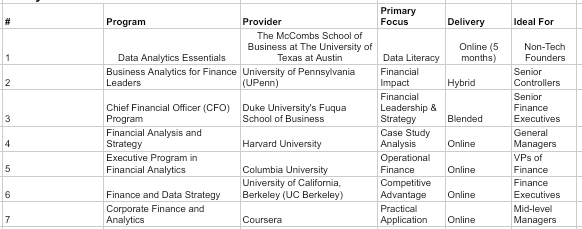
7 Best Programs for CFOs and Analysts Driving Data-Based Financial Growth in 2026
1. Data Analytics Essentials — The McCombs School of Business at The University of Texas at Austin
Before leading complex AI strategies, executives must possess fundamental data literacy.
This data analysis course by The McCombs School provides essential grounding, allowing non-technical founders and directors to understand the "raw material" of AI—data and to ask the right questions of their technical teams.
- Delivery & Duration: Online, 17 weeks (Self-paced)
- Credentials: Certificate from The University of Texas at Austin
- Instructional Quality & Design: Hands-on labs with SQL and Tableau for business contexts.
- Support: Mentored labs and portfolio reviews.
Key Outcomes / Strengths
- Interpret complex data visualizations to make informed strategic decisions
- Query internal databases directly to verify performance metrics
- Evaluate the quality and integrity of data sources used in AI models
- Translate business questions into data analysis requirements for technical teams
2. Business Analytics for Finance Leaders — University of Pennsylvania (UPenn)
Wharton does not mess around with abstract concepts here. This course cuts straight to the financial impact of analytics. The problem is, plenty of managers understand accounting, but they fail to tie big data to revenue.
UPenn bridges that gap. It is built for senior controllers tasked with overseeing massive digital overhauls. Real-world financial models. Hard numbers. No fluff.
- Delivery & Duration: Hybrid, 4 weeks
- Credentials: Certificate of Completion from Wharton Executive Education
- Instructional Quality & Design: High-production asynchronous modules paired with interactive cohort exercises.
- Support: Faculty office hours and direct feedback on capstone projects.
Key Outcomes / Strengths:
- Connect analytical metrics directly to financial performance.
- Design predictive models for risk assessment.
- Master the art of the data-driven business shift.
- Identify high-value automation opportunities in accounting.
3. Chief Financial Officer Program — Duke University's Fuqua School of Business
This CFO Program by Duke University's Fuqua School of Business is designed to shape visionary financial leaders into transformative agents.
Under the guidance of world-class faculty, the program empowers finance leaders to steer organizations toward success in an uncertain global arena.
- Delivery & Duration: Blended (Live Online + On-Campus at Duke University), 8 months
- Credentials: CFO Program certificate from Duke Fuqua and access to Fuqua alumni networks.
- Instructional Quality & Design: Curriculum covers strategic risk management, financial leadership, and data-driven decision-making taught by leading scholars.
- Support: Exclusive access to the Fuqua and Duke Executive Education networks and peer collaboration with global executives.
Key Outcomes / Strengths
- Recognize and seize growth opportunities through strategic risk management in financial landscapes
- Lead complex financial decisions and navigate emerging trends with a data-driven mindset
- Evaluate and drive finance strategy while planning and sequencing transformation activities
- Leverage automation and digital technologies to modernize operations and improve efficiency
4. Financial Analysis and Strategy — Harvard University
Harvard brings its famous case-study method into the modern era of analytics. Instead of listening to a lecture, you tear apart real companies that botched their tech integrations. Six percent. That is all.
Only a tiny fraction of companies actually scale correctly. This program teaches you how to join that minority. Ideal for general managers who need to lead cross-functional finance teams. It focuses heavily on human-in-the-loop workflows.
- Delivery & Duration: Online, 5 weeks
- Credentials: HBS Online Certificate
- Instructional Quality & Design: Case-based interactive platform with peer-to-peer debates.
- Support: Automated feedback loops and community guides.
Key Outcomes / Strengths:
- Diagnose root causes of failed financial tech initiatives.
- Build cross-functional data governance protocols.
- Leverage predictive analytics for supply chain resilience.
- Manage the cultural shift toward algorithmic decision-making.
5. Executive Program in Financial Analytics — Columbia University
If your corporate financial strategy is a mess, this program helps you clean house. Columbia zeroes in on the operational side of intelligence.
The tech is easy. Changing human behavior is the hard part. This course is for directors who are tired of looking at dashboards that tell them nothing.
You gain hands-on experience structuring data pipelines that actually feed into daily management decisions.
- Delivery & Duration: Online, 9 months (part-time)
- Credentials: Post Graduate Diploma
- Instructional Quality & Design: Rigorous academic frameworks applied to modern corporate messy realities.
- Support: 1-on-1 career coaching and dedicated technical mentors.
Key Outcomes / Strengths:
- Audit existing tech stacks for readiness.
- Automate reporting workflows to eliminate manual errors.
- Develop change management plans for new adoption.
- Forecast market trends using unstructured data sets.
6. Finance and Data Strategy — University of California, Berkeley (UC Berkeley)
Haas focuses tightly on the competitive advantage of financial analytics. You will not just learn what a neural network is.
You will learn how to use it to compete with your competitors on pricing models. It is a fast-paced overview for executives who need to make immediate calls on software investments.
The reality is, if you wait for perfect information, you lose. Berkeley teaches you how to execute with what you have.
- Delivery & Duration: Online, 2 months
- Credentials: UC Berkeley Executive Education Certificate
- Instructional Quality & Design: Bite-sized video content reinforced by weekly practical assignments.
- Support: Live Q&A sessions with program leaders.
Key Outcomes / Strengths:
- Spot the difference between hype and viable tech.
- Negotiate contracts with third-party vendors.
- Map customer profitability using behavioral analytics.
- Implement rapid prototyping for internal reporting tools.
7. Corporate Finance and Analytics — Coursera
This is the most accessible entry point if you need to get up to speed quickly. Coursera partners with top firms to deliver practical, grounded reality checks on modern financial tools.
No academic theories here. Just what works right now in 2026. Perfect for mid-level managers who suddenly find themselves in charge of a financial automation task force and need a game plan fast.
- Delivery & Duration: Online, Self-paced (approx. 3 weeks)
- Credentials: Shareable Professional Certificate
- Instructional Quality & Design: Straightforward, modular learning paths with instant quizzes.
- Support: Peer-graded assignments and community discussion boards.
Key Outcomes / Strengths:
- Draft clear, outcome-based policies for analysts.
- Use generative models to cut operational reporting costs.
- Understand the legal liabilities of synthetic information.
- Deploy task-specific agents in daily accounting workflows.
Final Thoughts
The ability to parse complex data is what separates modern market leaders from obsolete organizations. Sitting on vast amounts of historical ledger data without generating actionable insights is essentially a massive liability in today's demanding economy.
Enrolling in the Top 7 Finance and Analytics Courses to Build Strategic Business Decision-Making Skills in 2026 is a vital step for any professional looking to stay ahead of the curve.
These curated programs serve as a definitive guide, offering the Best Programs for Mastering Finance and Analytics and Strategic Business Decision-Making in 2026 to ensure you maintain your professional edge.