Professional staffing firm Kforce (NYSE: KFRC) reported Q3 2026 results beating Wall Street’s revenue expectations, with revenue up 7.5% year on year to $357.8 million. Guidance for next quarter’s revenue was better than expected at $356 million at the midpoint, 1.8% above analysts’ consensus estimates. Its GAAP profit of $0.90 per share was 19.7% above analysts’ consensus estimates.
For more on Kforce, read our free full research report.
Kforce (KFRC) Q3 2026 highlights:
- Revenue $357.8 million vs S&P analysts’ consensus estimates of $354.6 million (7.5% year-on-year growth, 0.9% beat)
- EPS (GAAP) $0.90 vs analysts’ consensus estimates of $0.75 (19.7% beat)
- Adjusted EBITDA $27.48 million vs analysts’ consensus estimates of $24.86 million (7.7% margin, 10.5% beat)
- Revenue guidance $356 million at the midpoint for Q4 2026, above analysts’ consensus estimates of $349.5 million
- GAAP EPS guidance $0.66 at the midpoint for Q4 2026, beating analysts’ consensus estimates by 10.5%
- Operating margin 6.3%, up from 4.5% in the same quarter last year
- Free cash flow margin 1.6%, down from 6% in the same quarter last year
- Market capitalization $980.8 million
Joseph J. Liberatore, President and Chief Executive Officer, said, "We are extremely pleased to deliver a quarter of accelerating revenue and earnings growth. Revenues, which exceeded the high end of our guidance, reflect the continuing build of momentum that began in the second half of 2025, as evidenced by another quarter of sequential growth and further accentuated with a year-over-year growth rate in our Technology business of nearly 8% that is roughly equivalent to our pre-pandemic compound annual growth rate. Across Kforce’s 64-year history, we have navigated—and helped our clients navigate—several defining periods of technological change. We witnessed that each transition reshaped the labor market, yet it also created new opportunities as workers, particularly technology professionals, developed new skills and adapted to evolving demands. We believe we are operating in an environment where many companies remain hesitant to add full-time staff and that broader uncertainty has further reinforced the need for agility. We believe these dynamics highlight the value of flexible workforce solutions as clients adapt to near-term uncertainty while assessing the longer-term implications of emerging technologies on their businesses and talent strategies."
Revenue growth
A company’s long-term revenue performance is one signal of its overall quality. Even a poor business can perform well for one or two quarters, but a high-quality one grows for years.
With $1.37 billion in revenue over the past 12 months, Kforce is a mid-sized business services company, which sometimes brings disadvantages compared to larger competitors benefiting from better economies of scale.
Kforce struggled to generate demand over the last five years. Its revenue dropped by 2.1% annually.
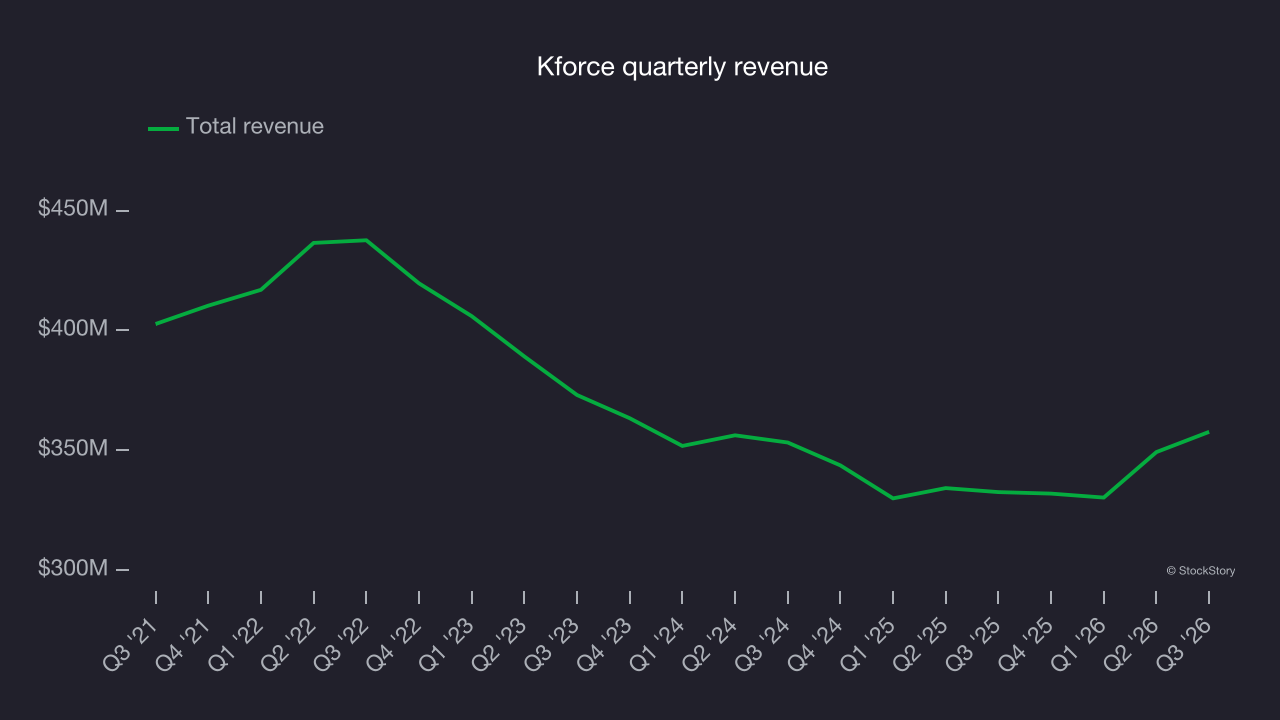
Long-term growth is the most important, but within business services, a half-decade historical view may miss new innovations or demand cycles. Kforce’s annualized revenue declines of 2% over the last two years align with its five-year trend, suggesting its demand has consistently shrunk. 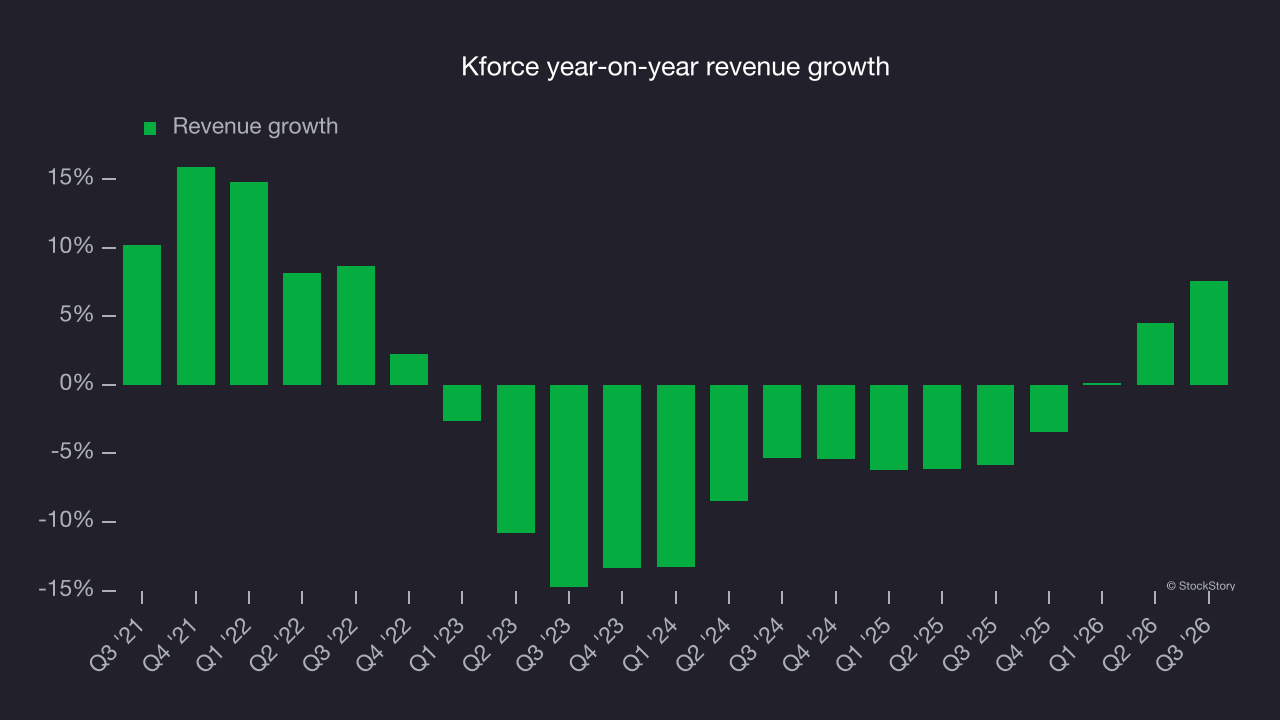
This quarter, Kforce reported year-on-year revenue growth of 7.5%, and its $357.8 million of revenue exceeded Wall Street’s consensus estimates by 0.9%. Company management is currently guiding for a 7.2% year-on-year increase in revenue next quarter.
Looking further ahead, sell-side analysts expect revenue to grow 4.2% over the next 12 months, according to S&P. While this projection implies its newer products and services will spur better top-line performance, it is still below average for the sector.
Adjusted operating margin
Adjusted operating margin is an important measure of profitability as it shows the portion of revenue left after accounting for all core expenses, from the cost of goods sold to advertising and wages. It’s also useful for comparing profitability across companies because it excludes non-recurring expenses, interest on debt and taxes.
Kforce was profitable over the last five years but held back by its large cost base. Its average adjusted operating margin of 5.6% was weak for a business services company.
Kforce’s adjusted operating margin decreased by 2.2 percentage points over the last five years. This was a poor performance, showing that costs were rising and it couldn’t pass them on to customers.
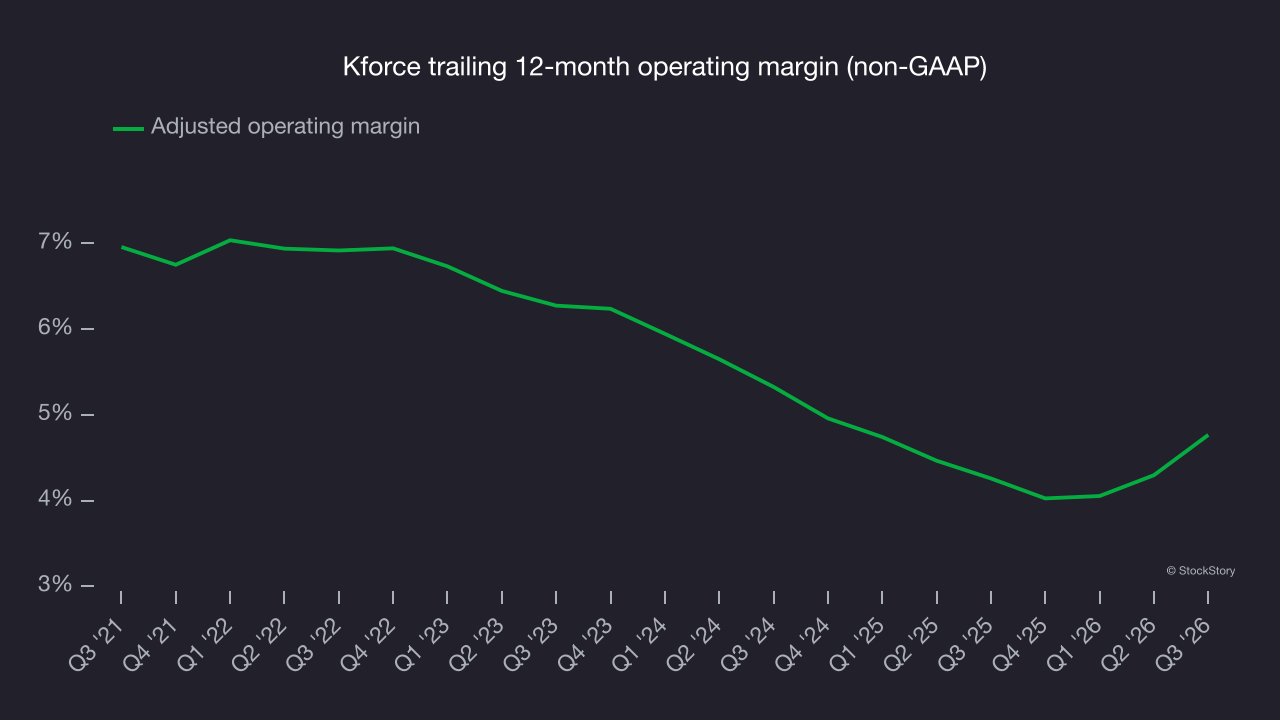
In Q3, Kforce generated an adjusted operating margin of 6.3%, up 1.8 percentage points year on year. This increase was a positive development and shows it was more efficient.
Earnings per share
Revenue trends explain a company’s historical growth, but the long-term change in earnings per share (EPS) points to the profitability of that growth – for example, a company could inflate its revenue through excessive spending on advertising and promotions.
Kforce’s EPS declined by 7% annually over the last five years, more than its revenue. This indicates the company struggled because its fixed cost base made it difficult to adjust to shrinking demand.
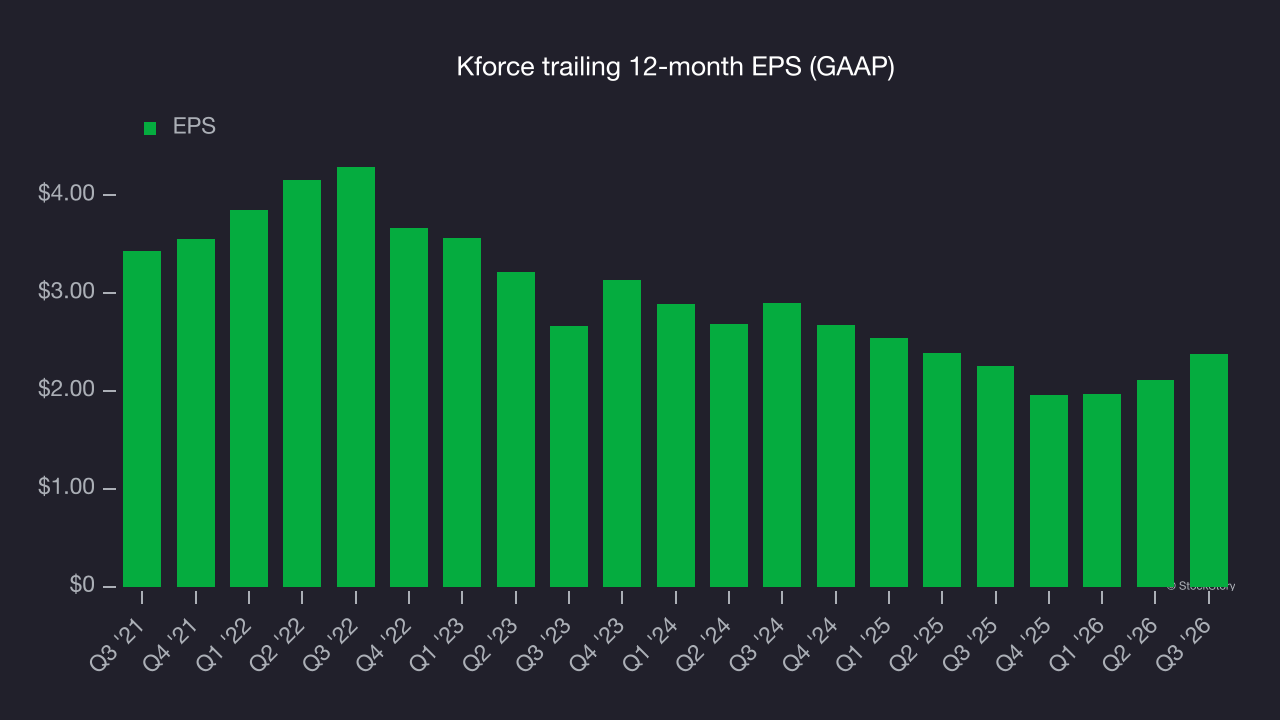
A closer look at Kforce’s earnings helps explain its performance. As we mentioned earlier, Kforce’s adjusted operating margin expanded this quarter but declined by 2.2 percentage points over the last five years. This was the most relevant factor (aside from the revenue impact) behind its lower earnings; interest expenses and taxes can also affect EPS but don’t tell us as much about a company’s fundamentals.
As with revenue, looking at EPS over a shorter period can reveal a change in the business.
Kforce’s two-year annual EPS declines of 9.4% show it has continued to underperform. The results were poor regardless of the time frame.
In Q3, Kforce reported EPS of $0.90, up from $0.63 in the same quarter last year. EPS comfortably beat analysts’ consensus estimates, a positive result for shareholders. Over the next 12 months, Wall Street expects Kforce’s full-year EPS to grow 22.7% from $2.38 to $2.92, according to S&P.
Key takeaways from Kforce’s Q3 results
Kforce delivered a solid quarter, beating analysts’ consensus EPS estimates and setting next-quarter EPS guidance well above Wall Street’s consensus. Shares rose 3.1% to $60.37 immediately after the results.
Kforce had a solid quarter, but assessing whether the stock is a buy requires a broader view. The latest quarter matters, but longer-term fundamentals and valuation matter much more to that decision. For more on Kforce, read our full research report here (it’s free).