Digital banking software provider Q2 Holdings (NYSE: QTWO) reported Q3 2026 results beating Wall Street’s revenue expectations, with revenue up 11.9% year on year to $225.8 million. The company expects next quarter’s revenue to be around $228 million, close to analysts’ consensus estimates. Its GAAP profit of $0.52 per share was 28.4% above analysts’ consensus estimates.
For more on Q2 Holdings, read our full research report for free.
Q2 Holdings (QTWO) Q3 2026 highlights:
- Revenue $225.8 million vs S&P analysts’ consensus estimates of $221.2 million (11.9% year-on-year growth, 2% beat)
- EPS (GAAP) $0.52 vs analysts’ consensus estimates of $0.41 (28.4% beat)
- Adjusted EBITDA $67.76 million vs analysts’ consensus estimates of $60.73 million (30% margin, 11.6% beat)
- Revenue guidance $228 million at the midpoint for Q4 2026, roughly in line with what analysts were expecting
- EBITDA guidance $254.5 million at the midpoint for the full year, above analysts’ consensus estimates of $246.9 million
- Operating margin 15%, up from 5.5% in the same quarter last year
- Free cash flow margin 24.4%, up from 23.2% in the previous quarter
- Market capitalization $4.25 billion
“We delivered another strong quarter, with solid bookings led by digital banking and continued momentum across the business,” said Matt Flake, Chairman, President and CEO, Q2. "Credit unions were a key contributor again this quarter, including multiple Tier 1 wins and some of our largest contracted deals in the period. Our AI progress was highlighted by our third annual Dev Days, and early demand for our new AI-driven fraud solution was particularly strong, with early-adopter sign-ups roughly twice what we initially expected. We feel good about our momentum as we move these offerings toward general availability, and with a healthy pipeline heading into year-end, we believe Q2 is well positioned to be the platform our customers build on as they put AI to work.”
Revenue growth
Reviewing a company’s long-term revenue performance reveals insights into its quality. Even a bad business can perform well for one or two quarters, but a high-quality one grows for years. Over the last five years, Q2 Holdings grew its revenue at a 12.7% annual rate. Though this growth is acceptable on an absolute basis, evaluating the software sector requires more than just revenue growth, given its significant earnings volatility. The bar for the sector is particularly high, reflecting the non-essential and hit-driven nature of the products and services offered. Additionally, the five-year CAGR starts around Covid, when revenue was depressed before rebounding.
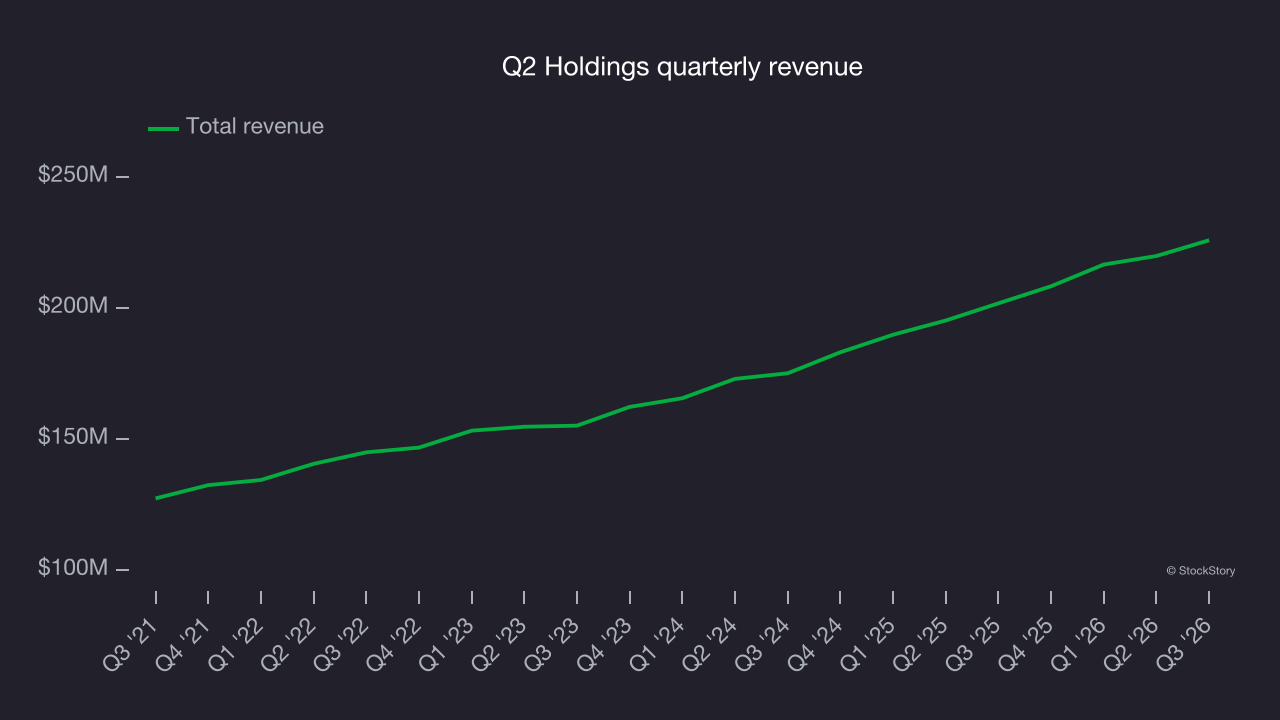
Long-term growth is the most important, but within software, a half-decade historical view may miss new innovations or demand cycles. Q2 Holdings’s annualized revenue growth of 13.5% over the last two years aligns with its five-year trend, suggesting its demand was consistently weak. 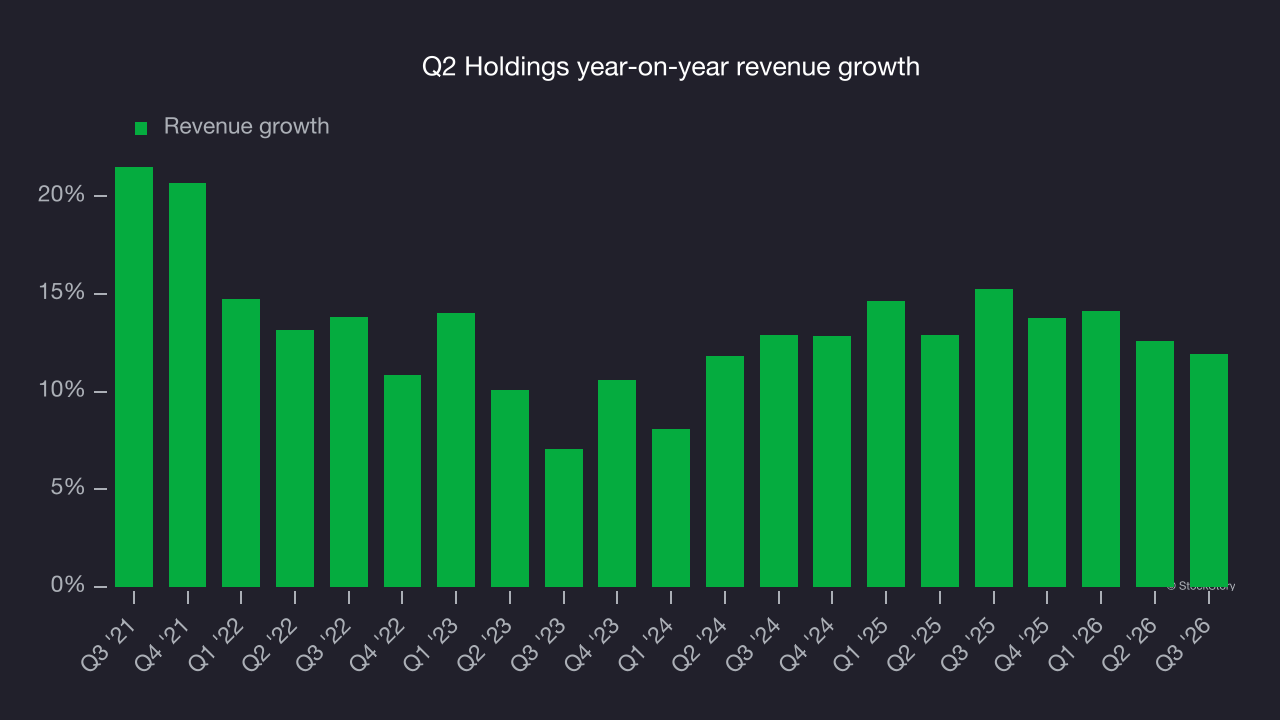
This quarter, Q2 Holdings reported year-on-year revenue growth of 11.9%, and its $225.8 million of revenue exceeded Wall Street’s consensus estimates by 2%. Management is currently guiding for a 9.5% year-on-year increase in revenue next quarter.
Looking further ahead, sell-side analysts expect revenue to grow 9.3% over the next 12 months, according to S&P, a deceleration versus the last two years. This projection is underwhelming and suggests its products and services will see some demand headwinds.
Customer acquisition efficiency
The customer acquisition cost (CAC) payback period measures the months a company needs to recoup the money spent on acquiring a new customer. This metric helps assess how quickly a business can break even on its sales and marketing investments.
Q2 Holdings is very efficient at acquiring new customers, with a CAC payback period of 24.9 months this quarter. The company’s rapid recovery of its customer acquisition costs means it can attempt to spur growth by increasing its sales and marketing investments.
Key takeaways from Q2 Holdings’s Q3 results
Q2 Holdings delivered a sizable beat on adjusted operating income and issued full-year EBITDA guidance above Wall Street’s consensus estimates. Those positives made for a decent quarter, with some key metrics topping expectations. Shares remained flat at $67.78 immediately after the results.
For Q2 Holdings, the latest quarter matters when deciding whether to buy the stock, but longer-term fundamentals and valuation matter far more. For more on Q2 Holdings, read the full research report here (it’s free).