Biopharma company Corcept Therapeutics (NASDAQ: CORT) reported revenue ahead of Wall Street’s expectations in Q3 2026, with revenue up 64% year on year to $340.5 million. The company expects the full year’s revenue to be around $1.15 billion, close to analysts’ consensus estimates. Its GAAP profit of $1.01 per share was 27.2% above analysts’ consensus estimates.
For more on Corcept, read our free full research report.
Corcept (CORT) Q3 2026 highlights:
- Revenue $340.5 million vs S&P analysts’ consensus estimates of $334.3 million (64% year-on-year growth, 1.9% beat)
- EPS (GAAP) $1.01 vs analysts’ consensus estimates of $0.79 (27.2% beat)
- Revenue guidance The company reconfirmed its revenue guidance for the full year of $1.15 billion at the midpoint
- Operating margin 33.7%, up from 4.9% in the same quarter last year
- Market capitalization $8.70 billion
“Awareness of the importance of diagnosing and treating patients with Cushing’s syndrome is steadily increasing and is driving the growth of our endocrinology business,” said Joseph K. Belanoff, MD, Corcept’s Chief Executive Officer. “Lifyorli’s uptake in ovarian cancer has been both very rapid and broad. Since its April 1st launch, more than 2,300 patients have received the medication. More than 1,700 physicians have prescribed it. We expect continued growth in both businesses and have reiterated our 2026 revenue guidance of $1.1 – $1.2 billion.”
Revenue growth
A company’s long-term performance is an indicator of its overall quality. Any business can have short-term success, but a top-tier one grows for years. Corcept’s revenue grew at a strong 22.3% compounded annual growth rate over the last five years. Its growth beat the average healthcare company and shows its offerings resonate with customers.
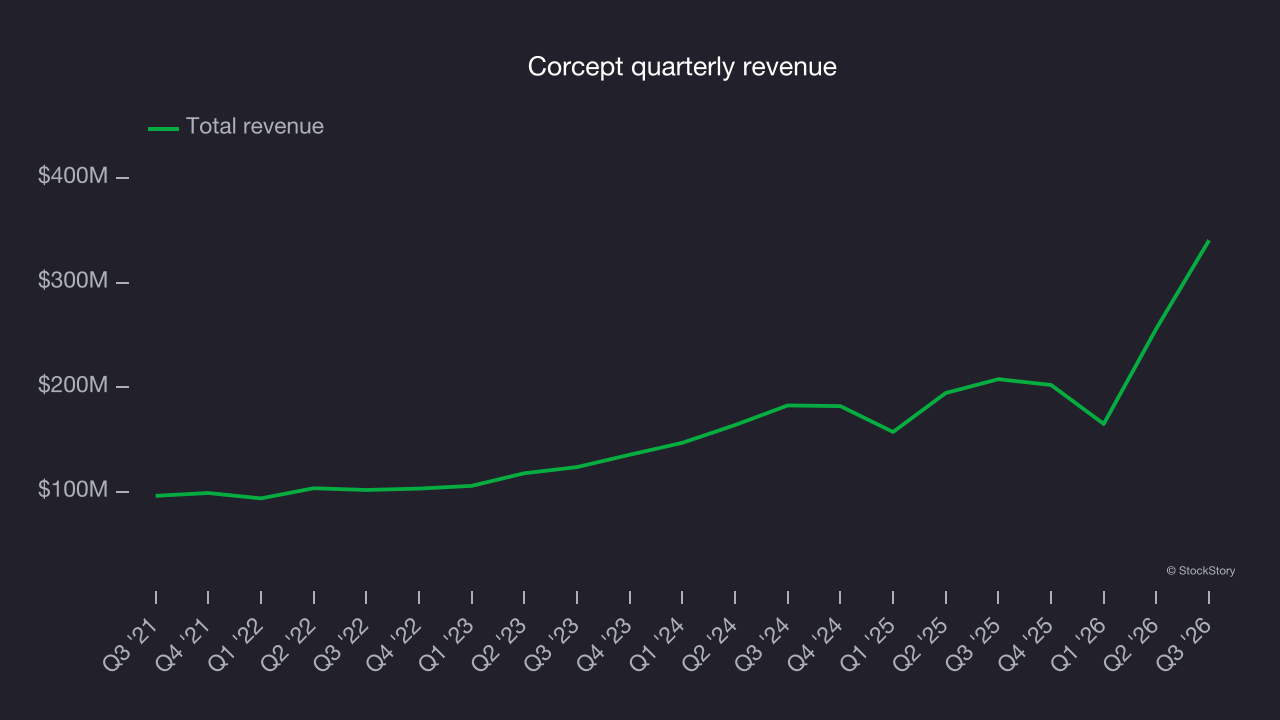
Long-term growth is the most important, but within healthcare, a half-decade historical view may miss new innovations or demand cycles. Corcept’s annualized revenue growth of 23.8% over the last two years is above its five-year trend, suggesting its demand was strong and recently accelerated. 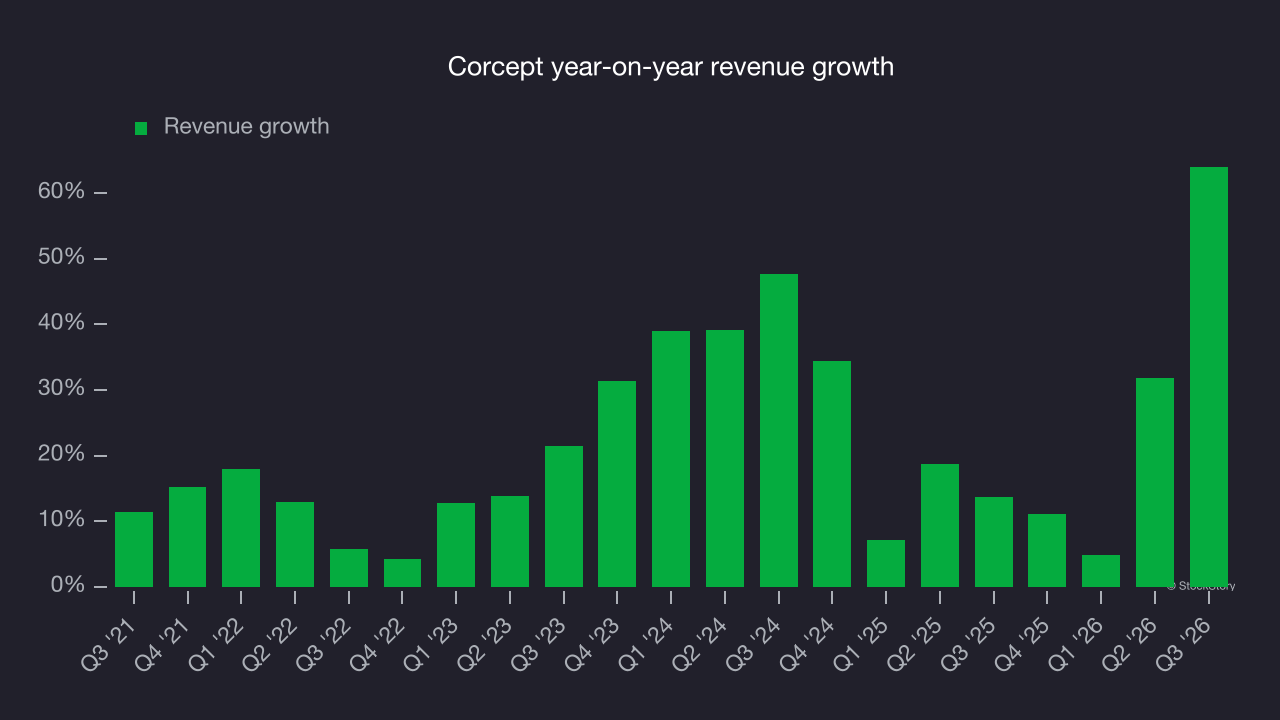
This quarter, Corcept reported year-on-year revenue growth of 64%, and its $340.5 million of revenue beat Wall Street’s consensus estimates by 1.9%.
Looking ahead, sell-side analysts expect revenue to grow 55.9% over the next 12 months, according to S&P, an improvement versus the last two years. This projection implies its newer products and services will spur better revenue performance.
Adjusted operating margin
Corcept has been an efficient company over the last five years. It was one of the more profitable businesses in the healthcare sector, with an average adjusted operating margin of 26.6%.
Corcept’s adjusted operating margin decreased by 23.5 percentage points over the last five years. The company’s two-year trajectory also shows it failed to restore profitability to its peak as its margin fell by 12.9 percentage points. This poor performance shows its expenses were rising and it couldn’t pass those costs on to its customers.
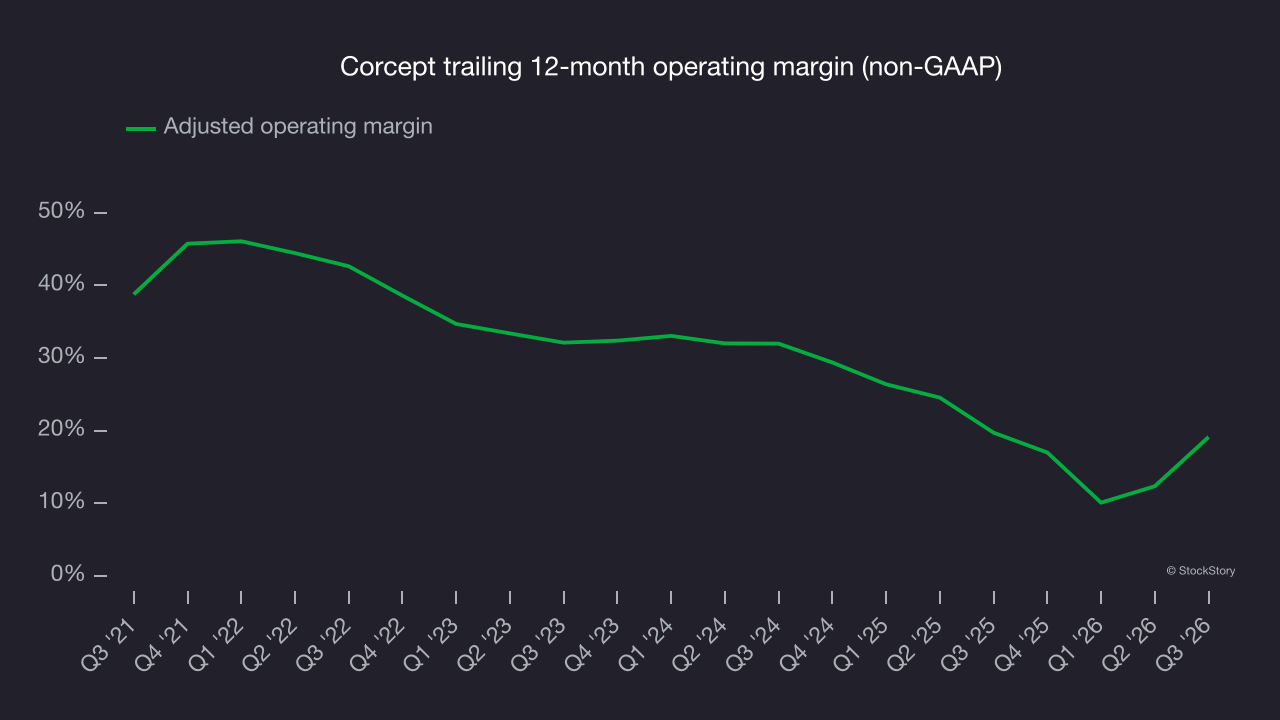
In Q3, Corcept reported an adjusted operating margin of 33.7%, up 17.8 percentage points year on year. This increase was a positive development and shows it was more efficient.
Earnings per share
Revenue trends explain a company’s historical growth, but the long-term change in earnings per share (EPS) points to the profitability of that growth. For example, a company could inflate its revenue through excessive spending on advertising and promotions.
Corcept’s EPS grew at a solid 8.7% compounded annual growth rate over the last five years. However, this performance trailed its 22.3% annualized revenue growth, indicating the company became less profitable on a per-share basis as it expanded due to non-fundamental factors such as interest expenses and taxes.
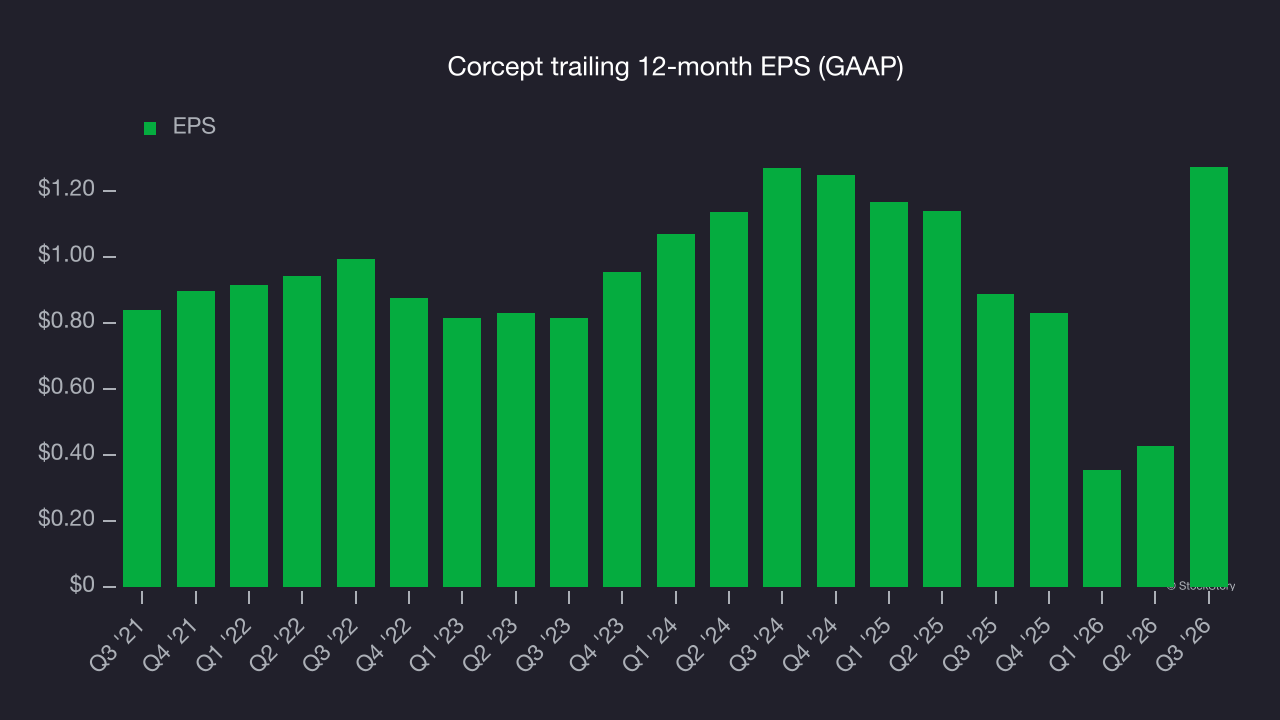
A closer look at Corcept’s earnings helps explain the drivers of its performance. As mentioned earlier, Corcept’s adjusted operating margin expanded this quarter but declined by 23.5 percentage points over the last five years. This was the most relevant factor (aside from the revenue impact) behind its lower earnings; interest expenses and taxes can also affect EPS but don’t tell us as much about a company’s fundamentals.
In Q3, Corcept reported EPS of $1.01, up from $0.16 in the same quarter last year. EPS beat analysts’ consensus estimates by a wide margin, a positive result for shareholders. Over the next 12 months, Wall Street expects Corcept’s full-year EPS to grow 253% from $1.27 to $4.49, according to S&P.
Key takeaways from Corcept’s Q3 results
Corcept delivered a decent Q3, with revenue and EPS both beating analysts’ consensus estimates. But investors were likely hoping for more, as shares tumbled 5% to $77.97 immediately after the results.
Corcept’s latest quarter is only one part of assessing its longer-term business quality. Quality, combined with valuation, can help determine whether the stock is a buy. For more on Corcept, read our full research report here (it’s free).