Retirement solutions provider Jackson Financial (NYSE: JXN) missed Wall Street’s revenue expectations in Q3 2026, but revenue rose 7.5% year on year to $1.54 billion. Its non-GAAP profit of $7.67 per share was 5.9% above analysts’ consensus estimates.
For more on Jackson Financial, read our free full research report.
Jackson Financial (JXN) Q3 2026 highlights:
- Net premiums earned $33 million
- Revenue $1.54 billion vs S&P analysts’ consensus estimates of $2.06 billion (7.5% year-on-year growth, 25% miss)
- Pre-tax profit $1 billion (64.9% margin)
- Adjusted EPS $7.67 vs S&P analysts’ consensus estimates of $7.24 (5.9% beat)
- Market capitalization $9.32 billion
Don Cummings, Chief Executive Officer and President of Jackson, stated, “Our third quarter results reflect the strength of our business and consistent execution against our strategy. We grew adjusted operating earnings per share, while delivering record retail annuity sales, up 22% year over year. Our distribution reach will be further enhanced by our recent announcement that Jackson has been named the exclusive provider of annuities for AARP members through the AARP® Annuity Program from Jackson®. Through this program, a distinct set of Jackson annuities will be available directly to millions of AARP members, helping them pursue long-term financial stability. Our spread business continues to perform well, driven by our broad, flexible product lineup, the enhanced capabilities of PPM, and our growing partnership with TPG. Our robust in-force book of business delivered substantial progress toward our financial targets, with $281 million of free capital generation in the third quarter, $291 million of capital return to common shareholders, and healthy levels of excess cash at the holding company. We believe we are well positioned for the future and remain committed to helping Americans achieve financial freedom for life.”
Revenue growth
Insurers earn revenue three ways. The core insurance business itself, often called underwriting and represented in the income statement as premiums earned, is one way. Investment income from investing the “float” (premiums collected upfront not yet paid out as claims) in assets such as fixed-income assets and equities is the second way. Fees from various sources such as policy administration, annuities or other value-added services are the third. Over the last five years, Jackson Financial grew its revenue at a mediocre 7.3% compounded annual growth rate, falling short of our benchmark for the insurance sector.
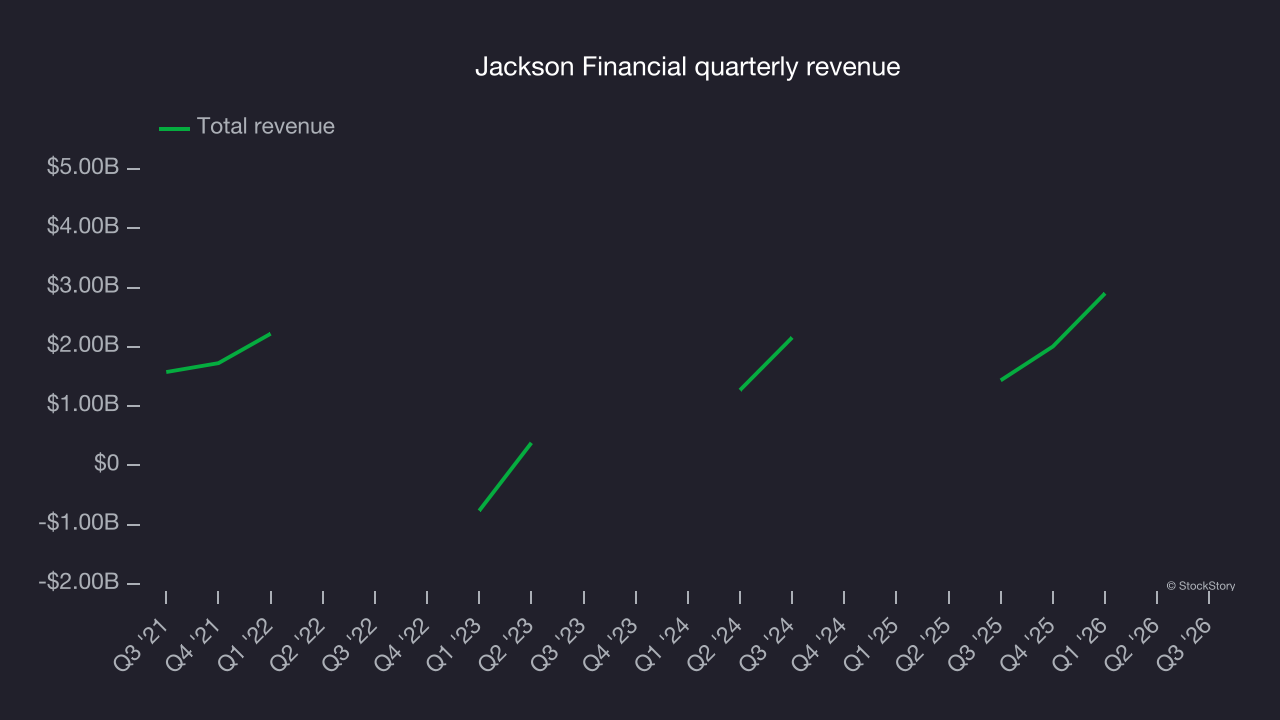
Note: Quarters not shown were determined to be outliers because they were impacted by outsized investment gains/losses that are not indicative of the recurring fundamentals of the business.Long-term growth is the most important, but within financials, a half-decade historical view may miss recent interest rate changes and market returns. Jackson Financial’s performance shows it grew in the past but relinquished its gains over the last two years, as its revenue fell by 7.1% annually.
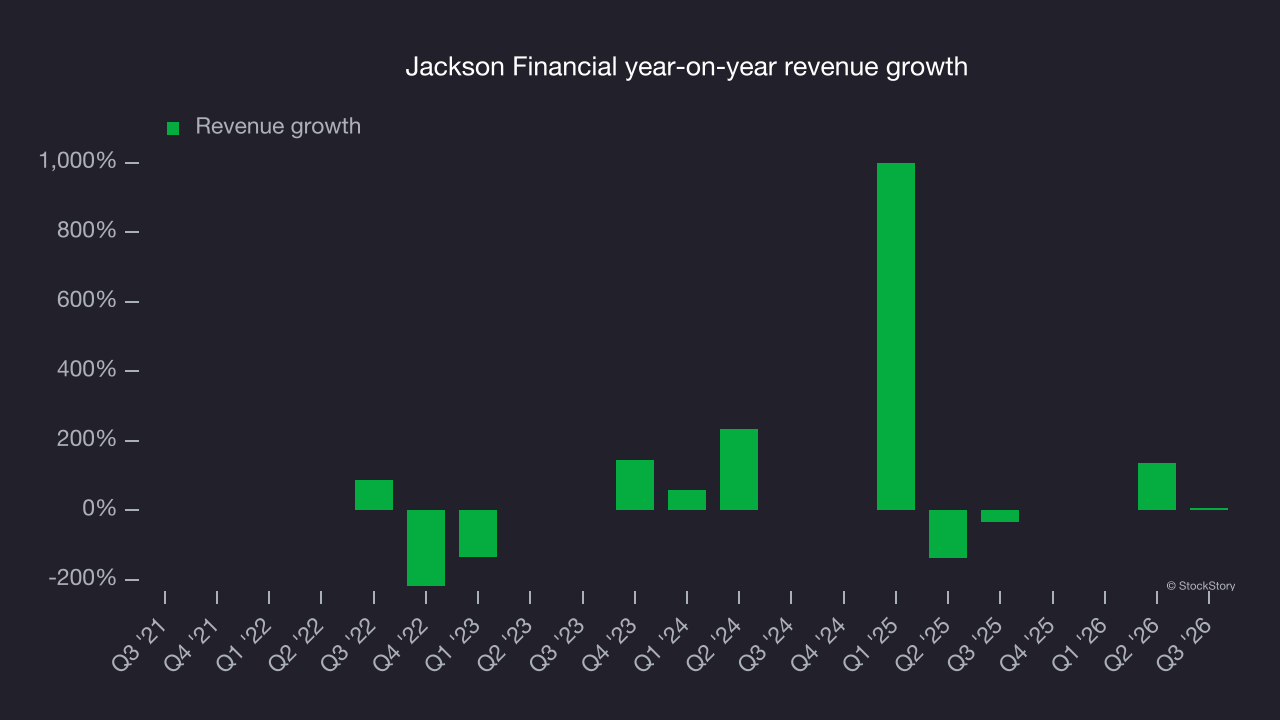
Note: Quarters not shown were determined to be outliers because they were impacted by outsized investment gains/losses that are not indicative of the recurring fundamentals of the business.
This quarter, Jackson Financial’s revenue grew by 7.5% year on year to $1.54 billion, missing Wall Street’s consensus estimates.
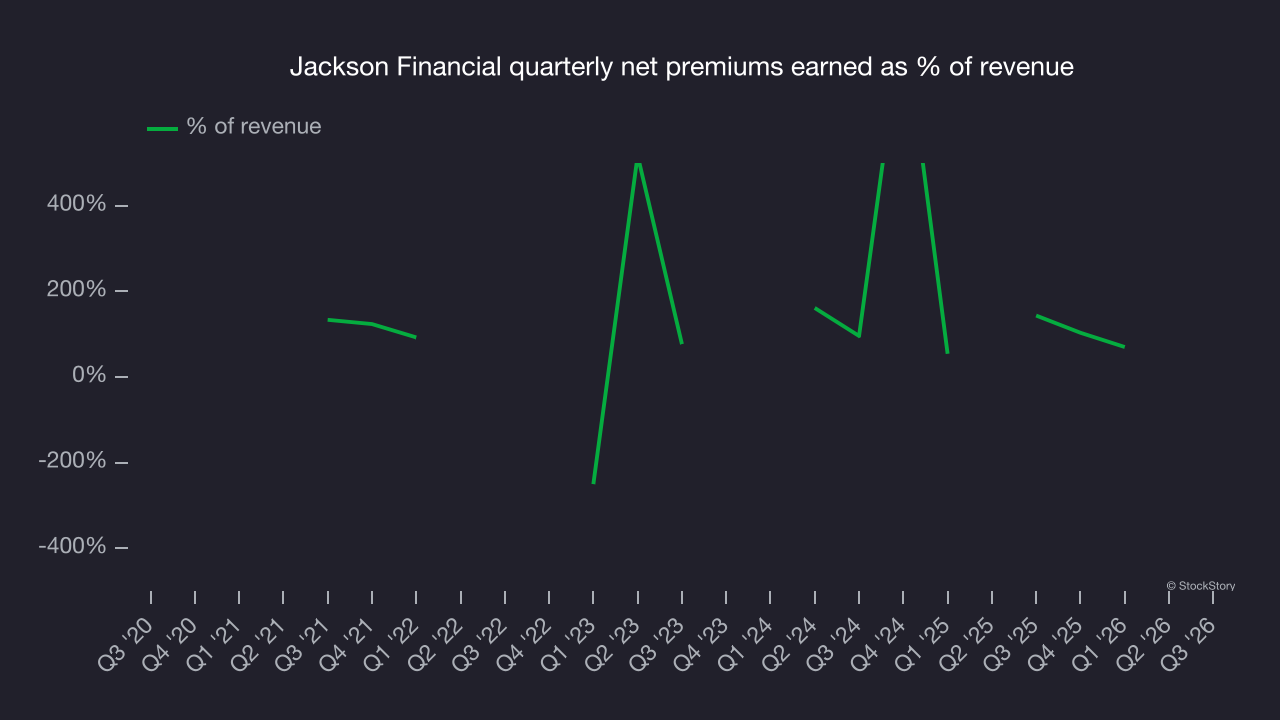
Since the company recorded losses on certain securities, it generated more net premiums earned than revenue (a 1.3x multiple of its revenue to be exact) during the last five years, meaning Jackson Financial depends heavily on its underwriting activities because non-insurance operations contribute little.
Note: Quarters not shown were determined to be outliers because they were impacted by outsized investment gains/losses that are not indicative of the recurring fundamentals of the business.
While insurers generate revenue from multiple sources, investors view net premiums earned as the cornerstone, as their direct link to core operations stands in sharp contrast to the unpredictability of investment returns and fees.
Net premiums earned
Net premiums earned are net of what’s paid to reinsurers (insurance for insurance companies), which are used by insurers to protect themselves from large losses.
Jackson Financial’s net premiums earned have declined by 4.8% annually over the last five years, much worse than the broader insurance industry. This shows that policy underwriting underperformed its other business lines.
Jackson Financial’s net premiums earned continued to decline over the last two years, with income dropping by 13% annually. Net premiums earned trailed total revenue over this period, indicating that insurance policies detracted from consolidated growth.
Jackson Financial’s net premiums earned $33 million this quarter.
Key takeaways from Jackson Financial’s Q3 results
While Jackson Financial missed Q3 revenue expectations, its non-GAAP EPS beat Wall Street's estimates. Overall, this was a mixed quarter. The stock traded up 1.7% to $143.06 immediately following the results.
The latest quarter matters when deciding whether to buy the stock, but not nearly as much as longer-term fundamentals and valuation. For more on those factors, read the full research report here (it’s free).