Building systems company Limbach (NASDAQ: LMB) reported Q3 2026 results beating Wall Street’s revenue expectations, with revenue up 24.9% year on year to $230.5 million. On the other hand, the company’s full-year revenue guidance of $775 million at the midpoint came in 3.1% below analysts’ consensus estimates. Its non-GAAP profit of $1.37 per share was 13.1% above analysts’ consensus estimates.
For more on Limbach, read our free full research report.
Limbach (LMB) Q3 2026 highlights:
- Revenue $230.5 million vs S&P analysts’ consensus estimates of $218.6 million (24.9% year-on-year growth, 5.4% beat)
- Adjusted EPS $1.37 vs S&P analysts’ consensus estimates of $1.21 (13.1% beat)
- Adjusted EBITDA $27.4 million vs analysts’ consensus estimates of $24.78 million (11.9% margin, 10.6% beat)
- Revenue guidance The company reconfirmed its revenue guidance for the full year of $775 million at the midpoint
- EBITDA guidance $81 million at the midpoint for the full year, in line with analysts’ consensus expectations
- Operating margin 6.5%, down from 7.6% in the same quarter last year
- Free cash flow margin 8.5%, up from 7% in the same quarter last year
- Market capitalization $559.6 million
“Our third-quarter results reflect improving customer activity and a return to organic growth in our owner-direct business,” said Michael McCann, President and Chief Executive Officer of Limbach. “We believe some of the project timing issues we discussed earlier this year are beginning to ease, giving us a clearer view of the work ahead. With the improvement in our core business and contributions from two acquisitions completed during the quarter, CYMCOR, Inc. (“CYMCOR”) and 1901 Inc. (“1901”), we are tracking at or near the high end of our revenue and Adjusted EBITDA guidance ranges.
Revenue growth
Reviewing a company’s long-term revenue performance reveals insights into its quality. Any business can report a good quarter or two, but many enduring ones grow for years. Limbach’s 8.1% annualized revenue growth over the last five years was decent. Its growth was slightly above the average industrials company and shows its offerings resonate with customers.
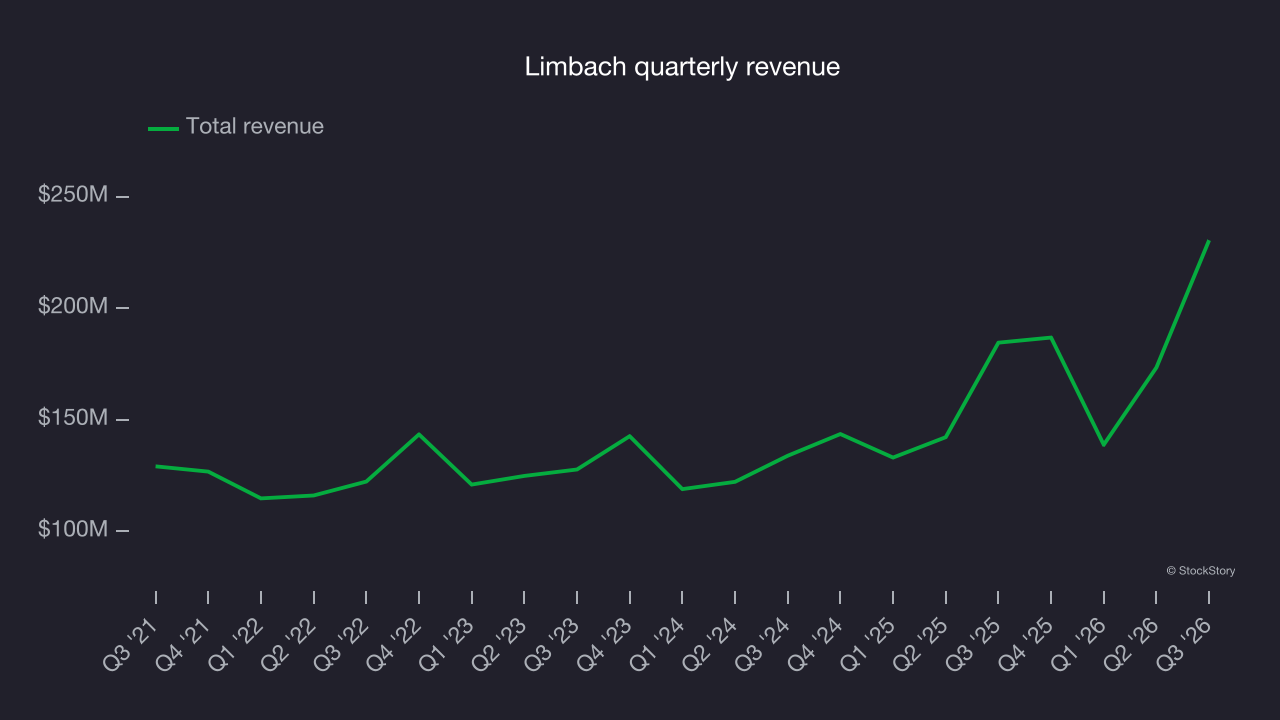
Long-term growth is the most important, but within industrials, a half-decade historical view may miss new industry trends or demand cycles. Limbach’s annualized revenue growth of 18.7% over the last two years is above its five-year trend, suggesting its demand recently accelerated.
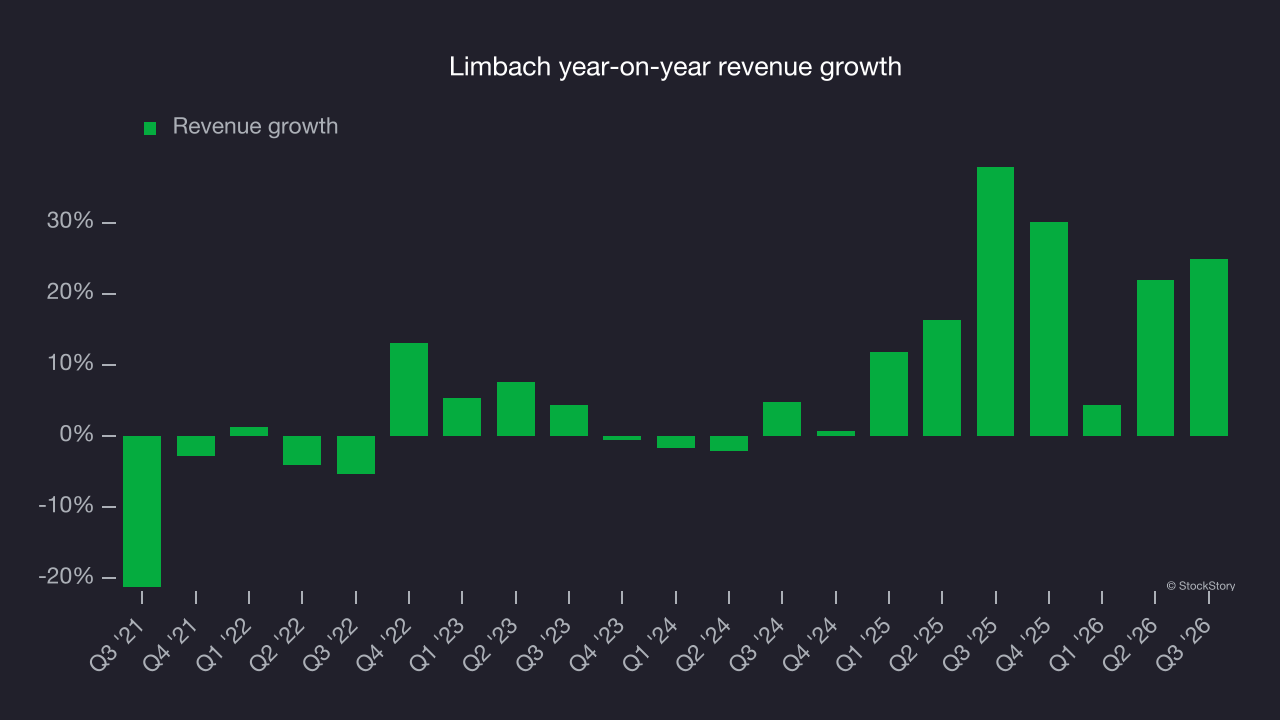
This quarter, Limbach reported strong year-on-year revenue growth of 24.9%, and its $230.5 million of revenue topped Wall Street’s consensus estimates by 5.4%.
Looking ahead, sell-side analysts expect revenue to grow 23.9% over the next 12 months, according to S&P, an improvement versus the last two years. This strong projection implies its newer products and services will spur faster revenue growth.
Operating margin
Operating margin is one of the best measures of profitability because it tells us how much money a company takes home after procuring and manufacturing its products, marketing and selling those products and keeping them relevant through research and development.
Limbach was profitable over the last five years but held back by its large cost base. Its average operating margin of 6% was weak for an industrials business. That outcome is unsurprising given its low gross margin baseline.
On the positive side, Limbach’s operating margin rose by 2.7 percentage points over the last five years, as its revenue growth provided operating leverage.
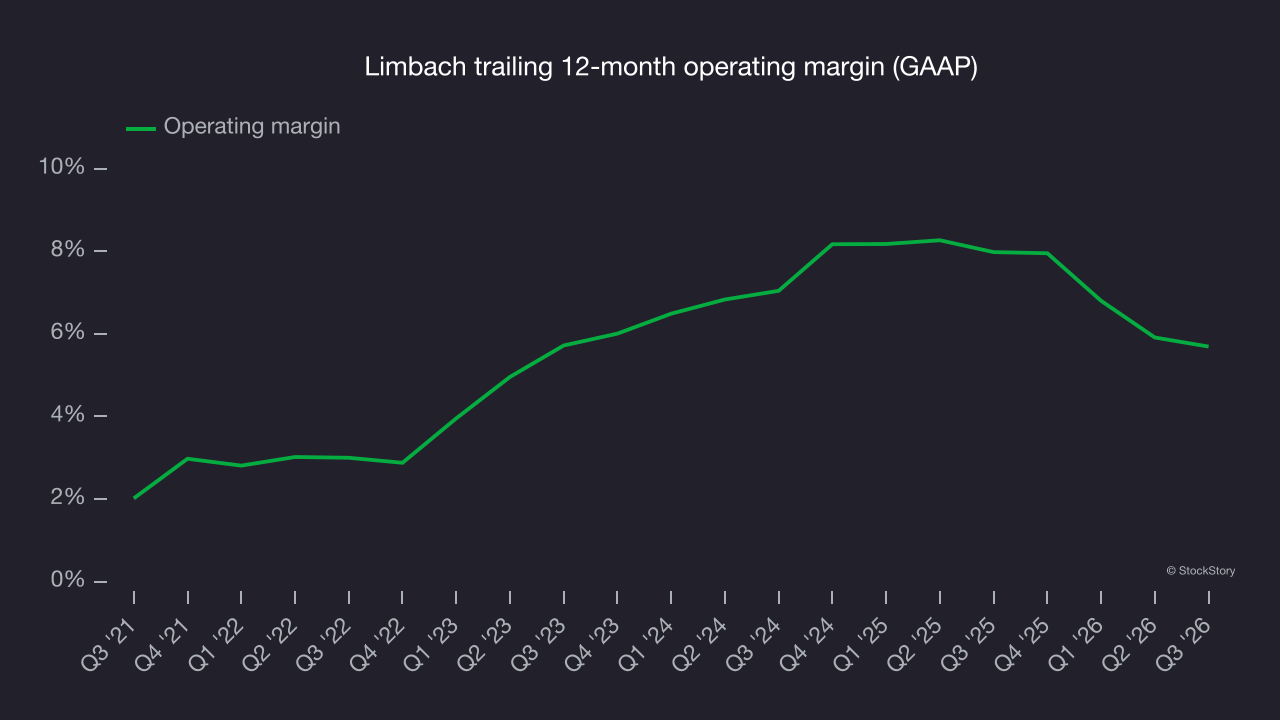
This quarter, Limbach generated an operating margin of 6.5%, down 1 percentage point year on year. Its operating margin decreased more than its gross margin, suggesting it was less efficient because expenses such as marketing, research and development and administrative overhead increased.
Earnings per share
We track the long-term change in earnings per share (EPS) for the same reason as long-term revenue growth. Compared to revenue, however, EPS highlights whether a company’s growth is profitable.
Limbach’s EPS grew at a 56.3% compounded annual growth rate over the last five years, higher than its 8.1% annualized revenue growth. This indicates the company became more profitable on a per-share basis as it expanded.
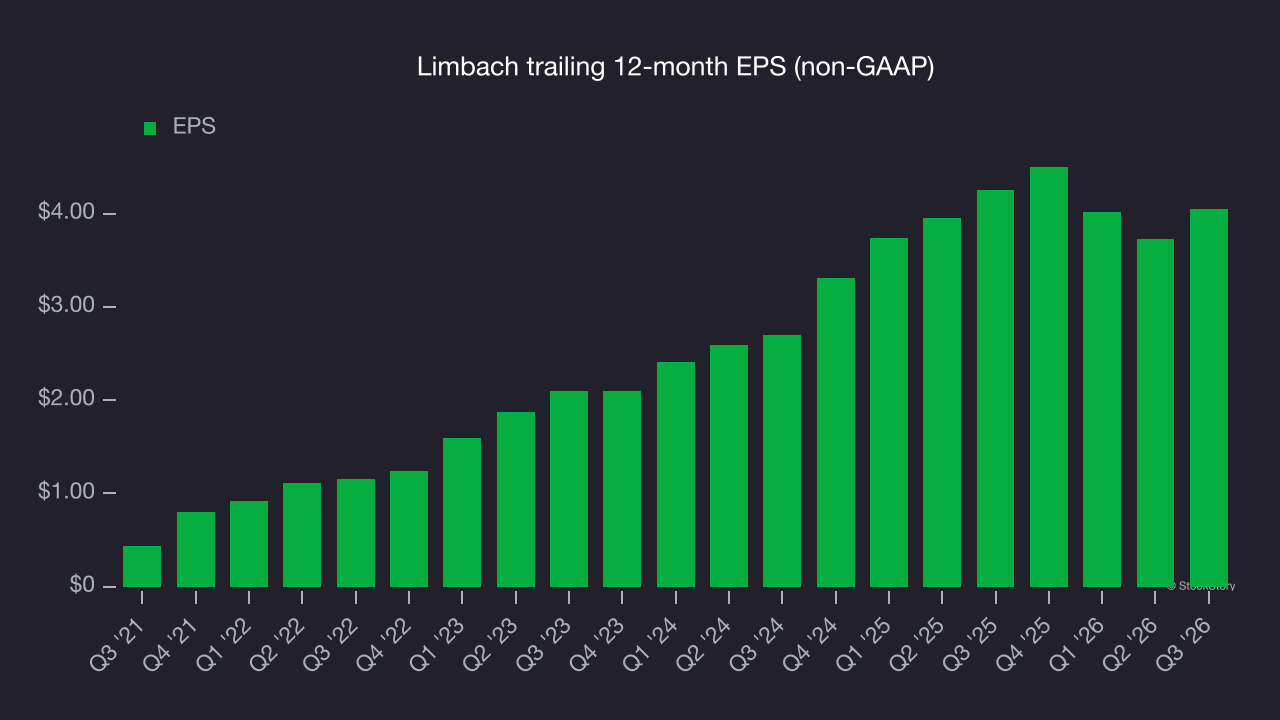
We can take a deeper look into Limbach’s earnings to better understand the drivers of its performance. As we mentioned earlier, Limbach’s operating margin declined this quarter but expanded by 2.7 percentage points over the last five years. This was the most relevant factor (aside from the revenue impact) behind its higher earnings; interest expenses and taxes can also affect EPS but don’t tell us as much about a company’s fundamentals.
As with revenue, we analyze EPS over a more recent period because it can provide insight into an emerging theme or development for the business.
Limbach’s two-year annual EPS growth of 22.6% was lower than its five-year trend but still a good pace.
In Q3, Limbach reported adjusted EPS of $1.37, up from $1.05 in the same quarter last year. EPS comfortably topped analysts’ consensus estimates, a positive result for shareholders. Over the next 12 months, Wall Street expects Limbach’s full-year EPS to grow 6% from $4.05 to $4.29, according to S&P.
Key takeaways from Limbach’s Q3 results
Limbach delivered sizable beats on both EBITDA and revenue, topping analysts’ consensus estimates by wide margins. The quarter still had some key positives. Shares soared 18.5% to $59.12 immediately after the report.
Limbach had a solid quarter, but is the stock a buy? What happened in the latest quarter matters, but not as much as longer-term business quality and valuation when deciding whether to invest. For more on that, read the full research report here (it’s free).