Infrastructure construction company Primoris (NYSE: PRIM) fell short of the market’s revenue expectations in Q3 2026, with revenue falling 10.4% year on year to $1.95 billion. Its non-GAAP profit of $1.20 per share was 53.4% above analysts’ consensus estimates.
For more on Primoris, read our free full research report.
Primoris (PRIM) Q3 2026 highlights:
- Revenue $1.95 billion vs S&P analysts’ consensus estimates of $2.03 billion (10.4% year-on-year decline, 3.8% miss)
- Adjusted EPS $1.20 vs S&P analysts’ consensus estimates of $0.78 (53.4% beat)
- Adjusted EBITDA $134.4 million vs analysts’ consensus estimates of $94.46 million (6.9% margin, 42.3% beat)
- Adjusted EPS guidance Management lowered its full-year adjusted EPS guidance to $2.18 at the midpoint, a 6.5% decrease
- EBITDA guidance $300 million at the midpoint for the full year, above analysts’ consensus estimates of $278.8 million
- Operating margin 4.9%, down from 6.3% in the same quarter last year
- Free cash flow -$33.07 million, down from $148.4 million in the same quarter last year
- Backlog $14.07 billion at quarter end, up 27.2% year on year
- Market capitalization $3.97 billion
“Our third quarter results reflect meaningful progress in completing the renewable energy projects that have weighed on our margins this year, while highlighting the continued strength and resilience of the broader Primoris platform,” said Koti Vadlamudi, President and Chief Executive Officer of Primoris. “As the last of our six previously discussed challenged projects moves closer to completion, we are increasingly confident that these impacts are soon to be behind us and that Primoris is well positioned to capitalize on the significant opportunities ahead.”
Revenue growth
Examining a company’s long-term performance can provide clues about its quality. Any business can experience short-term success, but top-performing ones enjoy sustained growth for years. Over the last five years, Primoris grew its revenue at a strong 15% compounded annual growth rate. Its growth beat the average industrials company and shows its offerings resonate with customers.
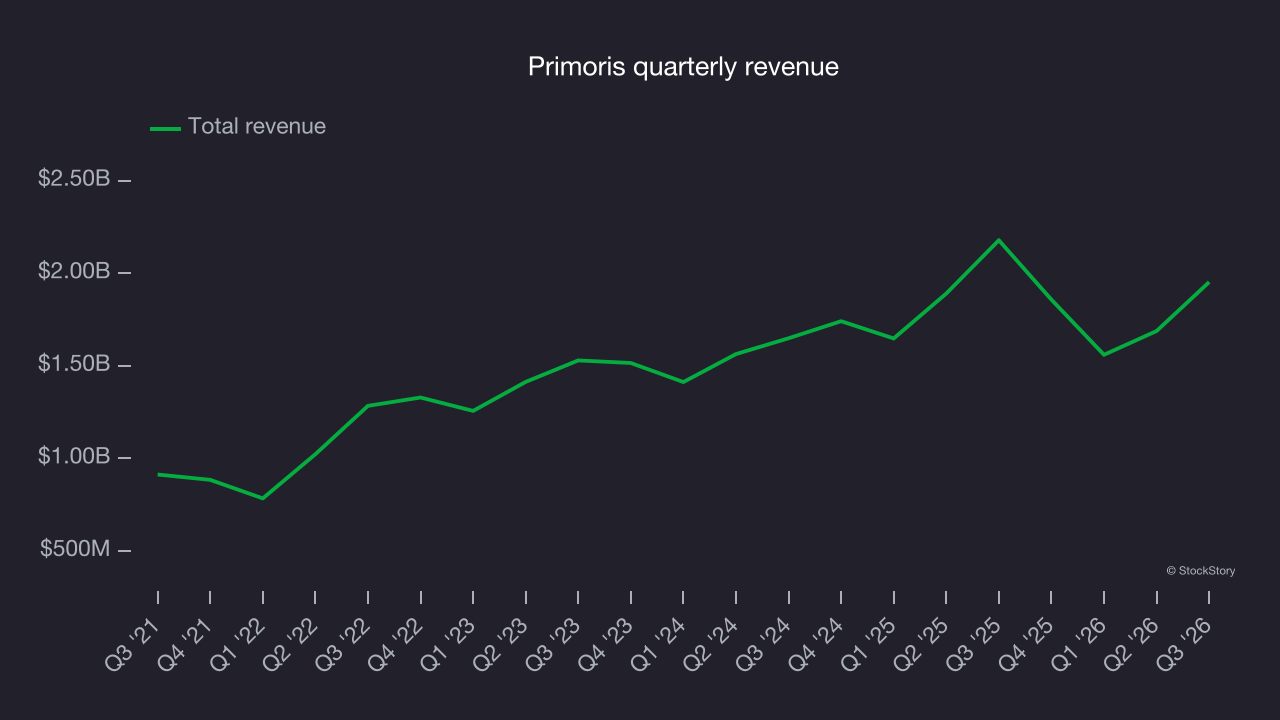
Long-term growth matters most, but within industrials, a half-decade historical view may miss cycles, industry trends or a company capitalizing on catalysts such as a new contract win or a successful product line. Primoris’s recent performance shows its demand has slowed significantly as its annualized revenue growth of 7.2% over the last two years was well below its five-year trend. 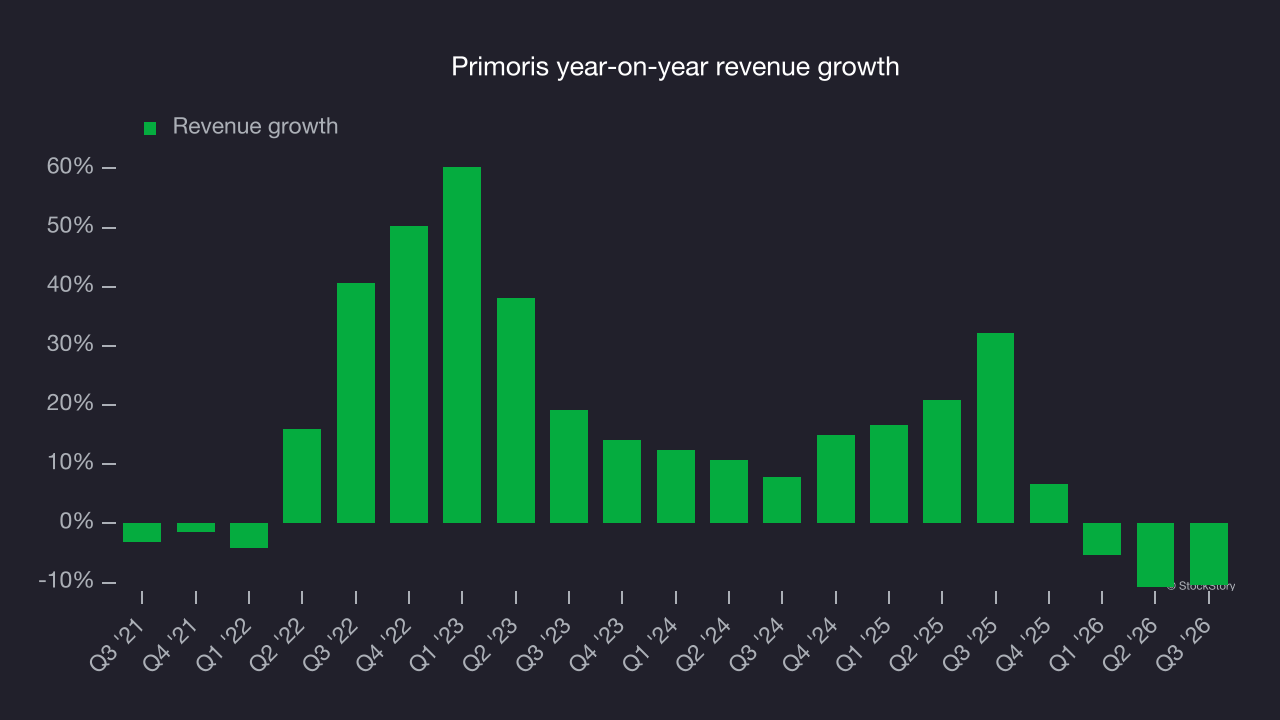
Analyzing the company’s backlog, or the value of its outstanding orders that have not yet been executed or delivered, offers a closer look at its revenue dynamics. Primoris’s backlog reached $14.07 billion in the latest quarter and averaged 68.6% year-on-year growth over the last two years. Backlog growth outpaced revenue growth, indicating that the company accumulated more orders than it could fulfill and deferred revenue to the future. This could imply elevated demand for Primoris’s products and services but raises concerns about capacity constraints. 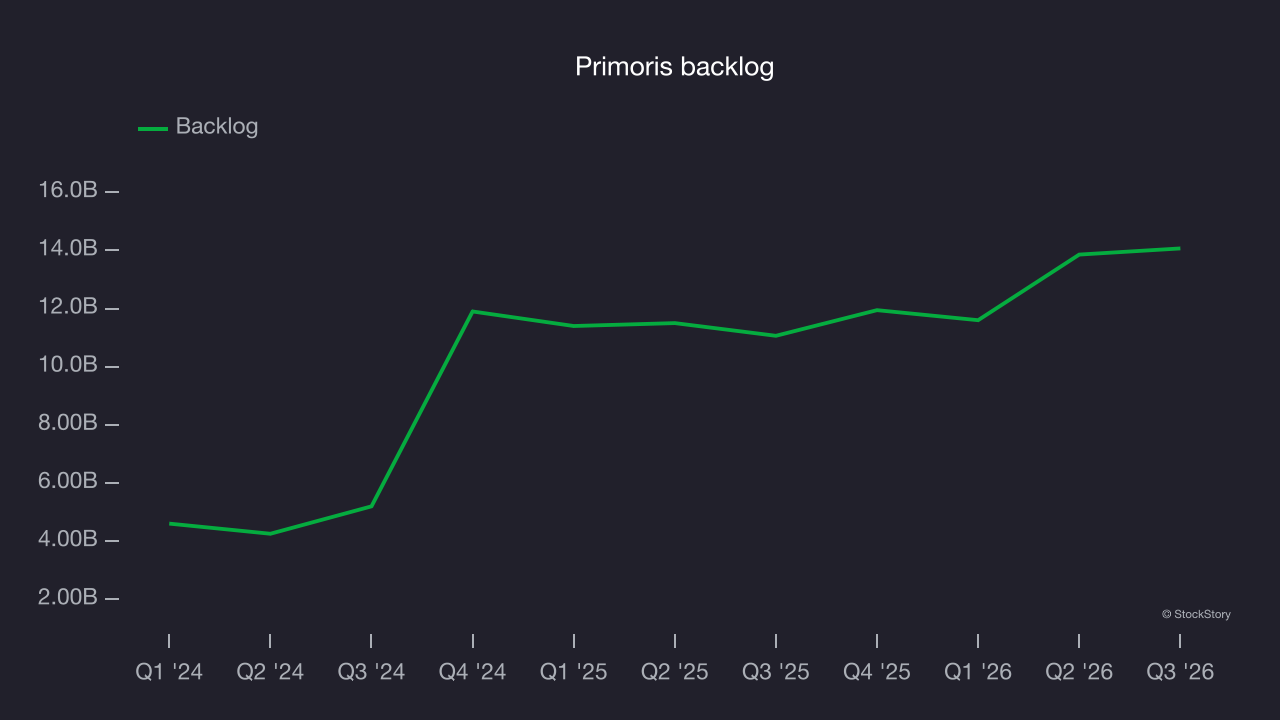
This quarter, Primoris missed Wall Street’s consensus estimates and reported an uninspiring 10.4% year-on-year revenue decline, generating $1.95 billion of revenue.
Looking ahead, sell-side analysts expect revenue to grow 14.2% over the next 12 months, according to S&P, an improvement versus the last two years. This favorable outlook suggests its newer products and services will fuel better revenue performance.
Operating margin
Operating margin is an important measure of profitability as it shows the portion of revenue left after accounting for all core expenses, including the cost of goods sold, advertising and wages. It’s also useful for comparing profitability across companies with different levels of debt and tax rates because it excludes interest and taxes.
Primoris was profitable over the last five years but held back by its large cost base. Its average operating margin of 4.3% was weak for an industrials business. That outcome is unsurprising given its low gross margin baseline.
Looking at the trend in its profitability, Primoris’s operating margin decreased by 1.9 percentage points over the last five years. This raises questions about the company’s expense base because its revenue growth should have given it leverage on its fixed costs, resulting in better economies of scale and profitability. Primoris’s poor performance shows that costs were rising and it couldn’t pass them on to its customers.
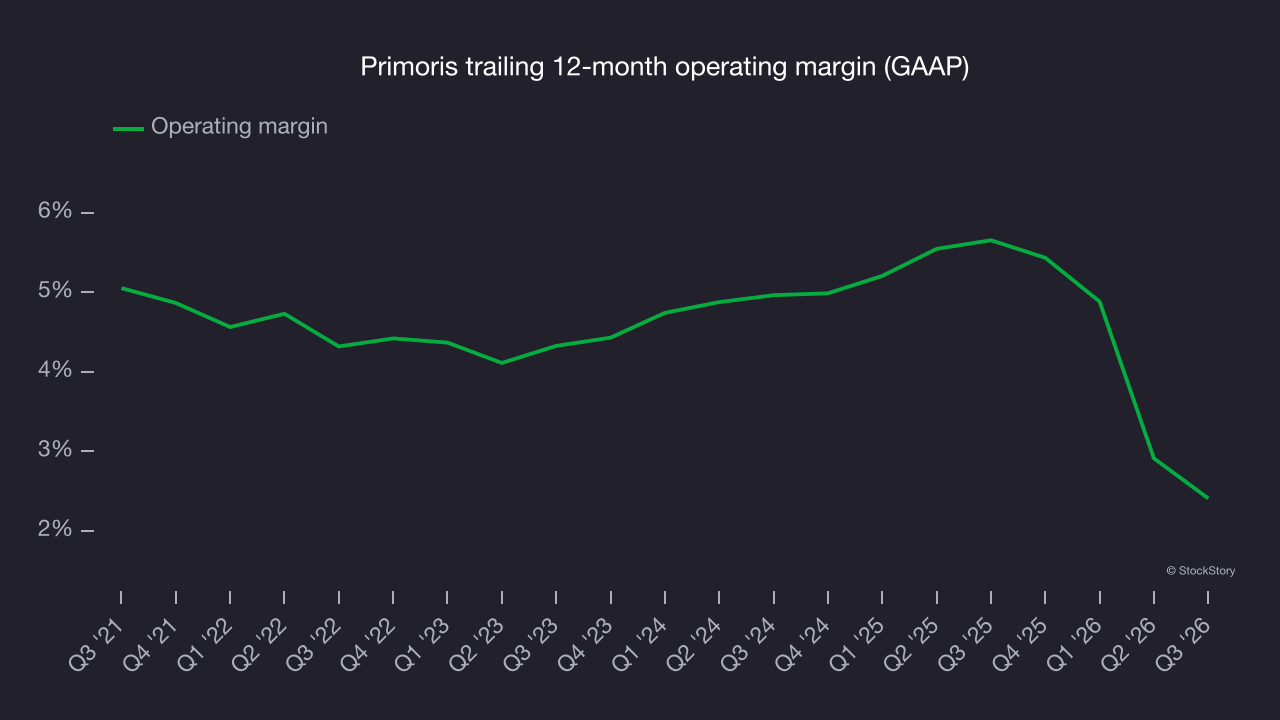
In Q3, Primoris generated an operating margin of 4.9%, down 1.4 percentage points year on year. Its operating margin decreased more than its gross margin, indicating lower efficiency as expenses such as marketing, R&D and administrative overhead increased.
Earnings per share
We track the long-term change in earnings per share (EPS) for the same reason as long-term revenue growth. Compared to revenue, however, EPS highlights whether a company’s growth is profitable.
Primoris’s EPS grew at a weak 1.7% compounded annual growth rate over the last five years, lower than its 15% annualized revenue growth. This tells us the company became less profitable on a per-share basis as it expanded.
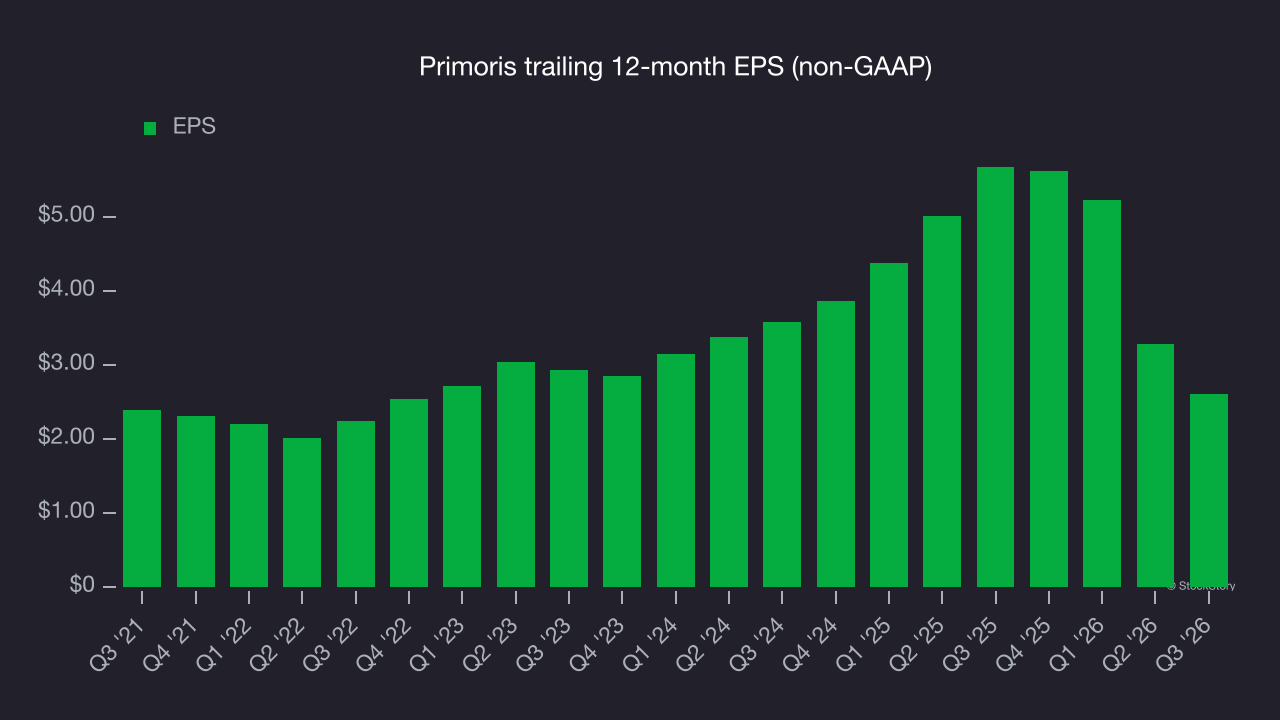
A closer look at Primoris’s earnings helps explain its performance. Primoris’s operating margin declined by 1.9 percentage points over the last five years. This was the most relevant factor (aside from the revenue impact) behind its lower earnings; interest expenses and taxes can also affect EPS but don’t tell us as much about a company’s fundamentals.
Like with revenue, we analyze EPS over a more recent period because it can provide insight into an emerging theme or development for the business.
For Primoris, its two-year annual EPS declines of 14.8% show it has continued to underperform. These were poor results.
In Q3, Primoris reported adjusted EPS of $1.20, down from $1.88 in the same quarter last year. Despite falling year on year, EPS came in well above analysts’ consensus estimates. Over the next 12 months, Wall Street expects Primoris’s full-year EPS to grow 79.6% from $2.60 to $4.67, according to S&P.
Key takeaways from Primoris’s Q3 results
Primoris delivered a decent quarter, with EPS above analysts’ consensus estimates and EBITDA beating Wall Street’s consensus by a wide margin. Revenue, however, missed expectations. Shares surged 8.3% to $86.25 immediately after the report.
Primoris had a solid quarterly earnings result, but is the stock a good investment at this price? The latest quarter is only one piece of the longer-term business quality picture. Quality, when combined with valuation, can help determine if the stock is a buy. For more on Primoris, read the full research report here (it’s free).