Artificial intelligence-powered lending platform Upstart (NASDAQ: UPST) reported revenue ahead of Wall Street’s expectations in Q3 2026, as revenue rose 33.7% year on year to $370.5 million. On the other hand, the company’s full-year revenue guidance of $1.35 billion at the midpoint came in 4.8% below analysts’ consensus estimates. Its GAAP profit of $0.33 per share was 44.1% above analysts’ consensus estimates.
For more on Upstart, read the full research report for free.
Upstart (UPST) Q3 2026 highlights:
- Revenue $370.5 million vs S&P analysts’ consensus estimates of $364.6 million (33.7% year-on-year growth, 1.6% beat)
- EPS (GAAP) $0.33 vs analysts’ consensus estimates of $0.23 (44.1% beat)
- Adjusted EBITDA $89.33 million vs analysts’ consensus estimates of $82.52 million (24.1% margin, 8.3% beat)
- Revenue guidance The company lowered its revenue guidance for the full year to $1.35 billion at the midpoint from $1.4 billion, a 3.6% decrease
- Operating margin 9.7%, up from 8.5% in the same quarter last year
- Free cash flow -$25.19 million compared to -$153.5 million in the previous quarter
- Market capitalization $2.07 billion
“Macro comes and goes, but alpha compounds,” said Paul Gu, co-founder and CEO of Upstart. “In Q3, our technology and marketing advances helped drive record Contribution Profit, our secured products reached positive Contribution Margin a quarter ahead of plan, and we supported platform growth with proportionately less equity capital. Macro is putting pressure on our near-term outlook, but the progress we’re making gives me more confidence than ever in Upstart’s long-term potential.”
Revenue growth
A company’s long-term performance is an indicator of its overall quality. Any business can deliver a good quarter or two, but the best consistently grow over the long term. Over the last five years, Upstart grew its revenue at a 16.3% annual rate. Though this growth is acceptable on an absolute basis, evaluating the software sector requires more than just revenue growth, given its potential for significant earnings volatility. The bar for the sector is particularly high, reflecting the non-essential and hit-driven nature of the products and services offered. Additionally, the five-year compound annual growth rate covers a period starting around Covid, when revenue was depressed and then rebounded. Still, there are other things to like about Upstart.
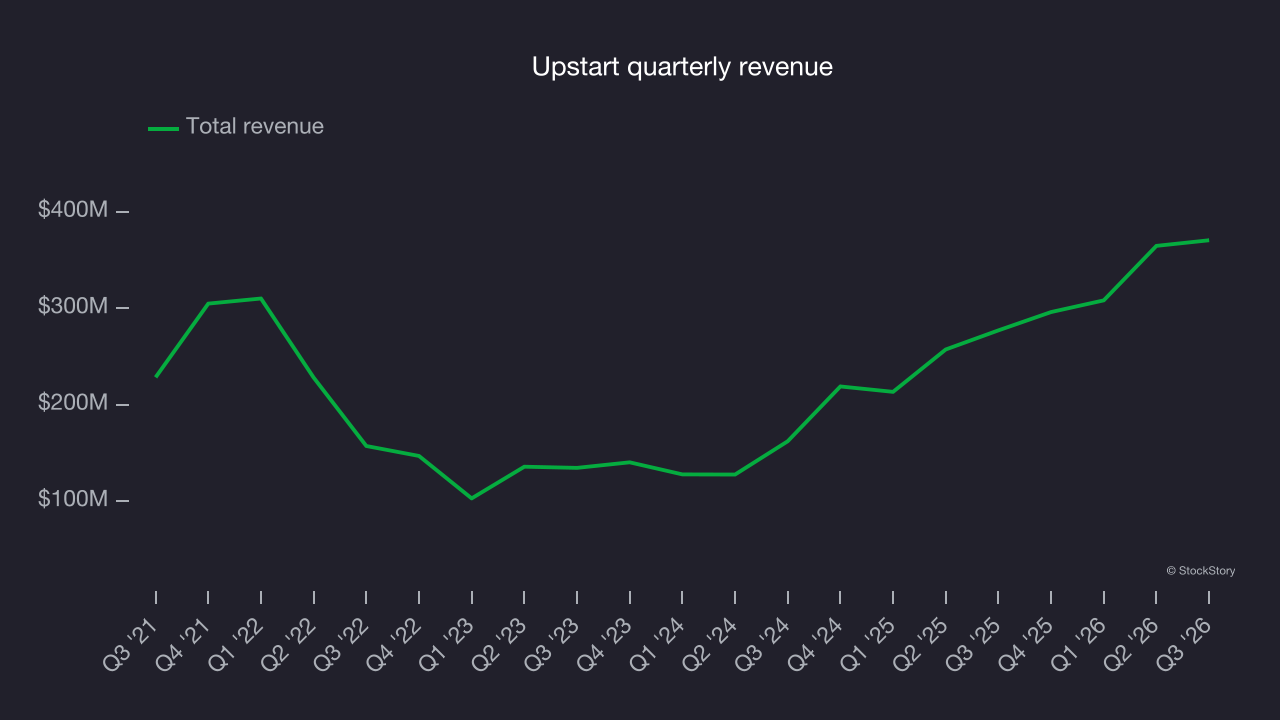
Long-term growth is the most important, but within software, a half-decade historical view may miss new innovations or demand cycles. Upstart’s annualized revenue growth of 55% over the last two years is above its five-year trend, suggesting its demand recently accelerated.
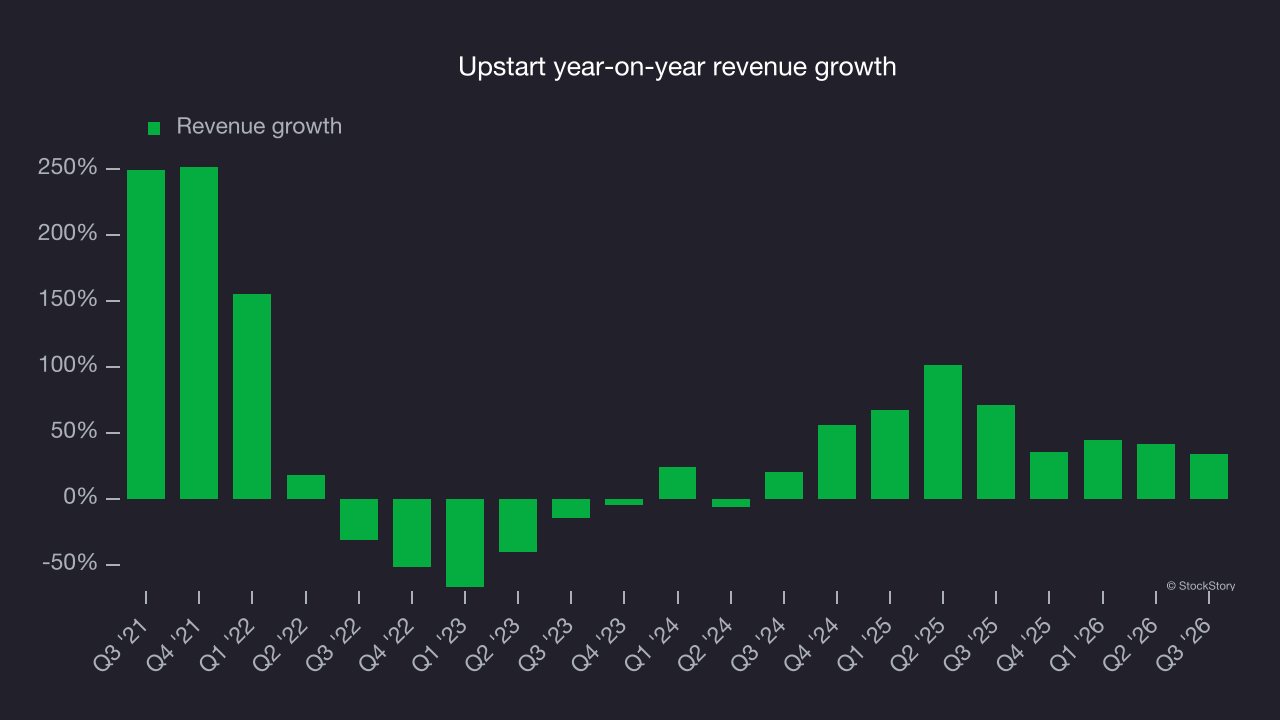
This quarter, Upstart reported strong year-on-year revenue growth of 33.7%, and its $370.5 million of revenue exceeded Wall Street’s consensus estimates by 1.6%.
Looking ahead, sell-side analysts expect revenue to grow 29.4% over the next 12 months, according to S&P, a deceleration versus the last two years. Still, the outlook is positive and indicates the market sees success for its products and services.
Total transaction volume
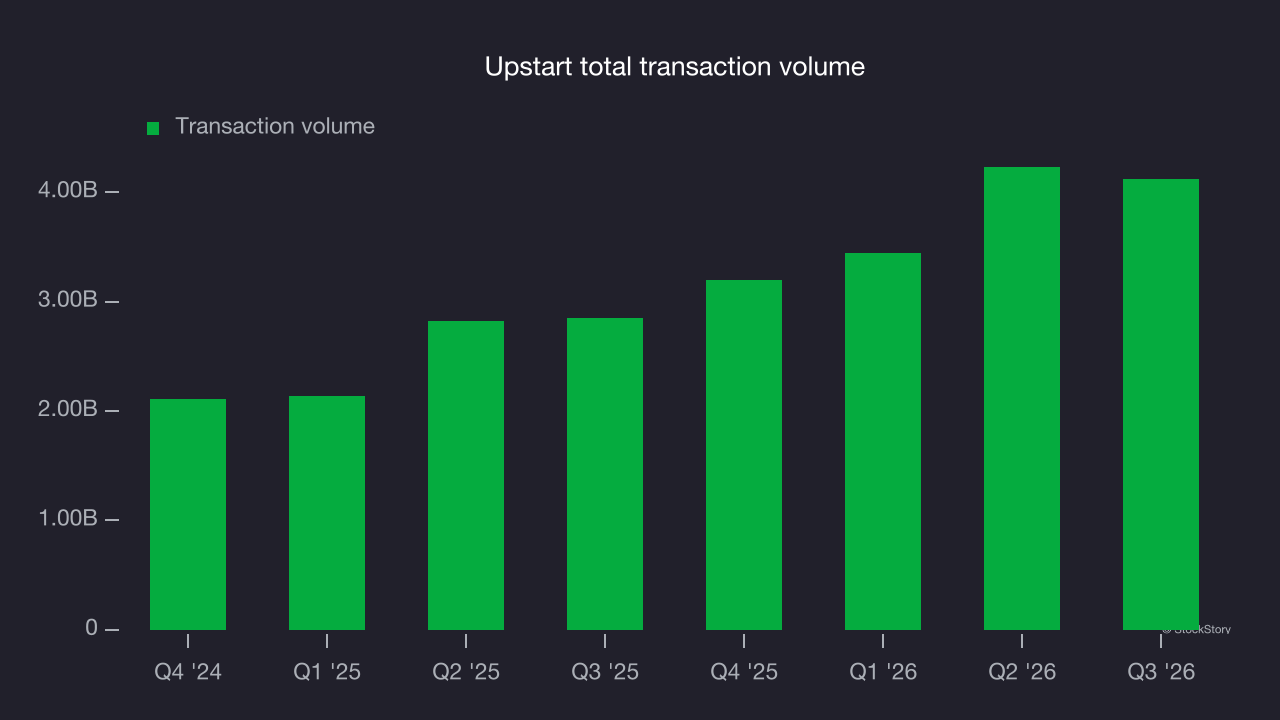
Total transaction volumes show the aggregate dollar value of loans processed on Upstart’s platform. This is the number from which the company will ultimately collect fees, and the higher it is, the more accurate its software becomes at assessing credit risk.
Upstart’s transaction volume totaled $4.12 billion in Q3, and over the last four quarters, its growth was strong, averaging 51.8% year-on-year increases. This alternative revenue metric grew faster than total revenue, meaning its loan processing fees outpaced the interest income from loans retained on its balance sheet. If this trend continues, it would lower Upstart’s risk profile by reducing its exposure to delinquencies and defaults.
Customer acquisition efficiency
The customer acquisition cost, or CAC, payback period measures the months a company needs to recoup the money spent on acquiring a new customer. This metric helps assess how quickly a business can break even on its sales and marketing investments.
Upstart is highly efficient at acquiring new customers, and its CAC payback period was 16.4 months this quarter. The company’s rapid recovery of its customer acquisition costs indicates it has a highly differentiated product offering and a strong brand reputation. These dynamics give Upstart more resources to pursue new product initiatives while maintaining the flexibility to increase its sales and marketing investments.
Key takeaways from Upstart’s Q3 results
Upstart topped analysts’ consensus revenue estimates in Q3, but its full-year revenue guidance fell short, making for a mixed quarter overall. Shares surged 5.4% to $22.46 immediately after the report.
Upstart’s latest quarter is only one piece of the longer-term business quality picture. Quality, combined with valuation, can help determine whether the stock is a buy at its current price. Read the full research report here for more on those factors (it’s free).