Cloud computing and online retail behemoth Amazon (NASDAQ: AMZN) reported Q1 CY2026 results beating Wall Street’s revenue expectations, with sales up 16.6% year on year to $181.5 billion. On top of that, next quarter’s revenue guidance ($196.5 billion at the midpoint) was surprisingly good and 4% above what analysts were expecting. Its GAAP profit of $2.78 per share was 68.2% above analysts’ consensus estimates.
Is now the time to buy Amazon? Find out by accessing our full research report, it’s free.
Amazon (AMZN) Q1 CY2026 Highlights:
- Revenue: $181.5 billion vs analyst estimates of $177.3 billion (2.4% beat)
- Amazon Web Services Revenue: $37.6 billion vs analyst estimates of $36.6 billion (2.6% beat)
- Advertising Revenue: $17.24 billion vs analyst estimates of $16.87 billion (2.2% beat)
- EPS (GAAP): $2.78 vs analyst estimates of $1.65 (68.2% beat)
- Operating Margin: 13.1%, up from 11.8% in the same quarter last year
- Free Cash Flow Margin: -10%, down from -4.7% in the same quarter last year
- Market Capitalization: $2.79 trillion
“We’re making customers’ lives easier and better every day across all our businesses, and their response is driving significant growth,” said Andy Jassy, President and CEO, Amazon.
Revenue Growth
Amazon shows that fast growth and massive scale can coexist despite conventional wisdom. The company’s revenue base of $419.1 billion five years ago has increased to $742.8 billion in the last year, translating into an excellent 12.1% annualized growth rate.
Over the same period, Amazon’s big tech peers Alphabet, Microsoft, and Apple put up annualized growth rates of 16.5%, 14.8%, and 7.6%, respectively. Comparing the four is relevant because investors often pit them against each other to derive their valuations. When adjusting for these benchmarks, we think Amazon’s price is fair. 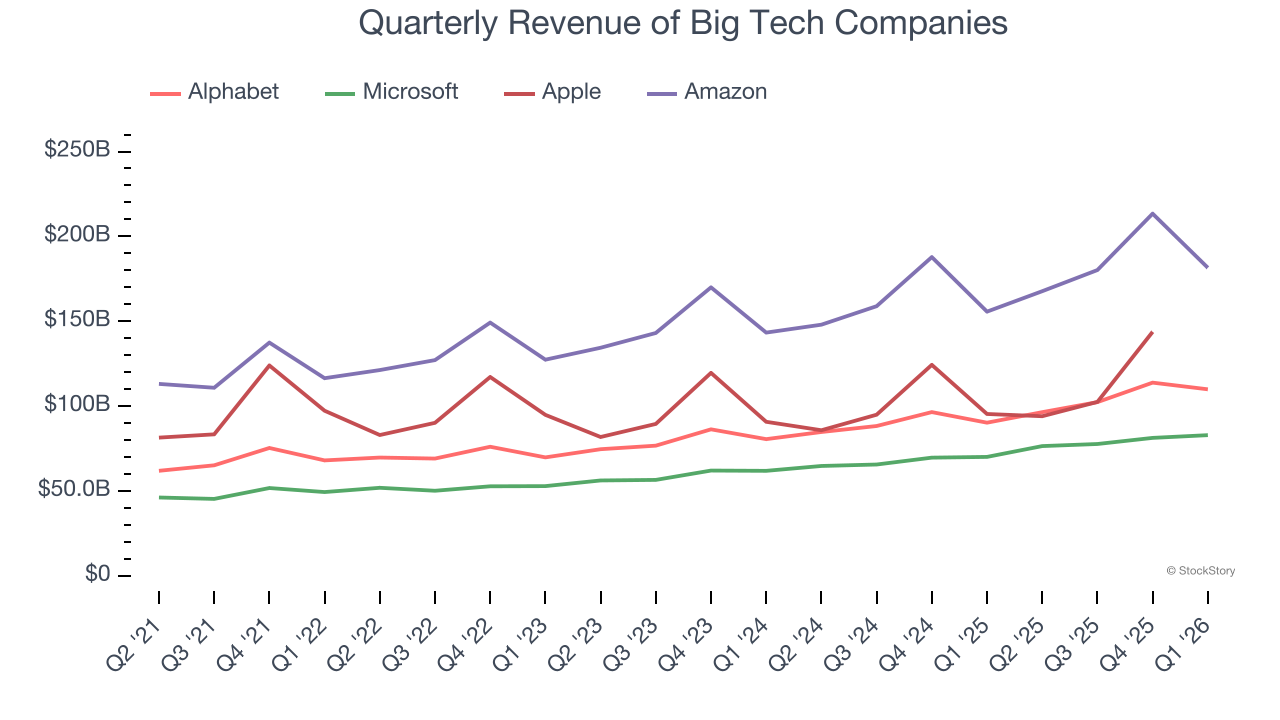
We at StockStory emphasize long-term growth, but for big tech companies, a half-decade historical view may miss emerging trends in AI. Amazon’s annualized revenue growth of 12.1% over the last two years aligns with its five-year trend, suggesting its demand was predictably strong. 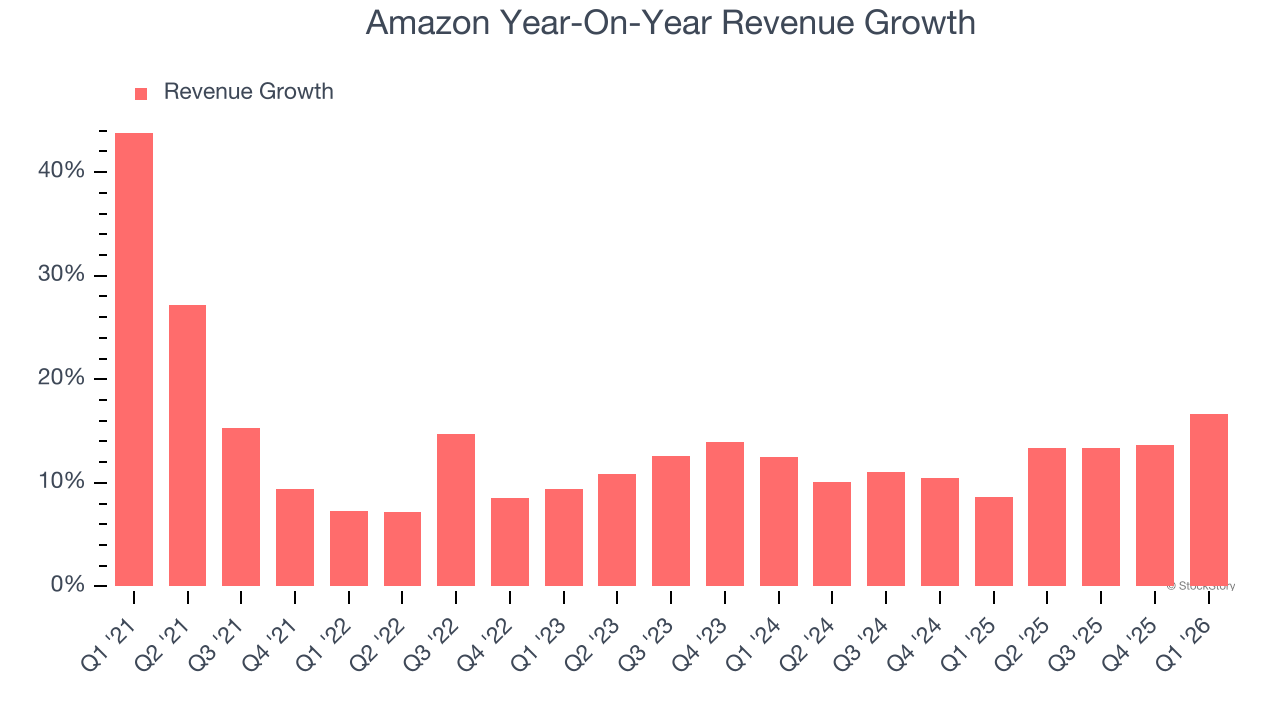
This quarter, Amazon reported year-on-year revenue growth of 16.6%, and its $181.5 billion of revenue exceeded Wall Street’s estimates by 2.4%. Company management is currently guiding for a 17.2% year-on-year increase in sales next quarter. Looking further ahead, sell-side This projection is admirable for a company of its scale and illustrates the market sees some success for its newer products.
ONE MORE THING: The $21 AI Application Stock Wall Street Forgot. While Wall Street obsesses over who’s building AI, one company is already using it to print money. And nobody’s paying attention.
AI chip stocks trade at ridiculous valuations. This company processes a trillion consumer signals monthly using AI and trades at a third of the price. The gap won’t last. The institutions will figure it out. You need to see this first. Read the FREE Report Before They Notice.
Profitability: The Key Debate
Many investors understand that Amazon’s e-commerce business caps its gross margin, which averaged 47.3% over the last five years. The company lags behind its pure-play tech peers because it sells many commoditized goods online where it must acquire and hold physical inventory.
What the market debates, however, is where Amazon’s long-term operating profitability could ultimately settle. Sure, its five-year margin of 8% was mediocre, but it rose by 7.4 percentage points thanks to leverage on the fixed costs in its consumer-facing businesses and the highly profitable AWS segment becoming a larger portion of its revenue. Our question is if Amazon’s momentum can continue and result in a mid-to-high teen percentage margin somewhere down the line.
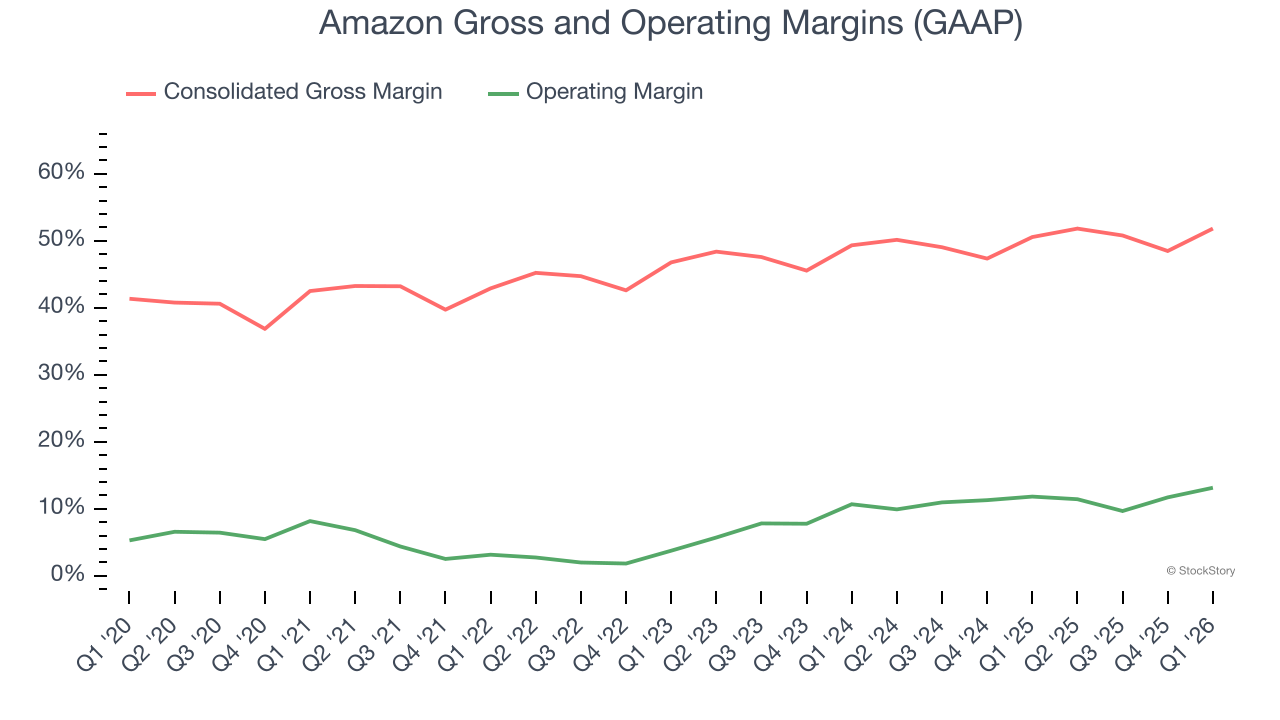
The company’s North America segment holds the keys to this answer. Throughout the years, Amazon has made huge investments to not only attract hoards of customers into its ecosystem but also retain them. Some areas of focus in this effort included its unmatched delivery network and video streaming content.
Bulls will argue that Amazon can afford to ease up and begin riding its investments of the last two-plus decades. Its trailing 12-month operating margin of 11.5%, combined with its performance over the last few years, suggests Amazon’s long-term profitability could go much higher, potentially leading to earnings and a stock price that follows.
Key Takeaways from Amazon’s Q1 Results
We were impressed Amazon beat analysts’ revenue expectations this quarter, with all-important AWS revenue coming in ahead. We were also glad its revenue guidance for next quarter trumped Wall Street’s estimates. Zooming out, we think this quarter featured some important positives. The market seemed to be hoping for more, and the stock traded down 2.2% to $258.07 immediately after reporting.
Should you buy the stock or not? We think that the latest quarter is only one piece of the longer-term business quality puzzle. Quality, when combined with valuation, can help determine if the stock is a buy. We cover that in our actionable full research report which you can read here (it’s free).