Electronics retailer Best Buy (NYSE: BBY) reported Q1 CY2026 results beating Wall Street’s revenue expectations, with sales up 1.9% year on year to $8.94 billion. The company expects the full year’s revenue to be around $41.65 billion, close to analysts’ estimates. Its non-GAAP profit of $1.28 per share was 4.3% above analysts’ consensus estimates.
Is now the time to buy Best Buy? Find out by accessing our full research report, it’s free.
Best Buy (BBY) Q1 CY2026 Highlights:
- Revenue: $8.94 billion vs analyst estimates of $8.82 billion (1.9% year-on-year growth, 1.3% beat)
- Adjusted EPS: $1.28 vs analyst estimates of $1.23 (4.3% beat)
- The company reconfirmed its revenue guidance for the full year of $41.65 billion at the midpoint
- Management reiterated its full-year Adjusted EPS guidance of $6.45 at the midpoint
- Operating Margin: 4.1%, up from 2.5% in the same quarter last year
- Free Cash Flow was $215 million, up from -$132 million in the same quarter last year
- Same-Store Sales rose 2% year on year (-0.7% in the same quarter last year)
- Market Capitalization: $13.6 billion
“Today we are pleased to report better-than-expected results for the first quarter,” said Corie Barry, Best Buy CEO.
Company Overview
With humble beginnings as a stereo equipment seller, Best Buy (NYSE: BBY) now sells a broad selection of consumer electronics, appliances, and home office products.
Revenue Growth
A company’s long-term performance is an indicator of its overall quality. Any business can put up a good quarter or two, but many enduring ones grow for years.
With $41.86 billion in revenue over the past 12 months, Best Buy is larger than most consumer retail companies and benefits from economies of scale, enabling it to gain more leverage on its fixed costs than smaller competitors. This also gives it the flexibility to offer lower prices. However, its scale is a double-edged sword because there is only so much real estate to build new stores, placing a ceiling on its growth. For Best Buy to boost its sales, it likely needs to adjust its prices or lean into foreign markets.
As you can see below, Best Buy’s revenue declined by 2.5% per year over the last three years as it closed stores.
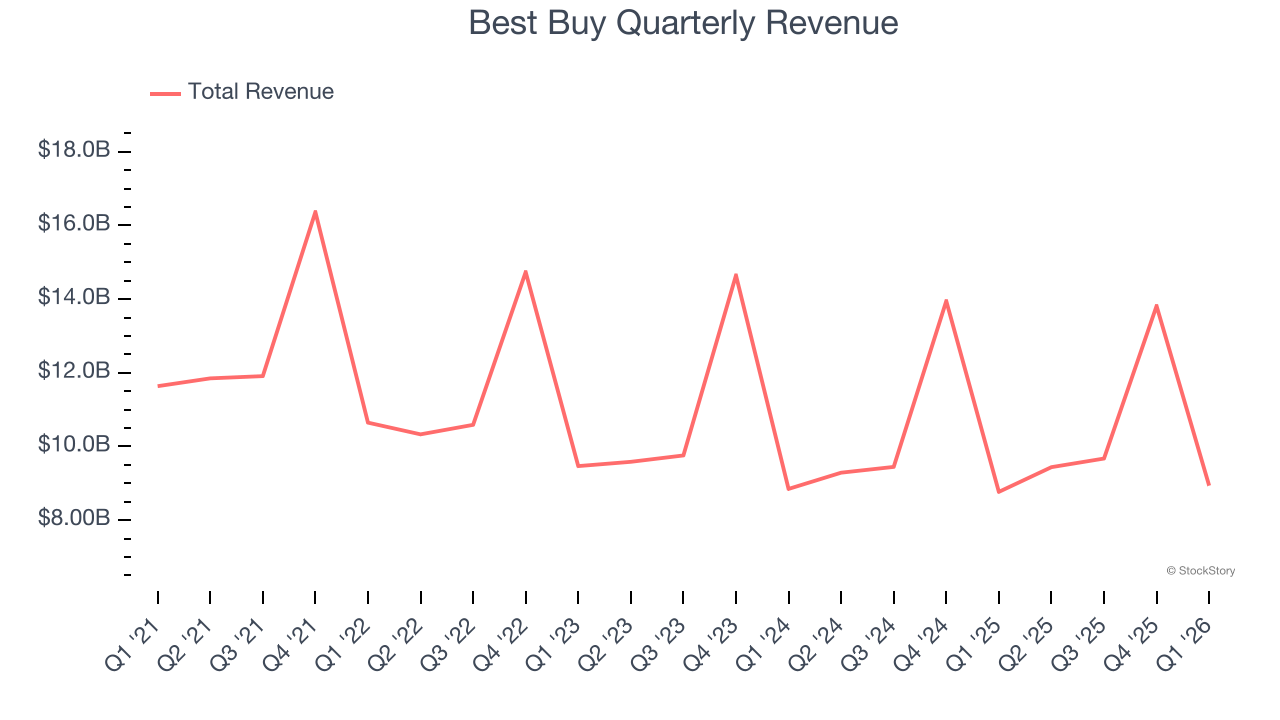
This quarter, Best Buy reported modest year-on-year revenue growth of 1.9% but beat Wall Street’s estimates by 1.3%.
Looking ahead, sell-side analysts expect revenue to remain flat over the next 12 months. Although this projection suggests its newer products will spur better top-line performance, it is still below average for the sector.
ONE MORE THING: The $21 AI Application Stock Wall Street Forgot. While Wall Street obsesses over who’s building AI, one company is already using it to print money. And nobody’s paying attention.
AI chip stocks trade at ridiculous valuations. This company processes a trillion consumer signals monthly using AI and trades at a third of the price. The gap won’t last. The institutions will figure it out. You need to see this first. Read the FREE Report Before They Notice.
Store Performance
Number of Stores
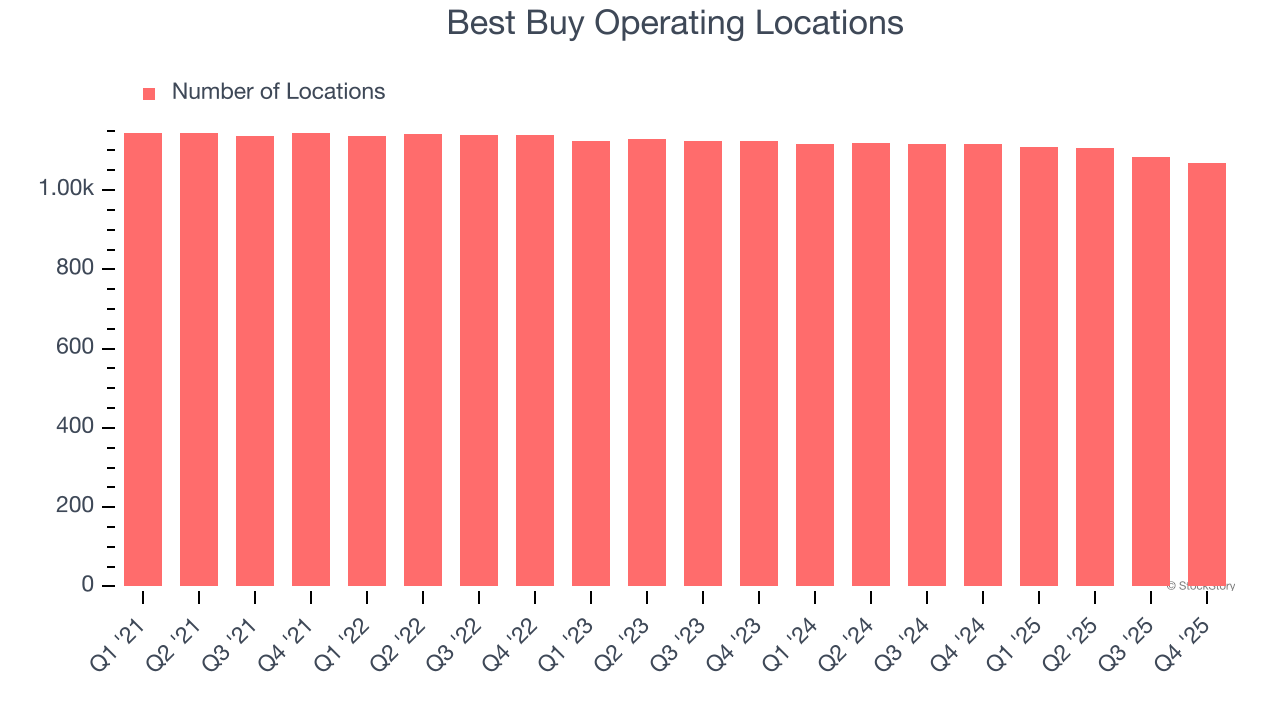
Best Buy has generally closed its stores over the last two years, averaging 1.7% annual declines.
When a retailer shutters stores, it usually means that brick-and-mortar demand is less than supply, and it is responding by closing underperforming locations to improve profitability.
Note that Best Buy reports its store count intermittently, so some data points are missing in the chart below.
Same-Store Sales
The change in a company’s store base only tells one side of the story. The other is the performance of its existing locations and e-commerce sales, which informs management teams whether they should expand or downsize their physical footprints. Same-store sales provides a deeper understanding of this issue because it measures organic growth at brick-and-mortar shops for at least a year.
Best Buy’s demand within its existing locations has barely increased over the last two years as its same-store sales were flat. This performance isn’t ideal, and Best Buy is attempting to boost same-store sales by closing stores (fewer locations sometimes lead to higher same-store sales).
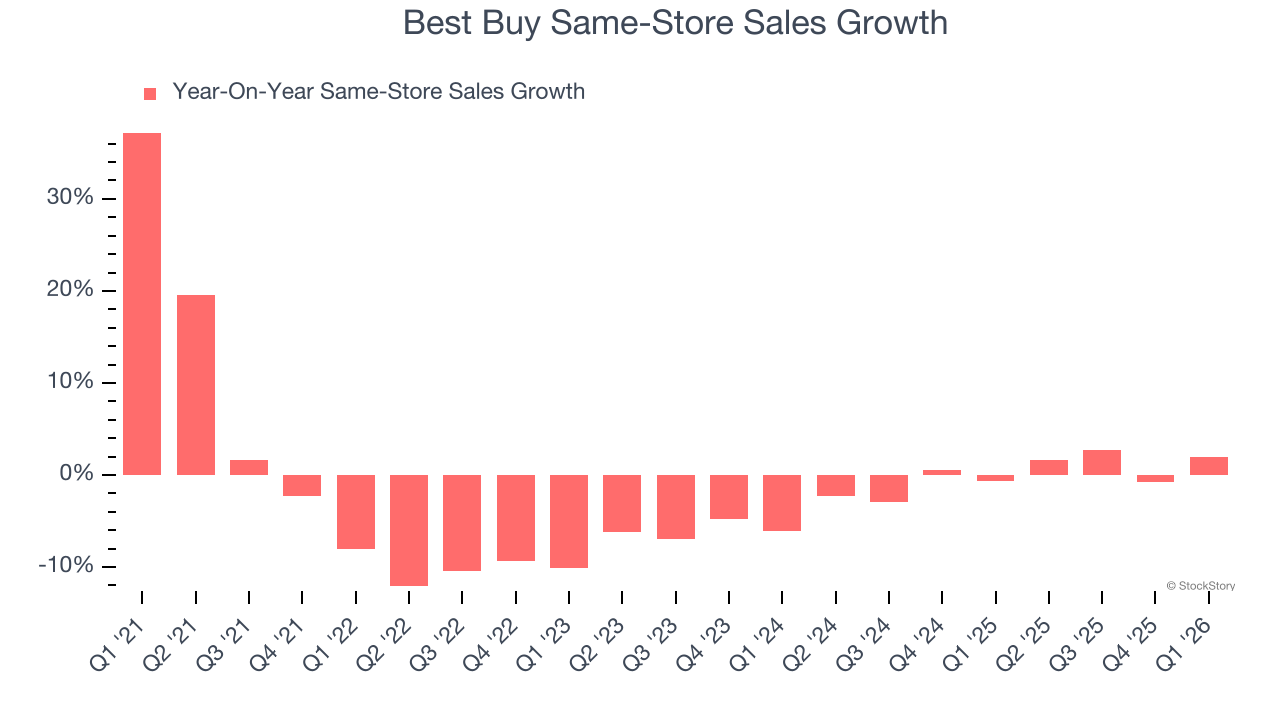
In the latest quarter, Best Buy’s same-store sales rose 2% year on year. This growth was an acceleration from its historical levels, which is always an encouraging sign.
Key Takeaways from Best Buy’s Q1 Results
Both revenue and EPS beat. The company also reaffirmed full-year guidance for revenue and EPS. Overall, this print had some key positives. The stock traded up 7.1% to $69.57 immediately following the results.
Best Buy had an encouraging quarter, but one earnings result doesn’t necessarily make the stock a buy. Let’s see if this is a good investment. The latest quarter does matter, but not nearly as much as longer-term fundamentals and valuation, when deciding if the stock is a buy. We cover that in our actionable full research report which you can read here (it’s free).