
Looking back on senior health, home health & hospice stocks’ Q1 earnings, we examine this quarter’s best and worst performers, including Chemed (NYSE: CHE) and its peers.
The senior health, home care, and hospice care industries provide essential services to aging populations and patients with chronic or terminal conditions. These companies benefit from stable, recurring revenue driven by relationships with patients and families that can extend many months or even years. However, the labor-intensive nature of the business makes it vulnerable to rising labor costs and staffing shortages, while profitability is constrained by reimbursement rates from Medicare, Medicaid, and private insurers. Looking ahead, the industry is positioned for tailwinds from an aging population, increasing chronic disease prevalence, and a growing preference for personalized in-home care. Advancements in remote monitoring and telehealth are expected to enhance efficiency and care delivery. However, headwinds such as labor shortages, wage inflation, and regulatory uncertainty around reimbursement could pose challenges. Investments in digitization and technology-driven care will be critical for long-term success.
The 7 senior health, home health & hospice stocks we track reported a satisfactory Q1. As a group, revenues beat analysts’ consensus estimates by 0.9%.
In light of this news, share prices of the companies have held steady. On average, they are relatively unchanged since the latest earnings results.
Chemed (NYSE: CHE)
With a unique business model combining end-of-life care and household services, Chemed (NYSE: CHE) operates two distinct businesses: VITAS, which provides hospice care for terminally ill patients, and Roto-Rooter, which offers plumbing and water restoration services.
Chemed reported revenues of $657.5 million, up 1.6% year on year. This print exceeded analysts’ expectations by 1.2%. Overall, it was a strong quarter for the company with a beat of analysts’ EPS estimates.
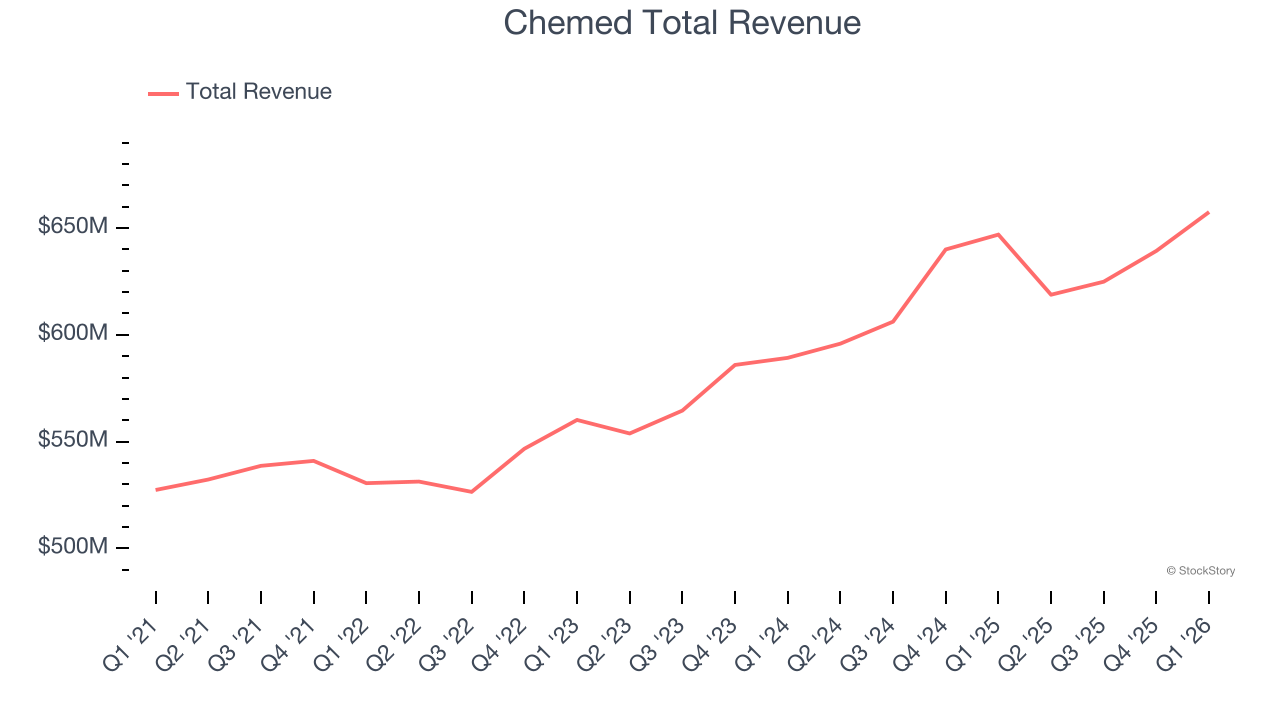
Interestingly, the stock is up 13.9% since reporting and currently trades at $436.27.
Is now the time to buy Chemed? Access our full analysis of the earnings results here, it’s free.
Best Q1: BrightSpring Health Services (NASDAQ: BTSG)
Founded in 1974, BrightSpring Health Services (NASDAQ: BTSG) offers home health care, hospice, neuro-rehabilitation, and pharmacy services.
BrightSpring Health Services reported revenues of $3.61 billion, up 25.6% year on year, outperforming analysts’ expectations by 6.3%. The business had an exceptional quarter with a beat of analysts’ EPS estimates and full-year EBITDA guidance topping analysts’ expectations.
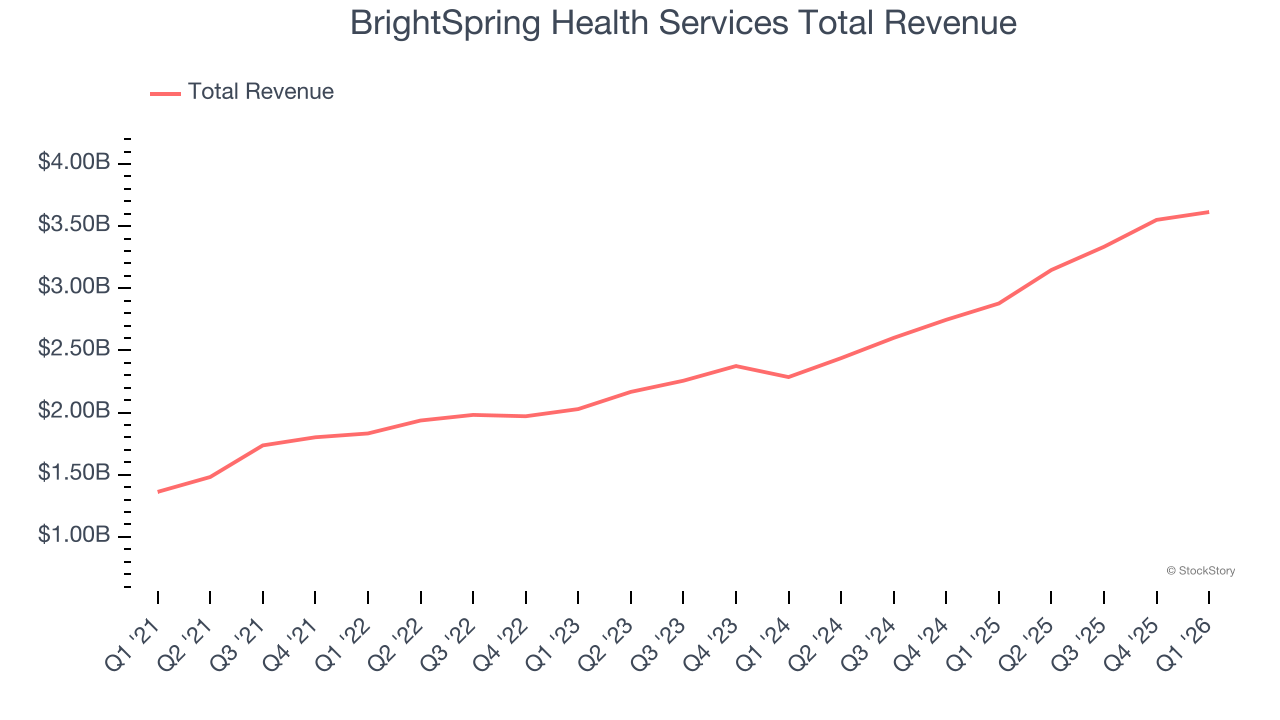
BrightSpring Health Services delivered the biggest analyst estimate beat and highest full-year guidance raise among its peers. The market seems happy with the results as the stock is up 39.2% since reporting. It currently trades at $66.76.
Is now the time to buy BrightSpring Health Services? Access our full analysis of the earnings results here, it’s free.
Weakest Q1: Option Care Health (NASDAQ: OPCH)
With a nationwide network of 177 locations serving 43 states and a team of over 4,500 clinicians, Option Care Health (NASDAQ: OPCH) is the largest independent provider of home and alternate site infusion services, delivering medications and clinical support to patients across the United States.
Option Care Health reported revenues of $1.35 billion, up 1.3% year on year, falling short of analysts’ expectations by 3.3%. It was a slower quarter as it posted full-year revenue guidance missing analysts’ expectations and full-year EBITDA guidance meeting analysts’ expectations.
Option Care Health delivered the weakest performance against analyst estimates and weakest full-year guidance update in the group. As expected, the stock is down 19.3% since the results and currently trades at $21.69.
Read our full analysis of Option Care Health’s results here.
Addus HomeCare (NASDAQ: ADUS)
Serving approximately 66,000 clients across 22 states with a focus on "dual eligible" Medicare and Medicaid beneficiaries, Addus HomeCare (NASDAQ: ADUS) provides in-home personal care, hospice, and home health services to elderly, chronically ill, and disabled individuals.
Addus HomeCare reported revenues of $363.6 million, up 7.7% year on year. This number came in 0.7% below analysts’ expectations. All in all, it was a slower quarter for the company.
The stock is down 5.9% since reporting and currently trades at $94.23.
Read our full, actionable report on Addus HomeCare here, it’s free.
Brookdale (NYSE: BKD)
With a network of over 650 communities serving approximately 59,000 residents across 41 states, Brookdale Senior Living (NYSE: BKD) operates senior living communities across the United States, offering independent living, assisted living, memory care, and continuing care retirement communities.
Brookdale reported revenues of $764.9 million, down 6% year on year. This result lagged analysts’ expectations by 0.8%. More broadly, it was actually a satisfactory quarter as it put up a beat of analysts’ EPS estimates.
Brookdale had the slowest revenue growth among its peers. The stock is down 3.7% since reporting and currently trades at $13.65.
Read our full, actionable report on Brookdale here, it’s free.
Market Update
Late in 2025 into early 2026, there was hand-wringing around artificial intelligence. For software companies, the fear was that AI would erode pricing power and compress margins as new tools made it easier to replicate what once required expensive enterprise platforms. Crypto investors had their own version of the same anxiety: if AI agents could trade, allocate capital, and manage wallets autonomously, what exactly was the long-term value of today’s crypto infrastructure?
These concerns triggered a noticeable rotation away from these sectors and into safer havens. But markets rarely dwell on one narrative for long. Spring 2026 came, and the focus shifted abruptly from technological disruption to geopolitical risk. The US’ conflict with Iran became the dominant driver of market psychology, and when geopolitics takes center stage, the script changes quickly. Investors stop debating growth rates and start worrying about oil supply, inflation, and global stability.
Want to invest in winners with rock-solid fundamentals? Check out our Top 5 Quality Compounder Stocks and add them to your watchlist. These companies are poised for growth regardless of the political or macroeconomic climate.
StockStory’s analyst team — all seasoned professional investors — uses quantitative analysis and automation to deliver market-beating insights faster and with higher quality.