Computer processor maker Intel (NASDAQ: INTC) reported revenue ahead of Wall Street’s expectations in Q2 CY2026, with sales up 25.4% year on year to $16.13 billion. On top of that, next quarter’s revenue guidance ($16.3 billion at the midpoint) was surprisingly good and 7.8% above what analysts were expecting. Its non-GAAP profit of $0.42 per share was 93.1% above analysts’ consensus estimates.
Is now the time to buy Intel? Find out by accessing our full research report, it’s free.
Intel (INTC) Q2 CY2026 Highlights:
- Revenue: $16.13 billion vs analyst estimates of $14.43 billion (25.4% year-on-year growth, 11.7% beat)
- Adjusted EPS: $0.42 vs analyst estimates of $0.22 (large beat)
- Revenue Guidance for Q3 CY2026 is $16.3 billion at the midpoint, above analyst estimates of $15.12 billion
- Adjusted EPS guidance for Q3 CY2026 is $0.38 at the midpoint, above analyst estimates of $0.28
- Operating Margin: 11.1%, up from -24.7% in the same quarter last year
- Free Cash Flow was -$8.42 billion compared to -$1.5 billion in the same quarter last year
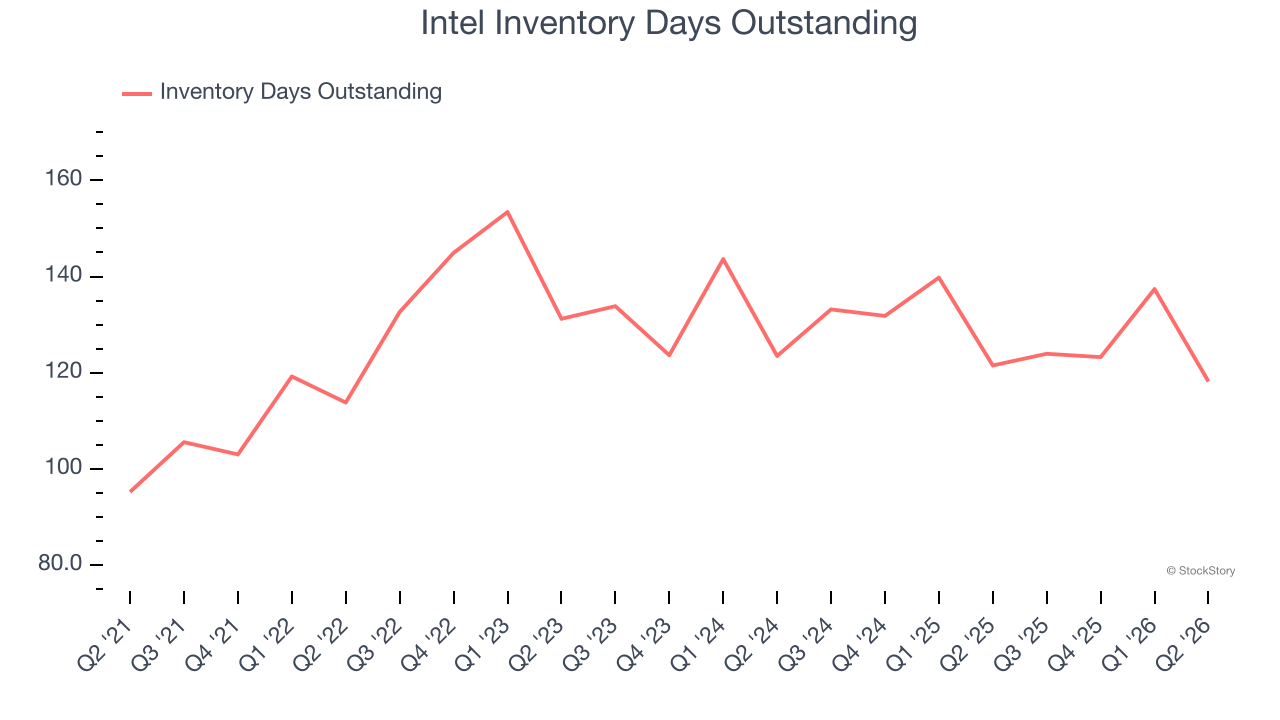
- Inventory Days Outstanding: 118, down from 137 in the previous quarter
- Market Capitalization: $515.8 billion
“AI is driving unprecedented demand for compute, and as we continue to execute, Intel is well-positioned to capture sustainable growth across our CPU franchise, ASICs, advanced packaging and vast wafer foundry network,” said Lip-Bu Tan, Intel CEO.
Company Overview
Inventor of the x86 processor that powered decades of technological innovation in PCs, data centers, and numerous other markets, Intel (NASDAQ: INTC) is a leading manufacturer of computer processors and graphics chips.
Revenue Growth
Reviewing a company’s long-term sales performance reveals insights into its quality. Even a bad business can shine for one or two quarters, but a top-tier one grows for years. Over the last five years, Intel’s demand was weak and its revenue declined by 4.9% per year. This wasn’t a great result and is a sign of poor business quality. Semiconductors are a cyclical industry, and long-term investors should be prepared for periods of high growth followed by periods of revenue contractions.
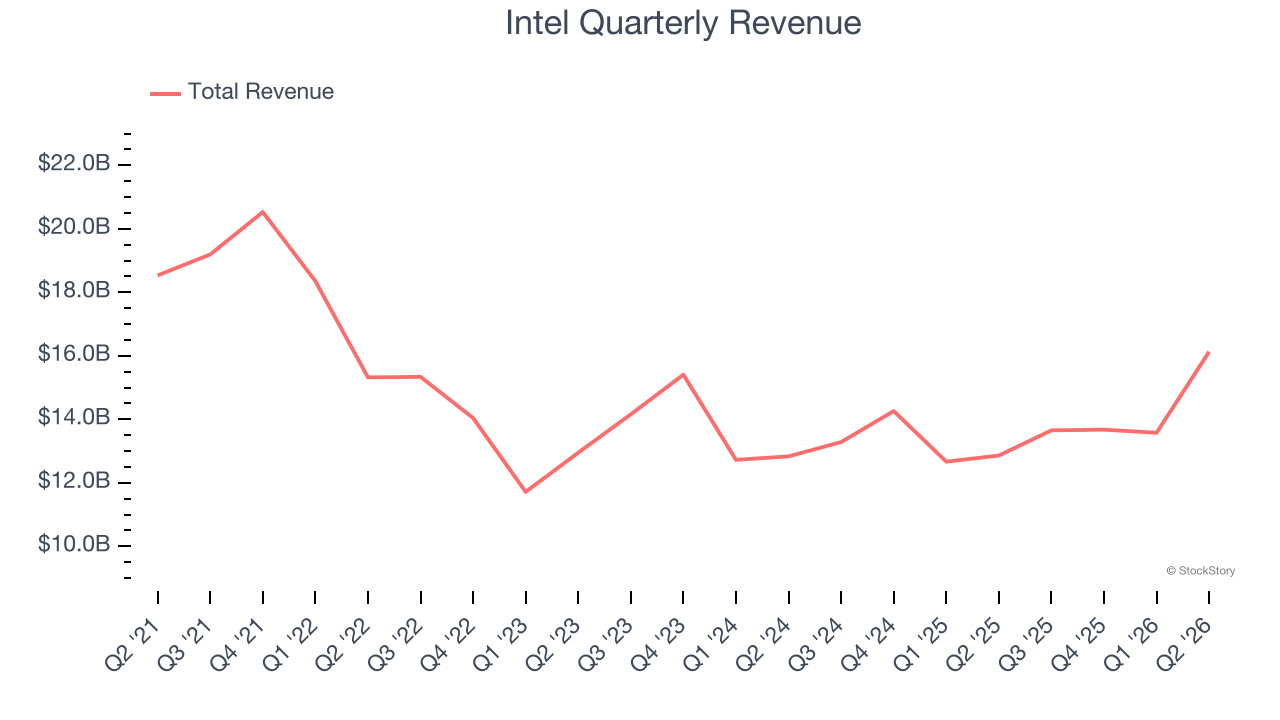
We at StockStory place the most emphasis on long-term growth, but within semiconductors, a half-decade historical view may miss new demand cycles or industry trends like AI. Intel’s annualized revenue growth of 1.7% over the last two years is above its five-year trend, which is encouraging. 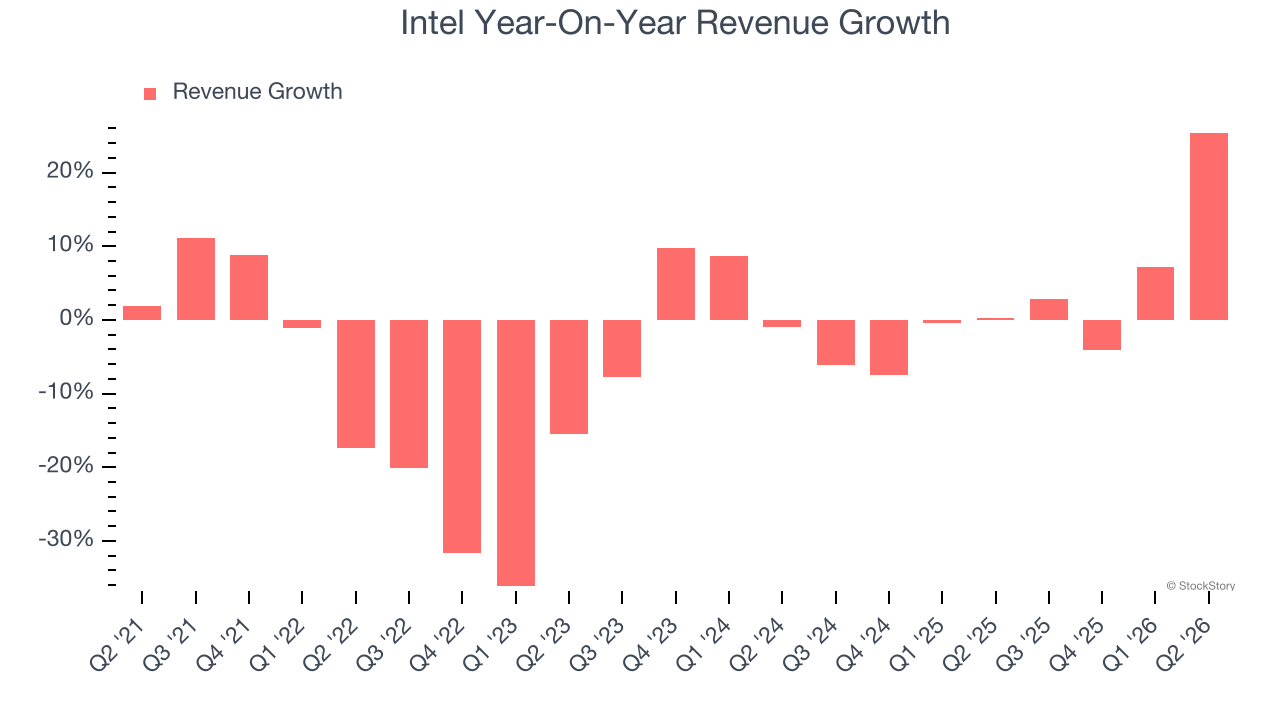
This quarter, Intel reported robust year-on-year revenue growth of 25.4%, and its $16.13 billion of revenue topped Wall Street estimates by 11.7%. Company management is currently guiding for a 19.4% year-on-year increase in sales next quarter.
Looking further ahead, sell-side analysts expect revenue to grow 8.4% over the next 12 months. While this projection suggests its newer products and services will spur better top-line performance, it is still below the sector average.
ONE MORE THING: 3 Hidden Platforms Growing 3X Faster than Amazon, Google, and PayPal. Amazon, Google, and Meta all followed the same playbook: Dominate an ignored market. Build an unbeatable moat. Scale until you’re unstoppable.
These three platforms are running that exact playbook right now. The early investors in Amazon made fortunes. The early investors in these could do the same. Get All 3 Stocks Here for FREE.
Product Demand & Outstanding Inventory
Days Inventory Outstanding (DIO) is an important metric for chipmakers, as it reflects a business’s capital intensity and the cyclical nature of semiconductor supply and demand. In a tight supply environment, inventories tend to be stable, allowing chipmakers to exert pricing power. Steadily increasing DIO can be a warning sign that demand is weak, and if inventories continue to rise, the company may have to downsize production.
This quarter, Intel’s DIO came in at 118, which is 10 days below its five-year average. At the moment, these numbers show no indication of an excessive inventory buildup.
Key Takeaways from Intel’s Q2 Results
We were impressed by Intel’s strong improvement in inventory levels. We were also glad its revenue and EPS outperformed Wall Street’s estimates. Looking ahead, next quarter's revenue and EPS guidance both came in ahead. Zooming out, we think this was a very good print with some key areas of upside. The stock traded up 4.5% to $109.48 immediately after reporting.
Intel had an encouraging quarter, but one earnings result doesn’t necessarily make the stock a buy. Let’s see if this is a good investment. When making that decision, it’s important to consider its valuation, business qualities, as well as what has happened in the latest quarter. We cover that in our actionable full research report which you can read here (it’s free).