Commercial vehicle retailer Rush Enterprises (NASDAQ: RUSH.A) met Wall Street’s revenue expectations in Q2 CY2026, but sales fell by 1.6% year on year to $1.9 billion. Its GAAP profit of $0.91 per share was 6.5% above analysts’ consensus estimates.
Is now the time to buy Rush Enterprises? Find out by accessing our full research report, it’s free.
Rush Enterprises (RUSHA) Q2 CY2026 Highlights:
- Revenue: $1.9 billion vs analyst estimates of $1.89 billion (1.6% year-on-year decline, in line)
- EPS (GAAP): $0.91 vs analyst estimates of $0.85 (6.5% beat)
- Operating Margin: 5.1%, in line with the same quarter last year
- Market Capitalization: $5.98 billion
The Company’s Board of Directors declared a three-for-two stock split with respect to both the Company’s Class A and Class B common stock. The stock split will be effected in the form of a stock dividend payable on August 31, 2026, to shareholders of record as of August 11, 2026. Holders of the Company’s common stock will receive one additional share for each two shares of common stock held as of the record date. The stock split will increase the number of outstanding shares of Class A common stock from approximately 61,142,458 to approximately 91,713,687 and will increase the number of outstanding shares of Class B common stock from approximately 16,677,344 to approximately 25,016,016. Additionally, the Company’s Board of Directors declared a cash dividend of $0.14 per share of Class A and Class B common stock, to be paid on September 24, 2026, to all shareholders of record as of September 9, 2026. “We remain dedicated to returning capital to our shareholders, and we are pleased to announce a post-stock split cash dividend of $0.14 per share. After the stock split, this represents a 10.5% increase in the quarterly cash dividend paid to our shareholders compared to the prior quarterly dividend and is our tenth increase since we announced our intent to begin paying a quarterly cash dividend in July 2018 as part of our capital allocation strategy,” said W.M. “Rusty” Rush, Chairman, Chief Executive Officer and President of Rush Enterprises, Inc.
Company Overview
Headquartered in Texas, Rush Enterprises (NASDAQ: RUSH.A) provides truck-related services and solutions, including sales, leasing, parts, and maintenance for commercial vehicles.
Revenue Growth
A company’s long-term performance is an indicator of its overall quality. Even a bad business can shine for one or two quarters, but a top-tier one grows for years. Over the last five years, Rush Enterprises grew its sales at a decent 7.7% compounded annual growth rate. Its growth was slightly above the average industrials company and shows its offerings resonate with customers.
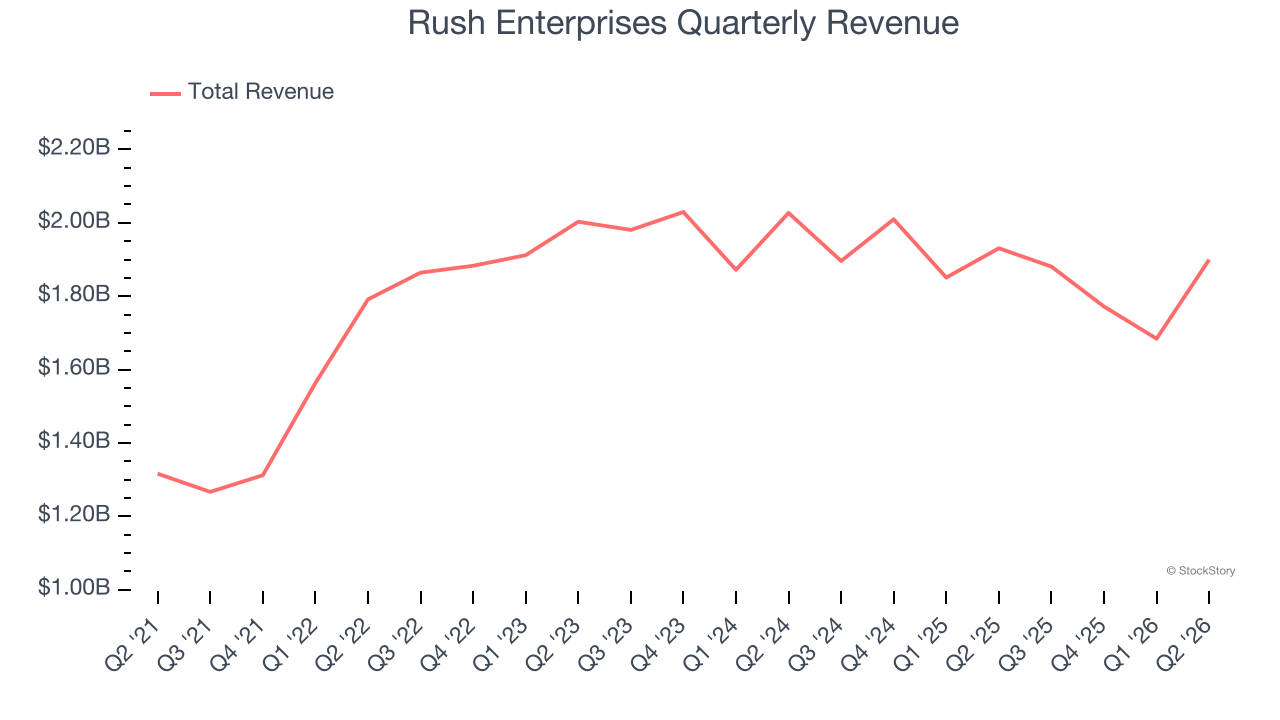
We at StockStory place the most emphasis on long-term growth, but within industrials, a half-decade historical view may miss cycles, industry trends, or a company capitalizing on catalysts such as a new contract win or a successful product line. Rush Enterprises’s recent performance marks a sharp pivot from its five-year trend as its revenue has shown annualized declines of 4.3% over the last two years. 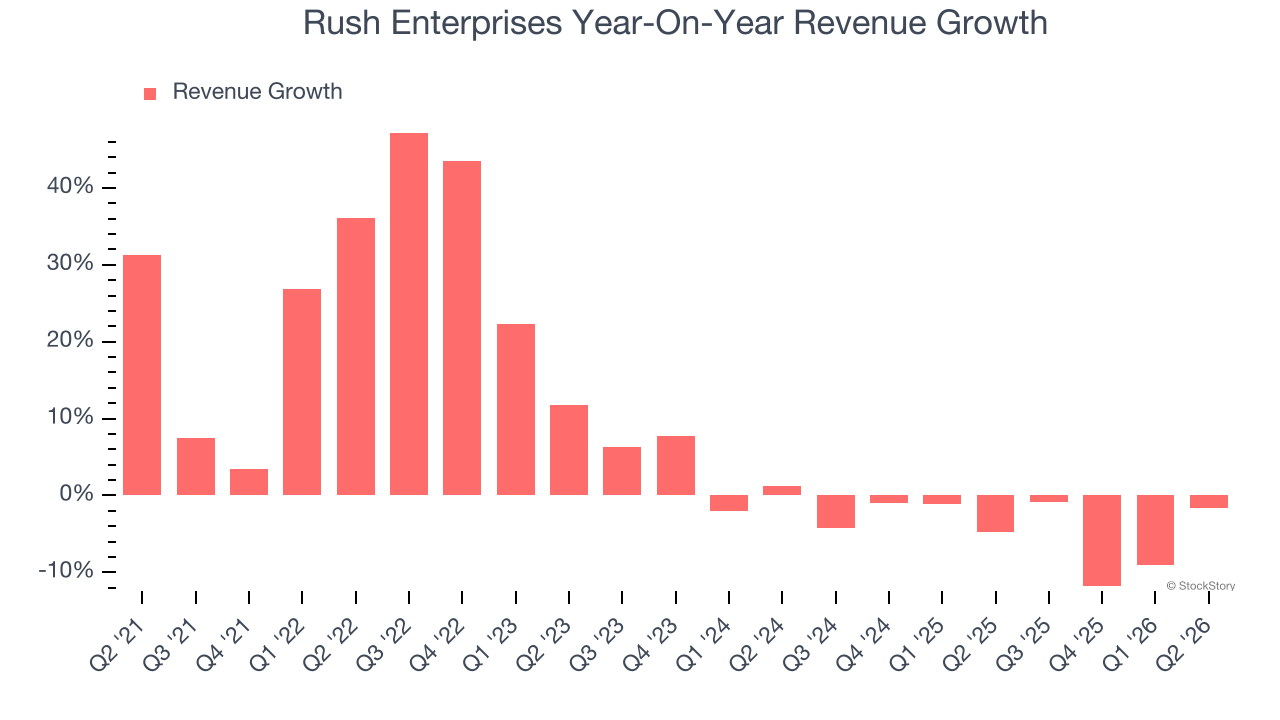
Rush Enterprises also breaks out the revenue for its most important segments, Vehicles and Aftermarket, which are 60.5% and 34% of revenue. Over the last two years, Rush Enterprises’s Vehicles revenue (new and used commercial trucks) averaged 24% year-on-year declines while its Aftermarket revenue (parts and services) averaged 20.6% declines. 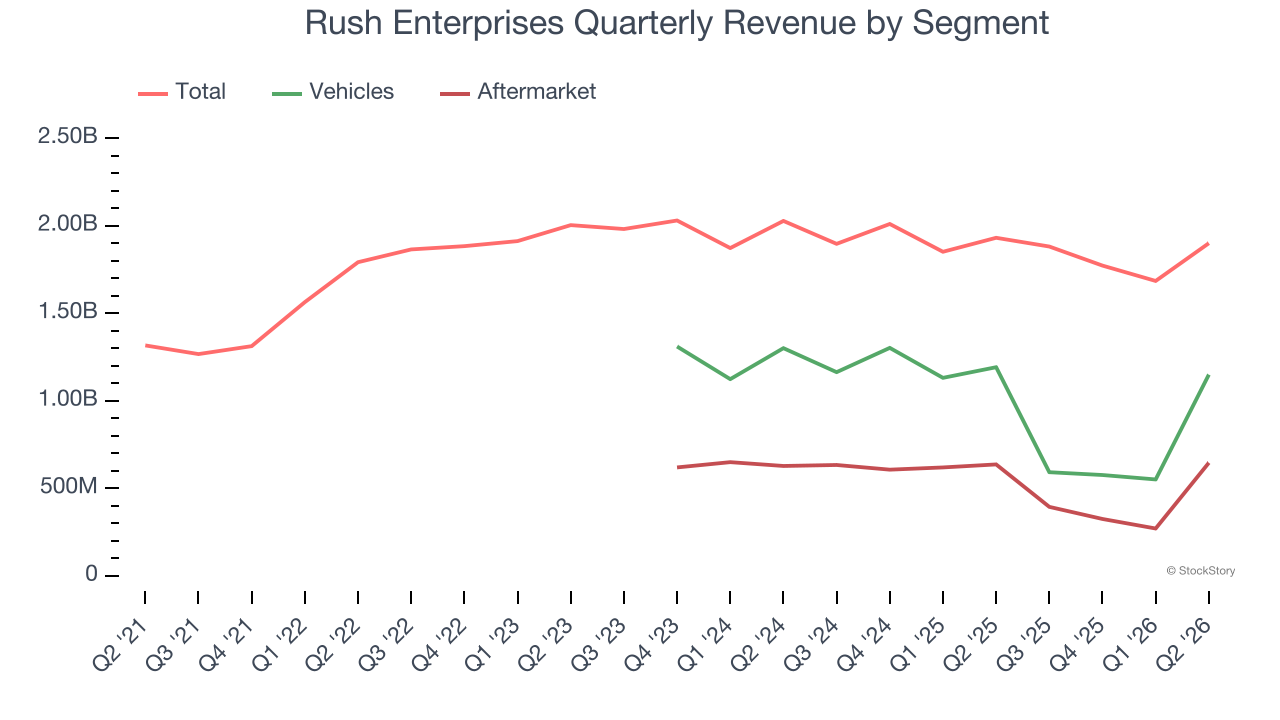
This quarter, Rush Enterprises reported a rather uninspiring 1.6% year-on-year revenue decline to $1.9 billion of revenue, in line with Wall Street’s estimates.
Looking ahead, sell-side analysts expect revenue to grow 12.8% over the next 12 months, an improvement versus the last two years. This projection is commendable and suggests its newer products and services will catalyze better top-line performance.
ONE MORE THING: 3 Hidden Platforms Growing 3X Faster than Amazon, Google, and PayPal. Amazon, Google, and Meta all followed the same playbook: Dominate an ignored market. Build an unbeatable moat. Scale until you’re unstoppable.
These three platforms are running that exact playbook right now. The early investors in Amazon made fortunes. The early investors in these could do the same. Get All 3 Stocks Here for FREE.
Operating Margin
Rush Enterprises was profitable over the last five years but held back by its large cost base. Its average operating margin of 6.1% was weak for an industrials business. This result isn’t too surprising given its low gross margin as a starting point.
Analyzing the trend in its profitability, Rush Enterprises’s operating margin decreased by 2 percentage points over the last five years. This raises questions about the company’s expense base because its revenue growth should have given it leverage on its fixed costs, resulting in better economies of scale and profitability. Rush Enterprises’s performance was poor no matter how you look at it - it shows that costs were rising and it couldn’t pass them onto its customers.
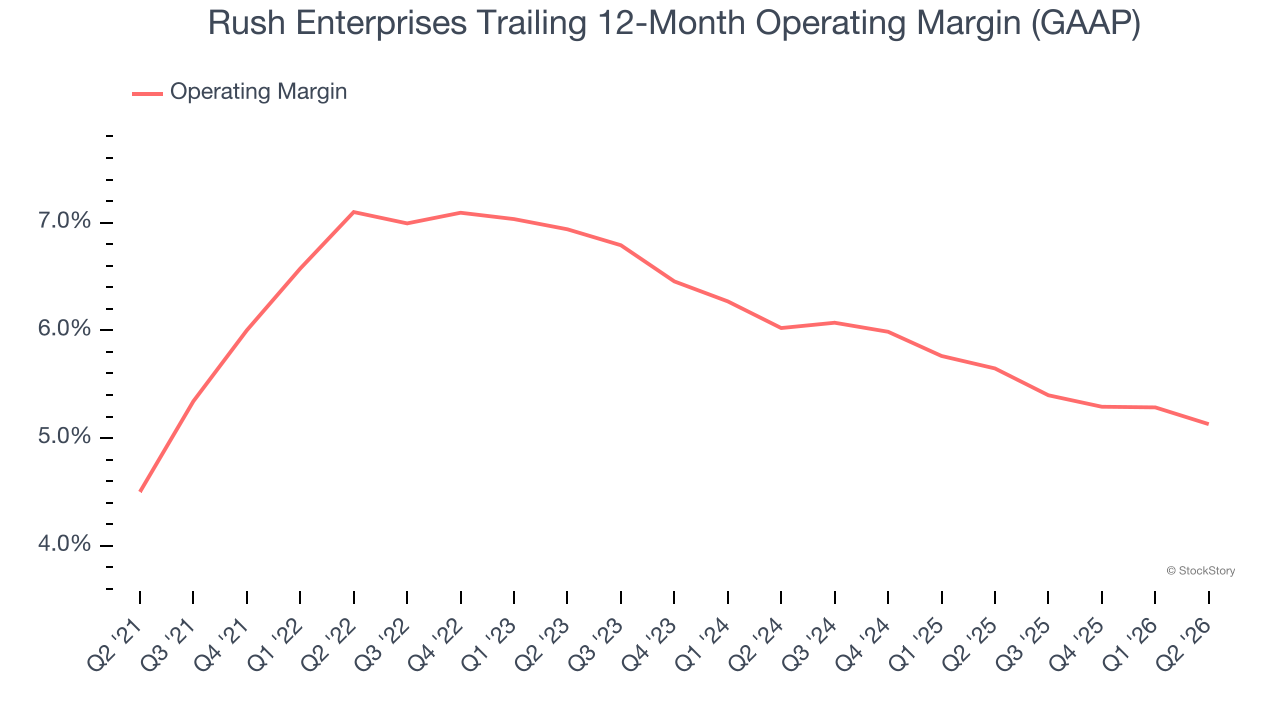
This quarter, Rush Enterprises generated an operating margin profit margin of 5.1%, in line with the same quarter last year. This indicates the company’s cost structure has recently been stable.
Earnings Per Share
We track the long-term change in earnings per share (EPS) for the same reason as long-term revenue growth. Compared to revenue, however, EPS highlights whether a company’s growth is profitable.
Rush Enterprises’s EPS grew at 9.9% compounded annual growth rate over the last five years, higher than its 7.7% annualized revenue growth. However, this alone doesn’t tell us much about its business quality because its operating margin didn’t improve.
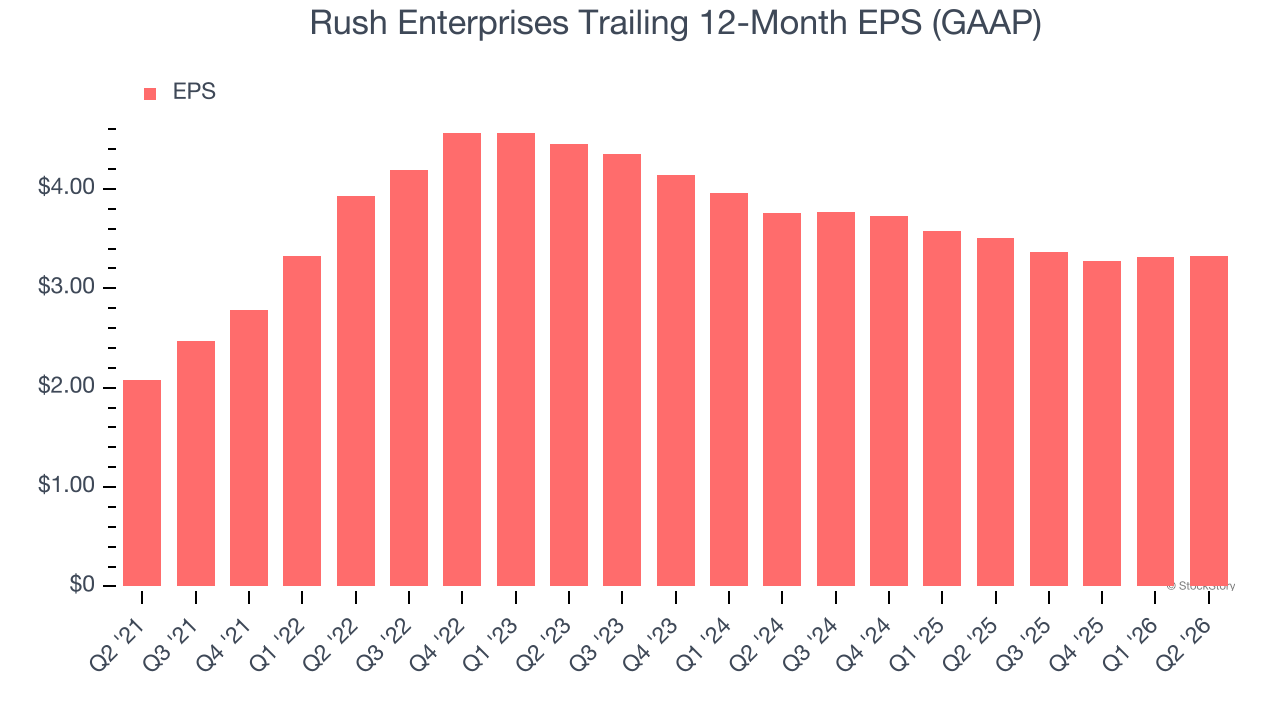
Diving into Rush Enterprises’s quality of earnings can give us a better understanding of its performance. A five-year view shows that Rush Enterprises has repurchased its stock, shrinking its share count by 7.7%. This tells us its EPS outperformed its revenue not because of increased operational efficiency but financial engineering, as buybacks boost per share earnings. 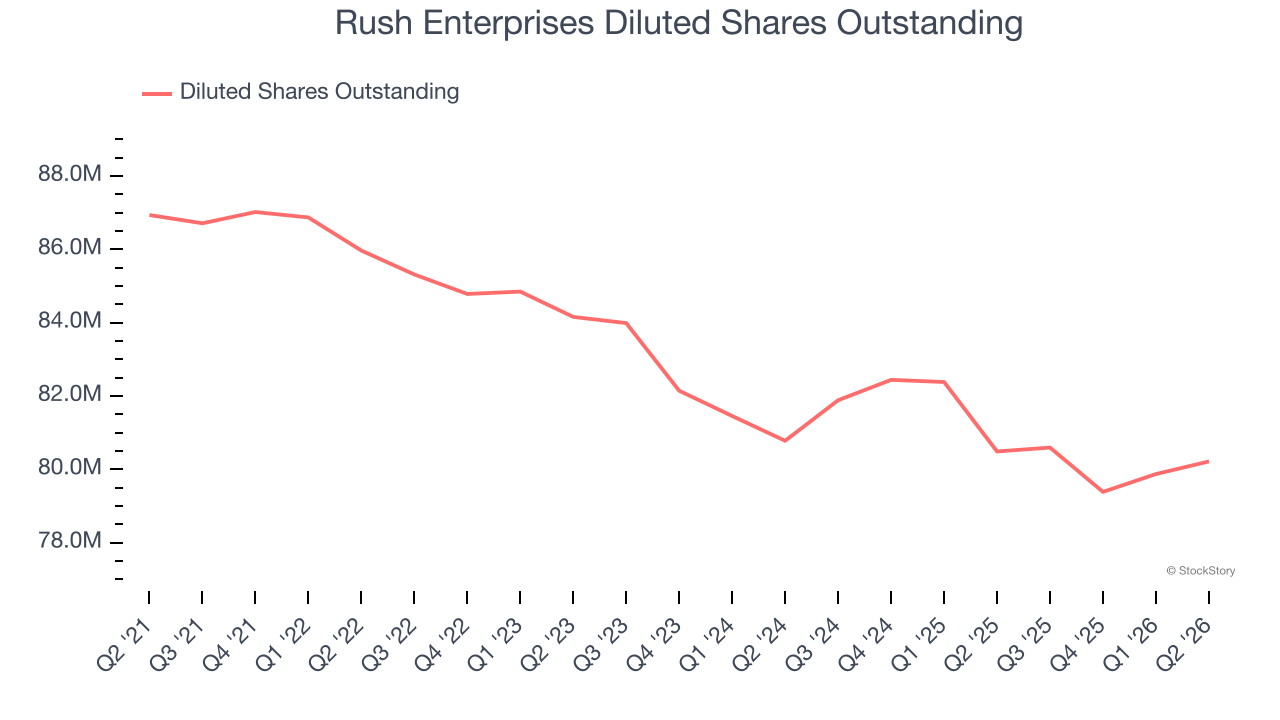
Like with revenue, we analyze EPS over a shorter period to see if we are missing a change in the business.
For Rush Enterprises, its two-year annual EPS declines of 6% mark a reversal from its five-year trend. We hope Rush Enterprises can return to earnings growth in the future.
In Q2, Rush Enterprises reported EPS of $0.91, up from $0.90 in the same quarter last year. This print beat analysts’ estimates by 6.5%. Over the next 12 months, Wall Street expects Rush Enterprises’s full-year EPS to grow 19.4% from $3.32 to $3.97.
Key Takeaways from Rush Enterprises’s Q2 Results
It was good to see Rush Enterprises beat analysts’ EPS expectations this quarter. We were also happy its revenue was in line with Wall Street’s estimates. Overall, this print had some key positives. The stock remained flat at $78.87 immediately after reporting.
Big picture, is Rush Enterprises a buy here and now? When making that decision, it’s important to consider its valuation, business qualities, as well as what has happened in the latest quarter. We cover that in our actionable full research report which you can read here (it’s free).