Over the past six months, Hormel Foods’s stock price fell to $20.86. Shareholders have lost 8% of their capital, which is disappointing considering the S&P 500 has climbed by 13.7%. This was partly due to its softer quarterly results and may have investors wondering how to approach the situation.
Is there a buying opportunity in Hormel Foods, or does it present a risk to your portfolio? See what our analysts have to say in our full research report, it’s free.
Why Do We Think Hormel Foods Will Underperform?
Even though the stock has become cheaper, we don’t have much confidence in Hormel Foods. Here are three reasons why there are better opportunities than HRL, plus one stock we’d rather own.
1. Demand Slipping as Sales Volumes Decline
Revenue growth can be broken down into changes in price and volume (the number of units sold). While both are important, volume is the lifeblood of a successful staples business as there’s a ceiling to what consumers will pay for everyday goods; they can always trade down to non-branded products if the branded versions are too expensive.
Hormel Foods’s average quarterly sales volumes have shrunk by 3.2% over the last two years. This decrease isn’t ideal because the quantity demanded for consumer staples products is typically stable. 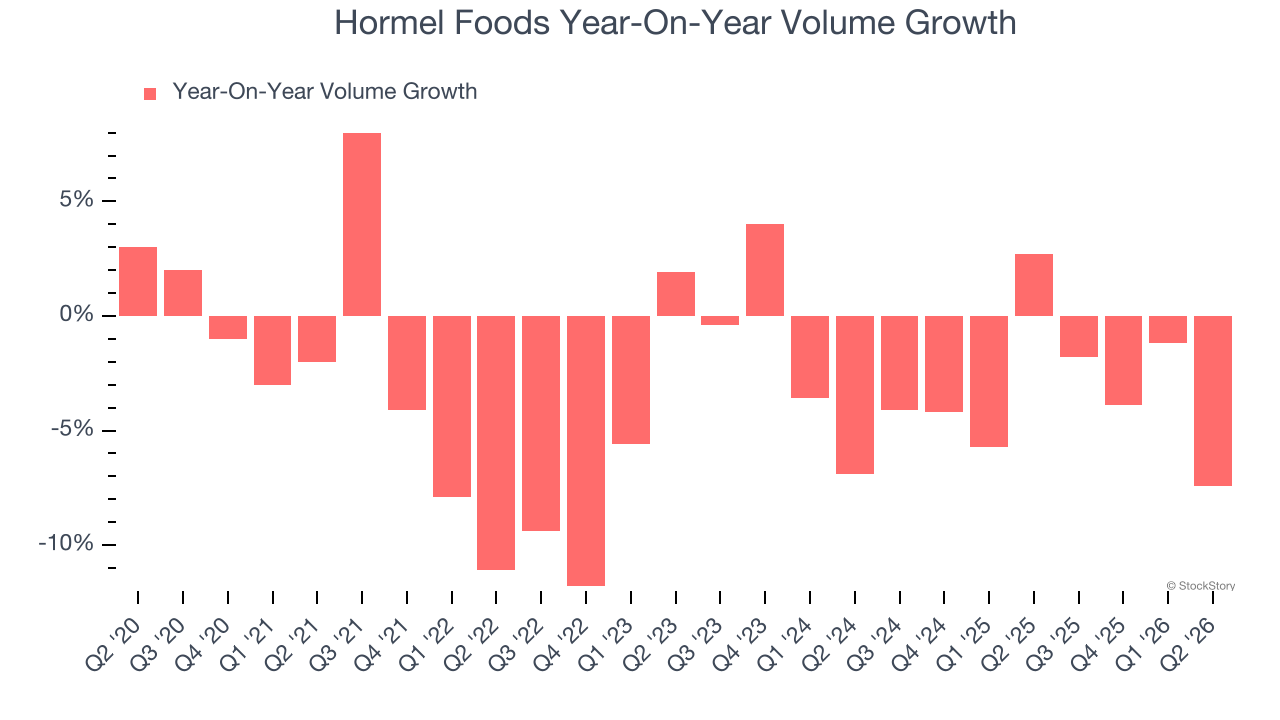
2. Projected Revenue Growth Shows Limited Upside
Forecasted revenues by Wall Street analysts signal a company’s potential. Predictions may not always be accurate, but accelerating growth typically boosts valuation multiples and stock prices while slowing growth does the opposite.
Over the next 12 months, sell-side analysts expect Hormel Foods’s revenue to stall, close to its flat result for the past three years. This projection is underwhelming and implies its newer products will not accelerate its top-line performance yet.
3. Low Gross Margin Reveals Weak Structural Profitability
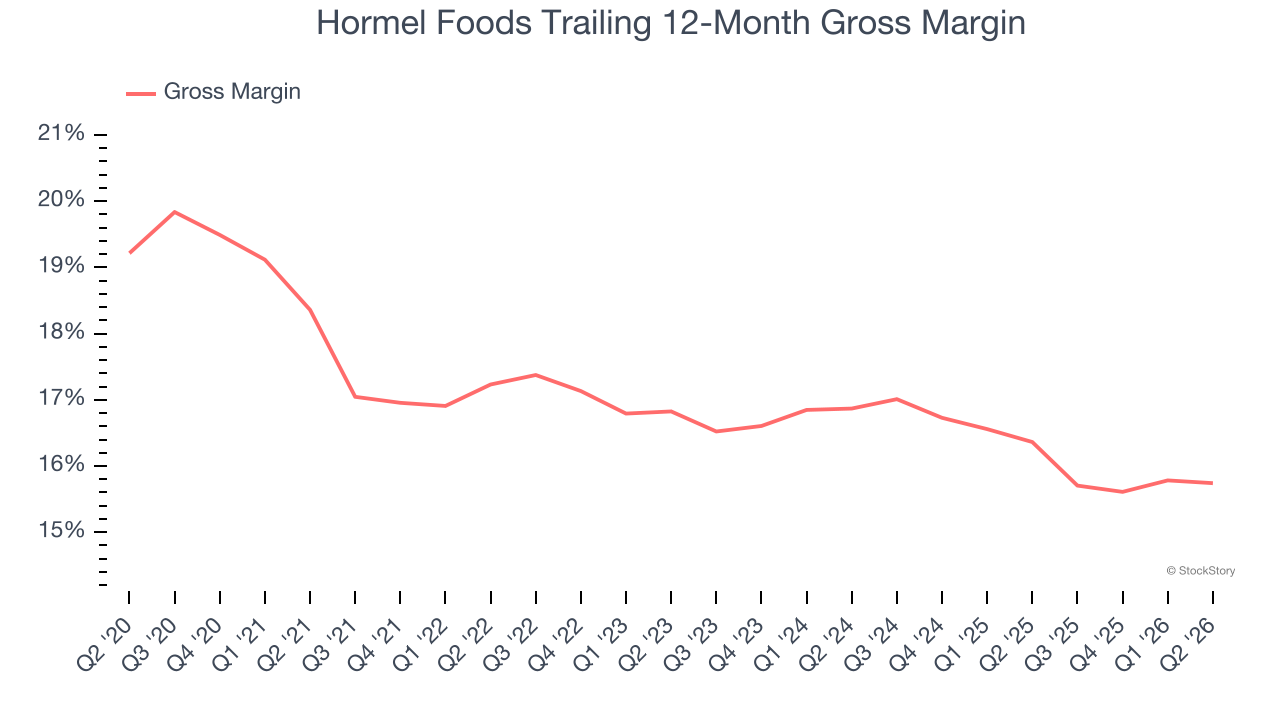
At StockStory, we prefer high gross margin businesses because they indicate pricing power or differentiated products, giving the company a chance to generate higher operating profits.
Hormel Foods has bad unit economics for a consumer staples company, signaling it operates in a competitive market and lacks pricing power because its products can be substituted. As you can see below, it averaged a 16.1% gross margin over the last two years. That means Hormel Foods paid its suppliers a lot of money ($83.95 for every $100 in revenue) to run its business.
Final Judgment
We see the value of companies helping consumers, but in the case of Hormel Foods, we’re out. Following the recent decline, the stock trades at 13.6× forward P/E (or $20.86 per share). While this valuation is fair, the upside isn’t great compared to the potential downside. There are better stocks to buy right now. Let us point you toward one of our all-time favorite software stocks.
Stocks We Would Buy Instead of Hormel Foods
ONE MORE THING: Top 5 Growth Stocks. The biggest stock winners almost always had one thing in common before they ran. Revenue growing like crazy. Meta. CrowdStrike. Broadcom. Our AI flagged all three. They returned 315%, 314%, and 455%, respectively.
Find out which 5 stocks it’s flagging this month — FREE. Get Our Top 5 Growth Stocks for Free HERE.
Stocks that have made our list include now familiar names such as Nvidia (+1,460% between June 2020 and June 2025) as well as under-the-radar businesses like the once-micro-cap company Tecnoglass (+1,552% between June 2020 and June 2025). Find your next big winner with StockStory today.