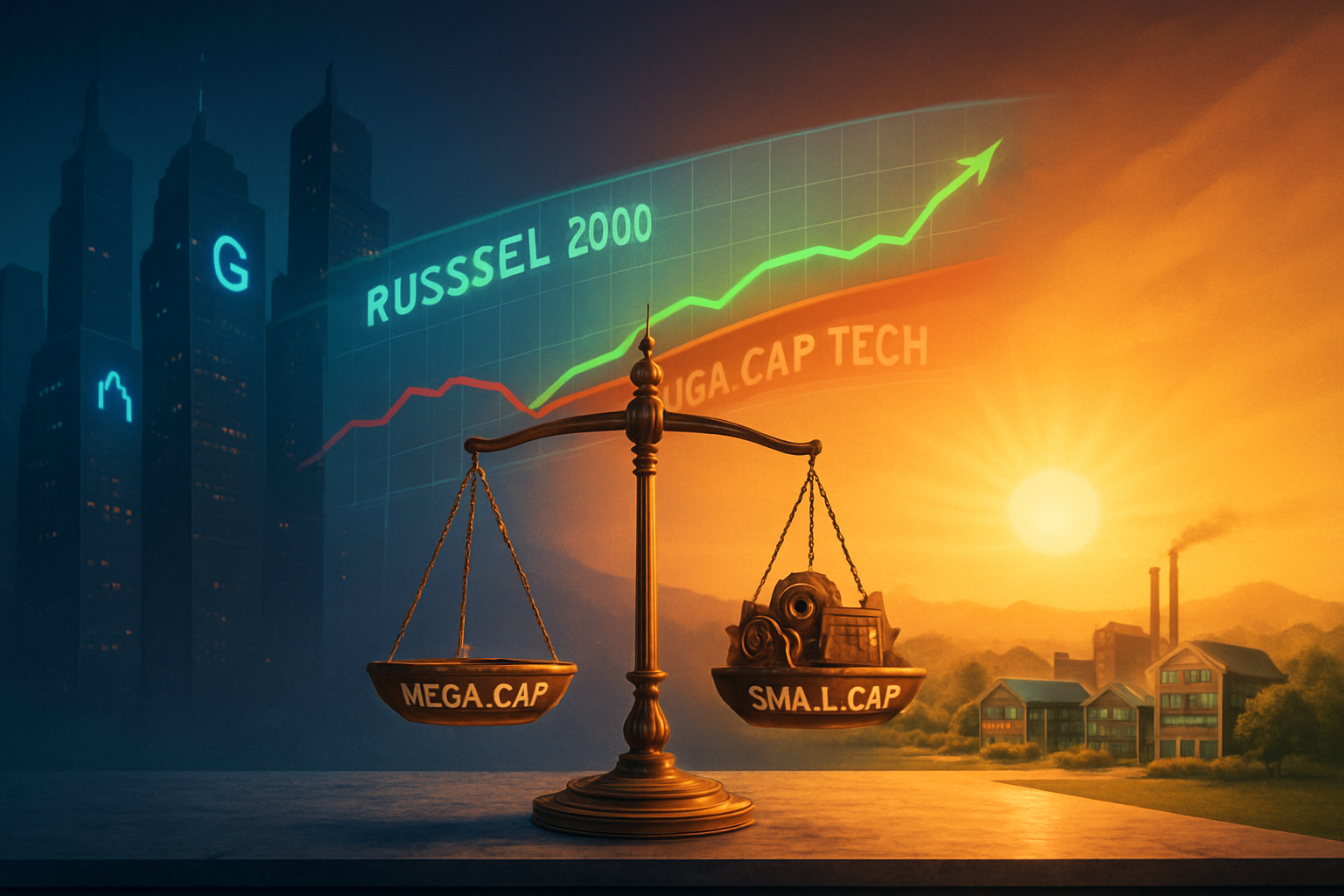
As of late January 2026, a seismic shift is rattling the foundations of Wall Street. After a multi-year era defined by the undisputed dominance of a handful of tech titans, the long-prophesied "Great Rotation" has finally arrived. The Russell 2000, the bellwether index for small-cap stocks, has surged nearly 8% in the first few weeks of the year, while the "Magnificent Seven" companies—which carried the market through the AI-frenzy of 2023 and 2024—have collectively stalled, with several entering modest correction territory.
This pivot represents more than just a seasonal adjustment; it is the realization of a massive "earnings handoff." For the first time in this decade, analysts are projecting that the earnings growth of small-cap companies will outpace that of mega-cap tech. As the Federal Reserve pauses its aggressive easing cycle at today’s January 28, 2026 meeting, investors are reassessing the value of the "AI premium" against a backdrop of revitalized domestic industrials and regional banks that are finally breathing after years of high borrowing costs.
A Easing Cycle Bears Fruit for the Underdog
The road to this rotation was paved by a significant shift in monetary policy that began in late 2024. Following a "higher for longer" stance that saw the federal funds rate peak above 5%, the Federal Reserve embarked on a decisive easing cycle throughout 2025. By December 2025, the central bank had delivered a total of 175 basis points in cuts, bringing the target range to its current 3.50% to 3.75%. At today's meeting, Fed Chair Jerome Powell and the FOMC elected to hold rates steady, signaling that the "normalization" phase is largely complete. This stability has provided the perfect "Goldilocks" environment for smaller firms that were previously suffocated by high interest expenses.
The timeline leading to this moment was accelerated by the passage of the One Big Beautiful Bill Act (OBBBA) in July 2025. This landmark legislation reinstated 100% bonus depreciation and expanded interest deductibility to 30% of EBITDA, providing a massive fiscal tailwind to capital-intensive, domestic firms. While the market leaders of the past—focused on high-margin software and chips—already had fortress balance sheets, the Russell 2000 was uniquely positioned to benefit from these tax breaks. The combination of lower rates and fiscal stimulus triggered a massive inflow of capital into the index starting in late October 2025, a rally that has shown no signs of abating in the first month of 2026.
Initial market reactions have been stark. Trading desks at major institutions like Goldman Sachs (NYSE: GS) and Morgan Stanley (NYSE: MS) reported record-breaking outflows from tech-heavy ETFs in favor of small-cap value funds. The "AI fatigue" that began to settle in during the third quarter of 2025 has fully crystalized, as investors demand more than just "future potential" from the market's previous darlings. As profit margins for small caps expand thanks to reduced debt-servicing costs, the valuation gap that reached two-decade highs in 2024 is rapidly closing.
Winners and Losers in the New Regime
The most visible casualties of this rotation are the members of the Magnificent Seven. NVIDIA (NASDAQ: NVDA), once the poster child of the AI revolution, has faced a difficult start to 2026 as its year-over-year growth comparisons finally began to normalize, leading to a year-to-date slide of 5%. Similarly, Apple (NASDAQ: AAPL) has struggled with cooling consumer demand and a transition away from its high-valuation hardware multiples, down 8% since the start of January. Even Microsoft (NASDAQ: MSFT) and Amazon (NASDAQ: AMZN), while still fundamentally strong, have seen their stock prices languish as capital moves toward higher-beta, smaller-cap opportunities that offer more "bang for the buck" in a 3.5% interest rate environment.
On the winning side of the ledger, regional banking and domestic manufacturing have emerged as the new leaders. Companies within the Russell 2000 that were heavily burdened by floating-rate debt have seen their net interest margins improve almost overnight. Small-cap biotech and industrial firms, which rely heavily on credit for expansion, are the primary beneficiaries of the Fed’s 175-basis-point gift. Investors are also flocking to Tesla (NASDAQ: TSLA) competitors in the niche EV and renewable space, which are benefiting from the OBBBA Act's domestic manufacturing incentives, though Tesla itself remains a wild card in the Mag 7 pack due to its unique retail following.
Institutional players are now favoring "the other 493" of the S&P 500 and the broader Russell 2000 index. Fundstrat’s Tom Lee, a long-time bull on small caps, noted that the current environment resembles the post-2000 dot-com bust, where the "S&P 493" significantly outperformed the tech-heavy leaders for several years. This shift is not just about avoiding tech; it is about seeking the "earnings acceleration" found in sectors like energy, materials, and regional finance, which are finally catching up to the broader market's post-pandemic recovery.
Broader Significance and Historical Precedents
The wider significance of this rotation cannot be overstated. It marks the end of a "narrow market" that many economists warned was a sign of systemic fragility. In 2023 and 2024, the top ten stocks in the S&P 500 accounted for a record percentage of the index's total market cap. By January 2026, this concentration has begun to unravel, leading to what market historians call "broadening breadth." A healthy market is typically one where many sectors participate in gains, and the current move suggests a more resilient economic foundation that is not solely dependent on a single technological breakthrough like generative AI.
This event also carries significant policy implications. With Fed Chair Jerome Powell’s term set to expire in May 2026, the current administration and potential successors are closely watching the market’s reaction to the "pause." The Trump administration’s influence is already being felt, as speculation grows that a more dovish chair could be appointed to drive rates even lower, potentially fueling a speculative "melt-up" in small-cap assets. This political backdrop adds a layer of complexity to the rotation, as the "OBBBA" tax incentives and potential for further deregulation are being priced into small-cap valuations today.
Historically, such rotations often occur when a dominant theme—like the internet in 1999 or Nifty Fifty in the 1970s—reaches a valuation ceiling. In 2026, we are seeing a parallel to the early 2000s, where the "Old Economy" stocks took the baton from the "New Economy" tech stars. While AI remains a transformative force, the market is now acknowledging that the productivity gains from AI are being felt by the users of the technology—the smaller, more efficient firms—rather than just the providers of the infrastructure.
Looking Ahead: The Road to May 2026
In the short term, volatility is expected to remain high as the market "re-prices" the Magnificent Seven. We may see tactical bounces in tech as dip-buyers attempt to reclaim the 2025 highs, but the structural trend favors the small-cap rotation as long as inflation stays near the 2.7% mark. The primary challenge for the Russell 2000 will be managing the risk of a "re-acceleration" of inflation, which would force the Fed to abandon its pause and potentially hike rates again—a move that would be catastrophic for the debt-sensitive small-cap sector.
Strategically, investors are likely to pivot toward "quality small caps"—companies with strong cash flows that can now leverage lower borrowing costs to fund acquisitions or stock buybacks. We should expect an M&A wave in late 2026, as the "cash-rich" tech giants like Alphabet (NASDAQ: GOOGL) and Meta (NASDAQ: META) use their cooling stock currency to buy up the very small-cap competitors that are currently outperforming them. This consolidation could be the next phase of the market cycle, blending the old-world reliability of the Russell 2000 with the technological prowess of the mega-caps.
Final Assessment: A Healthier Market Foundation
The current rotation into small-cap stocks as of January 2026 marks a turning point for global markets. The dominance of the Magnificent Seven was a necessary phase of the AI-driven recovery, but the current broadening of the market suggests a more sustainable and diverse economic expansion. The role of interest rates has been the primary catalyst; as the "cost of capital" normalized, the playing field was leveled for domestic, capital-intensive businesses that form the backbone of the U.S. economy.
Investors should watch the upcoming Fed leadership transition in May 2026 and the quarterly earnings reports of small-cap industrials as the ultimate barometers for this trend. If the "earnings handoff" holds true and small-cap profit growth continues to accelerate into the 30% range, the 2026 rotation will be remembered not as a brief anomaly, but as the beginning of a new era of market leadership. For now, the "Magnificent Seven" must learn to share the spotlight with the "Thousands" of smaller companies that are finally having their day in the sun.
This content is intended for informational purposes only and is not financial advice.