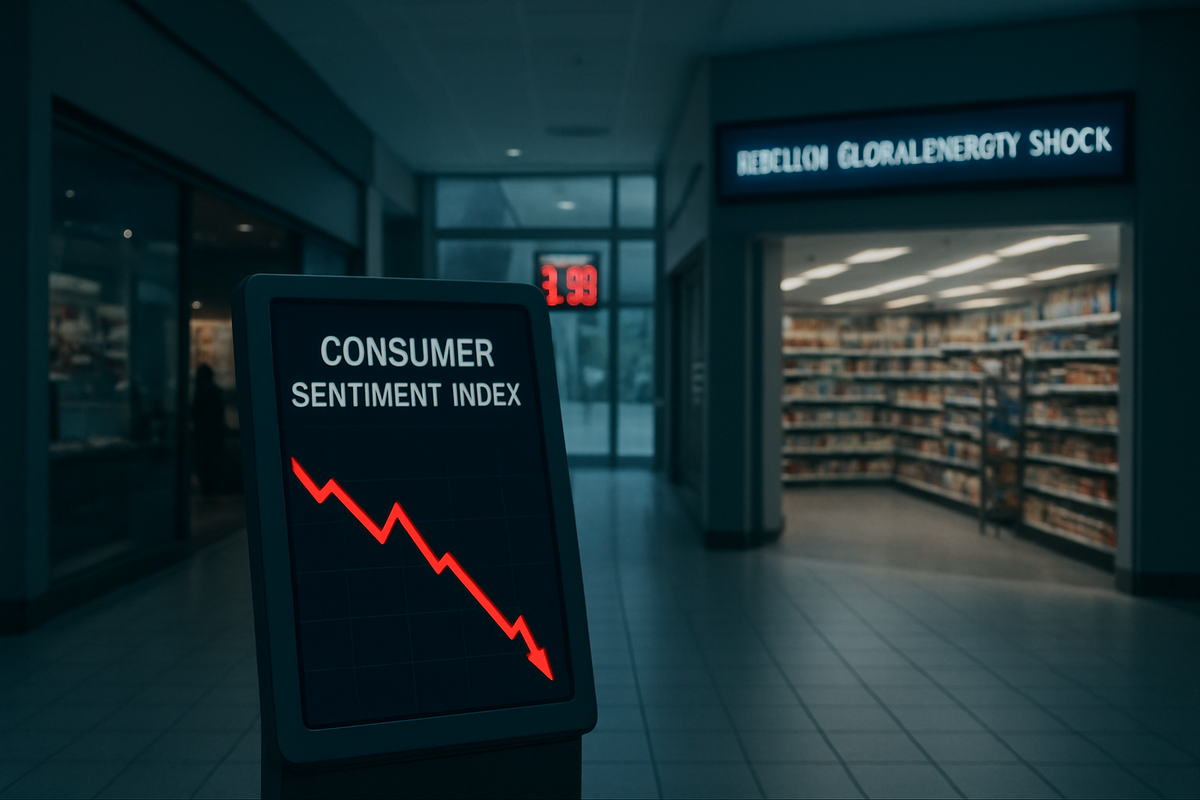
The American consumer, long the resilient engine of the global economy, is finally showing signs of a significant breakdown. As of late March 2026, a series of compounding economic pressures—ranging from a sudden energy price spike to a cooling labor market—has driven consumer sentiment to its lowest levels since the 2022 inflationary peak. The University of Michigan Consumer Sentiment Index plummeted to a final reading of 53.3 this month, a sharp drop from February’s 56.6, signaling a profound shift in household expectations that has sent tremors through the retail sector.
This collapse in confidence is not merely a psychological shift; it carries immediate implications for the broader market. With the Conference Board’s Expectations Index falling to a precarious 72.0—well below the 80-threshold traditionally associated with an impending recession—large-cap retailers are bracing for a prolonged pullback in discretionary spending. The "sentiment gap" between a record-high stock market and the lived experience of the average shopper has widened to a chasm, forcing investors to re-evaluate the sustainability of corporate earnings in an environment of "stagflationary" risk.
A Perfect Storm: The Catalyst Behind the March Sentiment Crash
The precipitous decline in sentiment throughout March 2026 can be traced to a "perfect storm" of external and internal shocks. The primary catalyst was the late February escalation of conflict in the Middle East, specifically involving U.S.-supported measures against Iran, which led to the temporary closure of the Strait of Hormuz. This geopolitical crisis sent Brent Crude prices soaring to $120 per barrel almost overnight, resulting in a national average gasoline price of $3.98 per gallon. For many American households, this "tax at the pump" arrived just as the stimulative effects of the One Big Beautiful Bill Act tax cuts were beginning to be offset by persistent headline inflation, which jumped toward 4.0% in the first quarter.
Compounding the energy shock was a surprisingly weak February jobs report, which revealed a net loss of 92,000 positions and pushed the national unemployment rate to 4.4%. This cooling of the labor market, after years of perceived invincibility, has introduced a new layer of anxiety for middle-income workers. Historically, the U.S. consumer has been willing to spend as long as their job felt secure; however, with mass layoffs appearing in tech and manufacturing sectors, that security has evaporated. Major financial institutions like JP Morgan (NYSE: JPM) have responded by raising their recession probability for 2026 to 35%, noting that the "soft landing" narrative of late 2025 is now under extreme duress.
The timeline of this sentiment crash has been remarkably swift. At the start of 2026, economists were optimistic that the Federal Reserve would begin a series of rate cuts. Instead, the "sticky" nature of service-sector inflation and the new energy-driven supply shock have forced the Fed to maintain a restrictive 3.50%–3.75% range. By the third week of March, market expectations pivoted from a June rate cut to a 50% probability of a rate hike, a move that further rattled consumer confidence and froze a housing market already burdened by 6.5% mortgage rates.
Retail Bifurcation: Who Wins and Loses in the Sentiment Slump?
The impact of this sentiment crash is not being felt equally across the retail landscape, leading to a stark bifurcation between value-oriented staples and discretionary "wants." Walmart Inc. (NYSE: WMT) has emerged as a primary beneficiary of the "flight to value." As high-income households (those earning over $100,000) begin to feel the pinch of rising costs, they have increasingly traded down to Walmart and Costco Wholesale Corporation (NASDAQ: COST). Walmart’s recent earnings guidance highlighted a 140-basis-point increase in its private-label penetration, particularly through its Member’s Mark brand, as consumers prioritize essentials over brand-name loyalty.
Conversely, Target Corporation (NYSE: TGT) finds itself in a more precarious position. With a product mix heavily weighted toward home decor, apparel, and electronics, Target is uniquely vulnerable to what its management has termed a "discretionary recession." Transactions at Target fell 2.9% as shoppers bypassed the "cheap chic" aisles to focus on groceries. In response, Target has announced a $1 billion investment to relaunch its Threshold home brand and wellness lines, attempting to lure back price-sensitive shoppers with high-quality, low-cost alternatives. However, analysts remain skeptical that these moves can offset the broader decline in consumer traffic.
Amazon.com, Inc. (NASDAQ: AMZN) and The Home Depot, Inc. (NYSE: HD) are also navigating significant headwinds. Amazon’s stock faced pressure in March after the company announced a massive $200 billion capital expenditure plan focused on AI, just as it terminated its "commingled inventory" program to combat counterfeit goods—a move that added operational complexity for third-party sellers during a period of slowing demand. Meanwhile, Home Depot is grappling with a "frozen" housing market. CEO Ted Decker recently warned of a "sharp decline in bigger-ticket projects" like full kitchen remodels, forcing the company to pivot its strategy toward its "Pro" customers and high-margin exclusive brands like Ryobi and Husky to sustain growth.
The Wider Significance: A Return to the 2022 Playbook?
The current decline in consumer confidence bears a striking, if uncomfortable, resemblance to the inflationary shock of 2022. However, the 2026 landscape is more complex due to the "Sentiment Gap"—the divergence between relatively strong GDP growth (projected at 2.2% for 2026) and the dismal mood of the public. This suggests that traditional economic indicators may no longer fully capture the psychological toll of sustained high costs of living. The event fits into a broader trend of "consumer exhaustion," where three years of post-pandemic price volatility have finally depleted the excess savings that previously propped up spending.
From a policy perspective, this sentiment crash places the Federal Reserve in a classic "stagflationary trap." If the Fed cuts rates to boost confidence and support the labor market, it risks reigniting inflation fueled by the energy shock. If it holds or raises rates to combat $120 oil, it could trigger the very recession that consumers now fear. This dilemma has global ripple effects; as the U.S. dollar fluctuates in response to these domestic pressures, international partners and competitors in the retail and energy sectors are forced to adjust their trade strategies, particularly as "Liberation Day" tariffs on global goods further inflate the cost of imported retail inventory.
Historical precedents, such as the 1970s oil shocks or the 2008 financial crisis, suggest that once the consumer "breaks," the recovery period is often measured in years, not months. The current event indicates that the "resilient consumer" narrative may have reached its structural limit. Retailers are now responding by aggressively adopting AI-driven supply chain automation to lower their "cost to serve," recognizing that they can no longer rely on volume growth alone to drive margins.
What Comes Next: Strategic Pivots and Potential Outcomes
In the short term, investors should expect a high degree of volatility as retailers report their Q1 2026 earnings. A key metric to watch will be inventory-to-sales ratios; companies like Walmart that have already automated their inventory management are likely to outperform those that are still sitting on high levels of discretionary goods. We may also see an increase in "promotional intensity" as retailers like Best Buy Co., Inc. (NYSE: BBY) and Target engage in price wars to capture a shrinking pool of consumer dollars.
Looking further ahead, a major strategic pivot toward "Pro" and "Value" segments is likely to become the industry standard. We could see more large-cap retailers following Amazon’s lead in prioritizing logistics efficiency and brand protection over rapid expansion. If the energy shock persists, the "e-commerce advantage" may strengthen further, as consumers choose the convenience and price-comparison tools of online shopping over the gasoline costs associated with driving to brick-and-mortar stores. The long-term scenario hinges on the Federal Reserve’s next move; a "hawkish hold" could solidify the sentiment floor, while any sign of panic could send the U.S. into a formal contraction by the end of 2026.
Wrap-Up: Navigating the New Retail Reality
The March 2026 collapse in consumer sentiment marks a turning point for the U.S. economy. The combination of geopolitical instability, rising energy costs, and a cooling labor market has effectively ended the era of "revenge spending" that characterized the mid-2020s. The key takeaway for the market is that the consumer is no longer a monolithic force; instead, we are seeing a fragmented landscape where the wealthy continue to spend while the middle and lower classes are forced into defensive, value-first postures.
Moving forward, the market will likely reward companies with strong balance sheets and the ability to pivot toward essentials. Investors should keep a close eye on the University of Michigan’s April sentiment preliminary readings and the upcoming retail sales data for signs of a "stabilization" or a further leg down. While the current outlook is clouded by uncertainty, the crisis also presents an opportunity for retailers to lean into innovation and efficiency. The coming months will determine which companies can weather the March chill and which will be left behind in the shifting economic sands.
This content is intended for informational purposes only and is not financial advice.