Quick Navigation
- Why Ordinary Lag Screws Strip and Split Hardwood ?
- Sinsun Structural Lag Screws – Design Matched to Heavy Timber
- Product variations for specific environments
- Conclusion: The Sinsun System Method
- Bulk Wholesale & Custom Supporting Services
- Need a Sizing Match for Your Next Timber Project?
If you've ever turned a heavy lag screw into dried hardwood timber. It is possible for the tension to give way mid-torque. There may be a sharp snap, only to find that the wood has split along its grain. Anyone working on heavy timber frame construction suffers major losses from these two issues.
Thread stripping leaves the screw spinning uselessly in an oversized or galled hole, offering zero clamp force. Timber splitting turns a structural connection into a cosmetic one, often requiring sistered joists or oversized brackets to pass inspection. These issues are no small matter for large terrace frames or multi-storey wooden structures: not only do they result in significant rework and increased material costs, but they can sometimes cause load-bearing connections to fail pull-out tests.
The common misconception is that the wood is too hard or the driver has too much torque. For large terrace frames or multi-story wooden structures, these issues are no small matter: not only do they result in significant rework and increased material costs, but they can sometimes even cause load-bearing connections to fail pull-out tests.
Why Ordinary Lag Screws Strip and Split Hardwood ?
Overcrowded standard thread pitch causes timber splitting.
Based on the design of machine bolts, standard lag screws typically have a relatively fine thread pitch. In dense hardwoods such as oak, ipe, or treated southern yellow pine, tightly spaced threads cannot efficiently displace the wood fibres. Rather than cutting a clean path, the screw compresses the wood laterally. As the pressure increases, the grain gives way, resulting in a split along the pilot hole and edge.
At the same time, the packed wood dust and fibres get trapped between the threads, increasing friction exponentially. The operator applies more torque as the driver struggles to turn, and either the threads strip the hole or the screw head shears off.
Heat treatment misapplied thread stripping.
The hardness of lag screws depends entirely on heat treatment technology. Low-cost ordinary lag screws have two extreme problems with hardness control: excessive quenching hardness makes the screw body brittle and rigid, preventing the thread teeth from slightly deforming during high-torque tightening. This results in direct wear and slippage with wood fibres, forming thread stripping. Under-heated, low-hardness screws, on the other hand, have insufficient rigidity and the thread teeth deform and collapse under load, losing locking force.
The proper engineered structural lag screw uses a casehardened core with a slightly tempered surface to balance thread retention and chipflow.
Unreasonable shank structure leads to long-term structural failure.
Many ordinary lag screws are designed with irregular thickened smooth shanks. The smooth shank diameter is much larger than the threaded section, making the stress concentrate on the root of the thread transition zone. When exposed to long-term wind vibration, temperature fluctuations, and structural loads, stress fatigue cracking occurs at the thread root, resulting in screw breakage. Within 1-2 years of use, this hidden danger will gradually fail, posing significant safety risks to timber structures.
Sinsun Structural Lag Screws – Design Matched to Heavy Timber
Sinsun addresses both failure points through thread geometry optimisation and controlled heat treatment, rather than simply increasing the steel grade.
Wider thread pitch with built‑in chip channel
Our structural lag screws feature a coarser thread pitch than generic fasteners. The wider spacing creates a defined relief path for wood chips and dust during driving. This reduces lateral compression inside the pilot hole by nearly 40% in high‑density hardwoods. The result: clean thread engagement without the wedging effect that causes splitting.
Additionally, the thread flanks are cut at a slightly sharper angle to shear the timber fibres rather than crushing them – a detail that makes a visible difference in ipe and cumaru decking.
Controlled hardness for toughness
We apply an induction‑hardening process that targets the thread roots while maintaining core toughness of approximately HRC 32–36 on the surface layer. This provides:
- Sufficient shear strength to cut through dense timber consistently.
- Enough ductility to absorb momentary torque spikes without thread deformation
- Resistance to fatigue in cyclic loading (e.g., deck live loads)
Product variations for specific environments
We segment our lag screw range to match real‑world exposure conditions, not just arbitrary coating names.
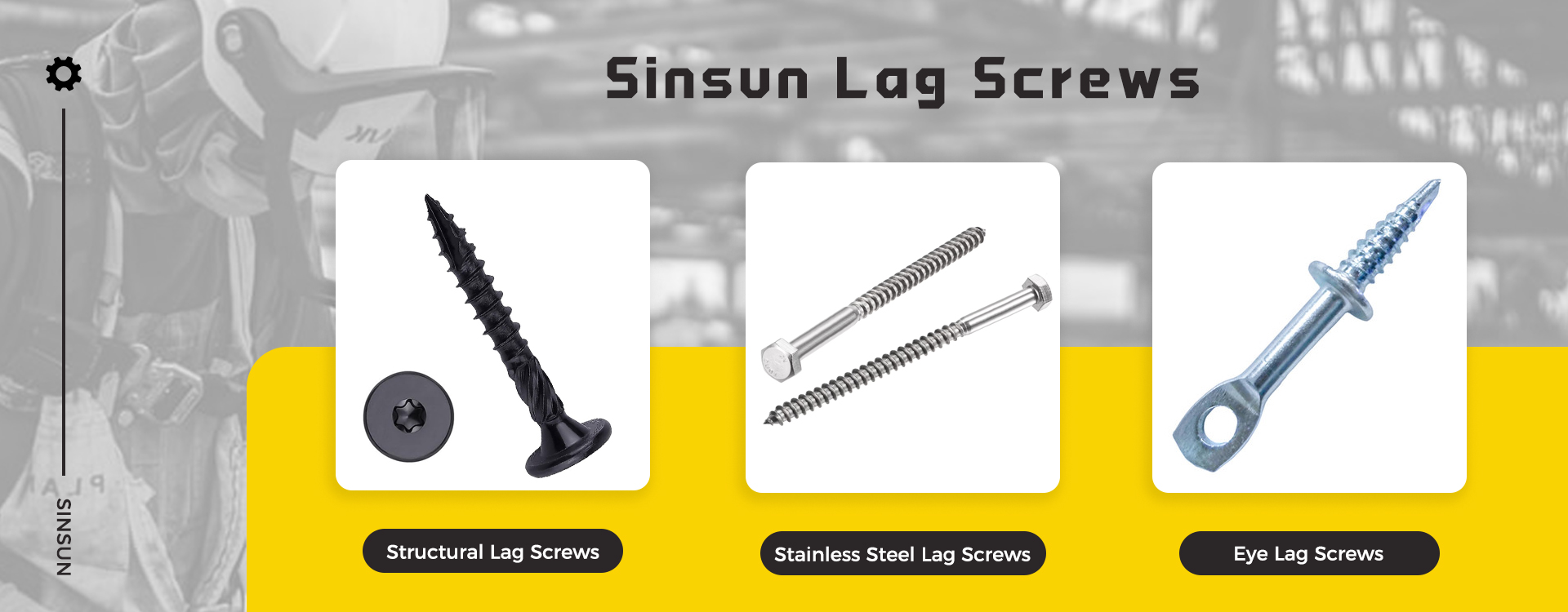
Sinsun Structural Lag Screws (Core) – Black E‑Coat / Black Oxide
Our structural line is designed for interior load-bearing timber frames, glued laminated timber (glulam) post-and-beam construction, and heavy wood connections where moisture exposure is minimal. Black ECoat, a thin, uniform coating, resists rust during the indoor service life of the product without adding excessive thickness to the threads. If the torque value remains constant, the screw will screw smoothly into the guide hole and seat fully without jamming.
Heavy‑Duty Deck Lag Screws – Hot‑dip Galvanized (HDG)
This is a heavy‑duty deck lag screws for use on exterior decks, Pergolas and ground contact timber applications. It has a robust hot dip galvanized coating that gives excellent corrosion resistance against rainwater, ground moisture and seasonal humidity. The HDG layer is thicker than the electroplated zinc, making it ideal for pressure treated lumber that has corrosive chemicals present. The coating also has a matte grey finish to match treated wood for visible deck surfaces.
Zinc Plated Eye Lag Screws – Bright Zinc
We also provide eye lag screws with a bright zinc electroplated finish for suspended overhead loads and cable bracing applications. The eye head will accept ropes, cables or turnbuckles and the thread design is the same as our structural series for reliable holding in overhead timber. These are for tension load only. For dynamic or lateral loads consult a structural engineer to verify eye size and thread engagement. This variant is not a direct substitute for structural lag bolts in primary framing, but is a useful accessory in bracing systems.
Specification & Torque Reference Table – Structural & Deck Models
This table applies to Sinsun Structural Lag Screws and Heavy‑Duty Deck Lag Screws only.
| Screw Size (Diameter) | Shank Diameter (mm) | Recommended Timber Types | Recommended Tightening Torque (Nm) | Available Finishes |
| 1/4" (6.35 mm) | 4 | Softwood, pine, cedar | 10–14 | E-Coat, HDG, 304 |
| 5/16" (7.94 mm) | 5 | Spruce, fir, light hardwood | 20–27 | E-Coat, HDG, 304, 316 |
| 3/8" (9.53 mm) | 6 | Oak, ipe, treated SYP | 34–41 | E-Coat, HDG, 304 |
| 1/2" (12.7 mm) | 8 | Dense hardwood, glulam beams | 68–81 | HDG, 304, 316 |
| 5/8" (15.9 mm) | 10 | Heavy structural timber (column base) | 108–135 | HDG only |
Torque values assume proper pilot hole diameter (see installation notes below). For stainless steel variants, reduce torque by 10–15% due to galling risk on threads.
Heavy-Duty Wood Structure Installation Process—Avoiding Rework
Unstandardized installation is one of the key inducements of lag screw failure even for high-quality structural-grade products.
Following are the steps for installing structural fasteners in compliance with ASTM A394 and the North American Wood Construction Code. To prevent wood splitting, stripped threads and insufficient clamping force, we have established clear quantitative standards for each operation.
→ Step 1: Drill standard pilot holes. Pre-drilling pilot holes is necessary when installing into hardwood or using large-diameter square-head lag screws. For hardwood, the pilot hole diameter should not exceed 75% of the screw diameter to minimise compressive stress. To minimize compression stress in hardwood, the pilot hole diameter should not exceed 75% of the screw diameter. The drill hole depth should be 3–5 mm deeper than the embedment depth of the screw to allow space for the bottom of the threads and prevent wood splitting caused by compression at the top.
→ Step 2: Adjust the fastening parameters appropriately. Use an electric or pneumatic drill with high torque and low speed, limiting the speed to ≤250 RPM. High speeds can cause high-temperature friction, resulting in severe wear on the thread flanks. This can result in stripped threads and failure before the bolt is fully tightened. Turn the tool on to constant torque mode to prevent instantaneous impact loads.
→ Step 3: Standardizing torque tightening procedures. Tighten the bolt evenly and consistently. Don’t stop or slam it hard. When the bolt head is flush with the wood surface, stop. When installing, observe the torque values given in the table. Over-torquing can crush thread flanks and cause hidden thread slip. If the torque is not sufficient the structural joints will be loose and will not carry the loads required.
→ Step 4: Layout with standardized spacing and edge distance. For outdoor load-bearing timber frames and wind-resistant structures, the lag screws installation spacing must be in compliance with local building wind load codes. The minimum edge distance from the centre of the screw to the edge of the timber is 100mm, which helps to distribute the edge stress and prevent the timber cracking at the edge. To improve the overall structural stability of multi-layer superimposed timber structures, the staggered installation method is adopted.
Bulk Wholesale & Custom Supporting Services
Sinsun Hardware is a professional manufacturer of structural fasteners, which is engaged in the R&D and mass production of high-standard lag screws for heavy timber construction. We keep a full-size inventory of stock for all popular specifications of structural lag screws, deck lag screws, and stainless steel lag screws, enabling us to quickly respond to large project orders and urgent engineering procurement needs. Several standardized heat treatments and rigorous performance tests are conducted on each batch of products to guarantee their tensile strength, torsional resistance, and corrosion resistance.
Our company is unique among fastener suppliers who only provide single products. The services we provide reduce procurement costs, ensure project quality, and simplify engineering docking procedures for global hardware wholesalers, timber engineering contractors, and prefab wood structure manufacturers.
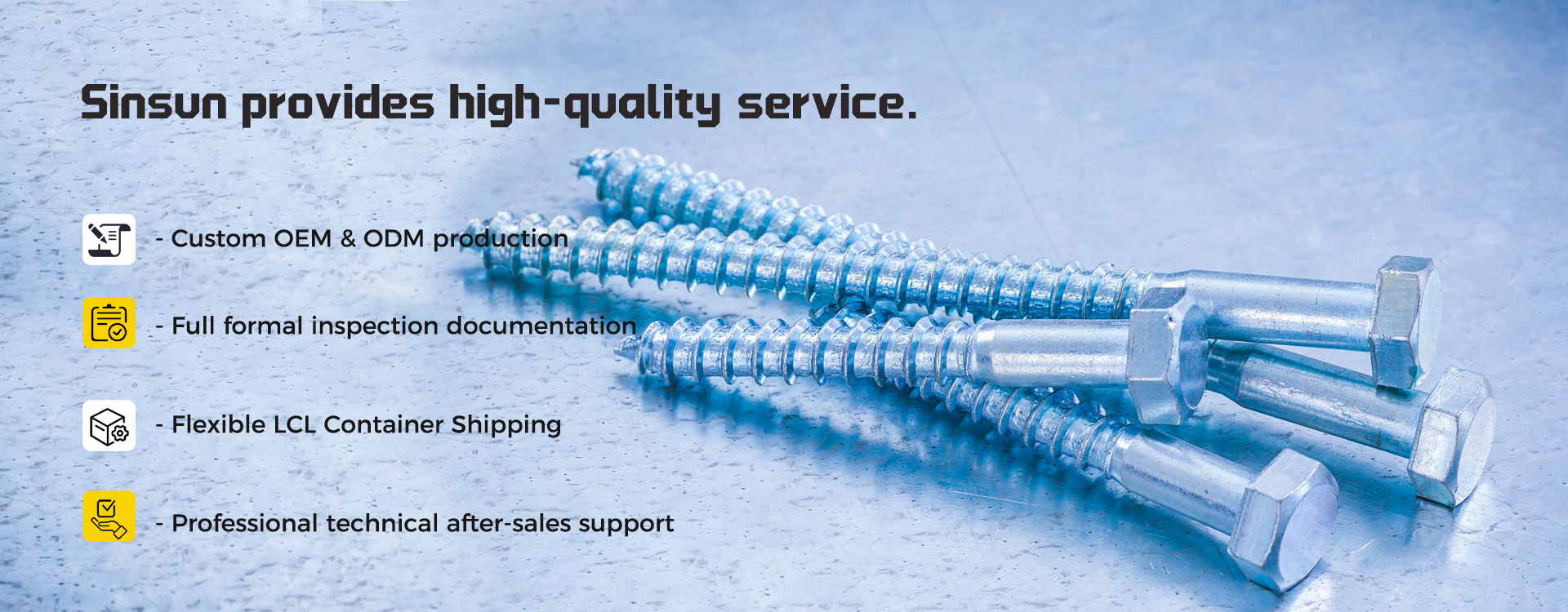
- Custom OEM & ODM production: Provide laser logo marking services for brand customization, as well as support customized thread pitch, shank length, screw head type, and surface coating.
- Full formal inspection documentation: Factory mechanical test report, torque resistance test data, tensile strength certificate, salt spray test report, support for project bidding qualification review, and cross-border customs clearance inspection.
- Flexible LCL Container Shipping: We support mixed shipments of square-head lag screws, wood screws, construction nails, wall anchors, and other hardware fasteners, effectively reducing overall ocean freight costs and simplifying bulk purchase management.
- Professional technical after-sales support: Our engineering team provides free pre-sales substrate matching guidance, on-site installation technical consultation and after-sales problem solving services, helping customers avoid fastener failure risks and improve project construction quality.
Need a Sizing Match for Your Next Timber Project?
Whether you need conventional standard lag screw bulk procurement, special specification customized fasteners, or professional structural fastening solution consultation for heavy timber projects, you can contact the Sinsun Hardware professional team at any time. We will provide accurate parameter matching, competitive bulk quotation and full-process technical support for your construction projects.
Email us: [info@sinsunscrew.com] with or use the contact form below.
Media Contact
Company Name: Tianjin Sinsun Imp & Exp Co., Ltd.
Email: Send Email
Country: China
Website: https://www.sinsunhardware.com/