Most expensive used-car regrets trace back to something the buyer could have known in advance. Here is how to know.
By Karen Holloway
Ask anyone who has been burned buying a used car, and the story tends to rhyme. The vehicle looked great, the price seemed fair, and the trouble only showed up weeks later — a transmission that should have been flagged, a frame that had clearly been repaired, a title that turned out to be branded. The frustrating part is that almost all of these surprises were knowable before any money changed hands.
That is the central truth of smart used-car shopping: the worst outcomes are usually the most preventable. The information exists. It is just a matter of pulling it before you sign rather than discovering it after.
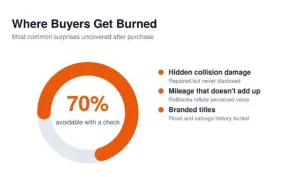
The breakdown above captures where buyers most often get caught. Hidden collision damage leads the list — repairs that were done well enough to pass a glance but never disclosed. Close behind is mileage that does not add up, where an odometer has been rolled back to inflate the car’s apparent value. Then come branded titles: flood and salvage histories quietly buried beneath a fresh coat of detailing.
What ties these together is that each leaves a documented trail. A reported collision generates insurance and repair records. A rollback creates a contradiction between past mileage readings and the current dashboard. A branded title is, by definition, an official designation sitting in motor-vehicle records. Pull the vehicle’s history and these trails come into view.
The tool that surfaces them is a VIN report. Enter the car’s seventeen-character identification number into a service such as this car history checker and you receive a compiled record assembled from insurers, auctions, motor-vehicle agencies, and federal safety databases. The accidents, the mileage timeline, the title status, the open recalls — all of it lands in one place, in seconds.
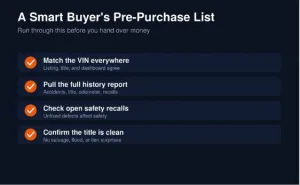
The checklist above is the practical version of all this — the routine to run through before you hand over money. Start by matching the VIN across the listing, the title, and the dashboard; they should agree exactly. Pull the full history report. Check specifically for open safety recalls, which are unfixed defects the manufacturer has already acknowledged. And confirm the title is clean, with no salvage, flood, or lien surprises lurking in the record.
None of this is complicated, and that is rather the point. The barrier to protecting yourself is not difficulty — it is simply remembering to do it. The buyers who get burned are almost never the ones who ran a report and ignored a warning. They are the ones who never ran the report at all.
There is real money on the line. Undisclosed accident repairs routinely run into the thousands, and a branded title can slash a vehicle’s resale value far below what you paid. Against those numbers, the cost of a history report is a rounding error. Even better, a report frequently pays for itself directly: when it surfaces a documented issue, that issue becomes leverage. Buyers regularly negotiate hundreds of dollars off a price simply by showing a seller a problem the seller hoped to keep quiet.
For larger purchases, a second look is worth the small extra effort. Running the same VIN through an independent service like a separate vehicle-records report gives you a way to cross-check the first report’s findings. Agreement between two sources is strong reassurance. A discrepancy tells you exactly where to dig deeper before committing.
It is only fair to be clear about what a report can and cannot promise. A clean history is powerful reassurance, but it is not an absolute guarantee. If an accident was never reported to a source the service can access, it will not show up, and coverage can vary depending on where the car has lived. The honest, reputable services state this plainly. The right way to use a report is as one strong layer of protection, paired with a pre-purchase inspection from a trusted mechanic who can assess the car’s physical condition in the present.
Think of it as two complementary checks. The history report tells you what the car has been through on paper. The mechanic tells you what shape it is in today. Run both, and the universe of nasty surprises shrinks dramatically. Skip both, and you are buying a stranger’s problems sight unseen.
It helps to picture the kinds of stories these reports routinely uncover, because they are more common than most buyers assume. There is the sedan with a spotless interior whose record shows a major collision two owners ago, repaired just well enough to hide. There is the pickup advertised with surprisingly low mileage whose service history reveals a reading thousands of miles higher recorded years earlier. There is the bargain crossover from a coastal state whose title carries a flood brand the seller never mentioned. In each case the car looked fine and the price looked fair — and in each case the record told a different story than the listing did. The buyers who pulled a report saw the gap; the ones who did not, paid for it.
The good news is how accessible all of this has become. The VIN is right there on the dashboard and the doorjamb. The report takes seconds. The checklist fits on a sticky note. For a modest investment of time and a few dollars, you convert the single biggest gamble of a used-car purchase into a calculated, well-informed decision. The surprises that cost the most are the ones you can see coming — so look before you buy.