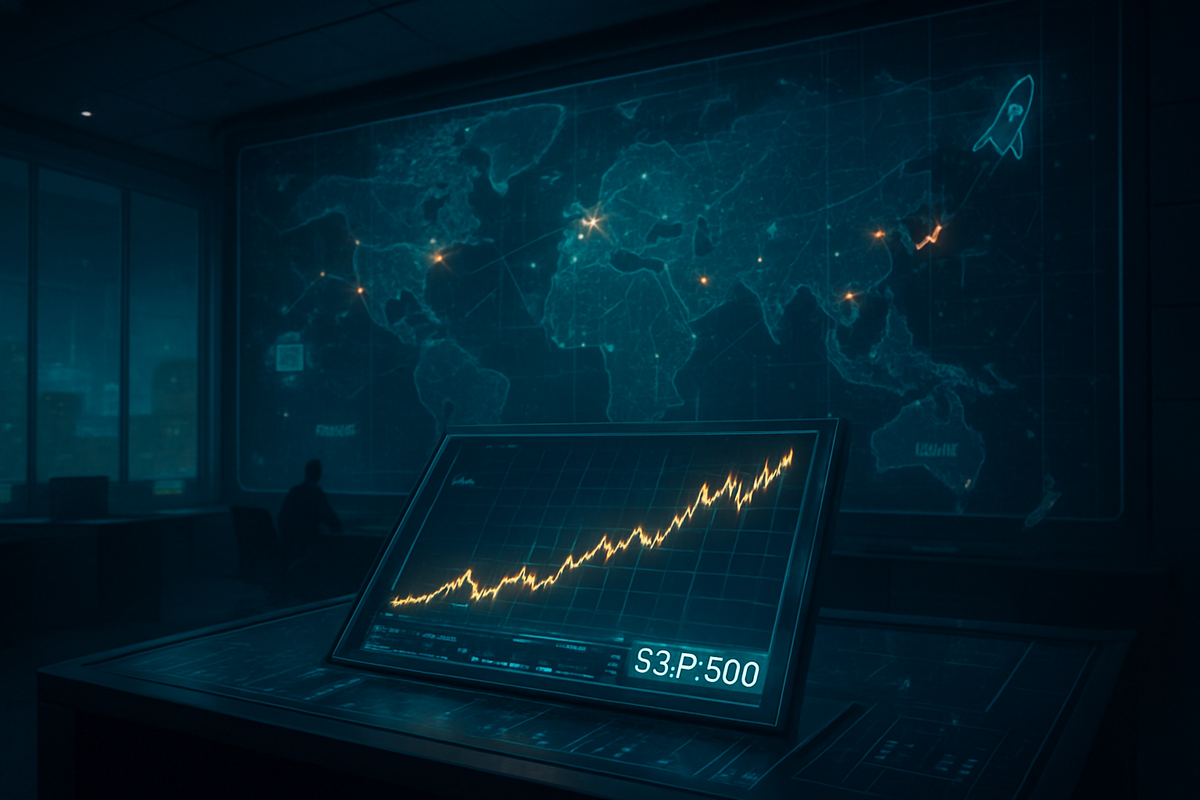
The primary theme for the year is a "broadening bull market," where investors are looking for growth beyond the tech titans that have carried the index to its current heights. However, with the S&P 500 currently trading at a forward P/E ratio of 24x and a Shiller CAPE ratio breaching 40—levels not seen since the peak of the dot-com bubble—the margin for error has never been thinner.
The immediate implications of this high-valuation environment are clear: volatility is expected to return with a vengeance. Analysts from firms like Goldman Sachs and Oppenheimer have set median year-end targets for the S&P 500 at approximately 7,550, implying a modest 6-10% return for the year. While these forecasts remain positive, they represent a significant deceleration from the explosive double-digit gains of 2024 and 2025. The market's resilience will be tested early in Q1 2026 by a combination of geopolitical flashpoints in the Middle East and the looming shadow of the 2026 U.S. Midterm elections, which historically introduce policy uncertainty and technical corrections.
Navigating the 'Broadening' Trade: A Timeline of 2025 and the Road to Now
The path to the current 2026 market climate began in mid-2025, as the Federal Reserve successfully navigated a "soft landing," bringing inflation toward its 2% target without triggering a recession. By October 2025, the central bank had initiated a series of quarter-point rate cuts, bringing the federal funds rate to its current range of 3.50%–3.75%. This easing cycle provided the liquidity necessary for the S&P 500 to maintain its record-breaking momentum, even as concerns about "AI fatigue" began to surface in financial headlines.
Key players throughout this period have shifted from mere hardware providers to the "monetizers" of the AI economy. In late 2025, we saw the first meaningful evidence of productivity gains in the services sector, where enterprise software companies began reporting double-digit margin expansions attributed to autonomous agents. However, the concentration of the market has reached a record high, with the top ten holdings now accounting for 38% of the S&P 500's total market capitalization. This concentration means that the broader market's health is now inextricably linked to a handful of balance sheets, making the upcoming Q1 earnings season a high-stakes event for global sentiment.
Initial market reactions in early January 2026 have been characterized by a "rotation into quality." As large-cap valuations appear stretched, institutional capital has begun flowing into high-quality small- and mid-cap stocks that were previously overlooked. This "broadening" of the bull market is a direct response to the massive valuation gap between the tech giants and the rest of the index. While the tech sector remains the engine of growth, the market's survival in 2026 likely depends on whether the other 490 companies in the S&P 500 can step up to sustain the rally.
The Winners and Losers of the 2026 Paradigm
The winners of 2026 are expected to be the companies that can bridge the gap between AI hype and tangible bottom-line results. Nvidia Corporation (NASDAQ: NVDA) remains the undisputed leader of the hardware cycle, with the anticipated H2 2026 launch of its "Vera Rubin" superchip expected to drive a massive upgrade cycle for global data centers. Similarly, Microsoft Corporation (NASDAQ: MSFT) is poised to win as its Azure AI services move into a mature phase of integration, with analysts projecting the company to become the first to sustain a $5 trillion market capitalization. Alphabet Inc. (NASDAQ: GOOGL) is also seeing a resurgence, as its Gemini integration successfully defends its search dominance against emerging AI-first competitors.
Conversely, the losers in this high-valuation environment are sectors sensitive to policy volatility and geopolitical shocks. The banking sector, led by giants like JPMorgan Chase & Co. (NYSE: JPM), has faced headwinds in early 2026 due to administrative calls for stricter interest rate caps on consumer credit. Similarly, the aerospace and defense sector, including Lockheed Martin Corporation (NYSE: LMT), has seen price targets slashed following executive directives aimed at curbing dividend payouts in favor of increased R&D spending. These "policy by statement" shocks have created a fragmented market where sector-specific risks can lead to sudden, sharp sell-offs regardless of broader index performance.
International markets also face a difficult year compared to the U.S. "exceptionalism" trade. Despite trading at a 40% discount to U.S. equities, European and Japanese markets are struggling with slower GDP growth—forecasted at just 1.5% for 2026—and a lack of homegrown AI infrastructure. While the U.S. market is "expensive," it remains the only major market offering significant exposure to the primary driver of 21st-century productivity, leading many global funds to maintain an overweight position in domestic stocks despite the high price of entry.
Historical Echoes and the Geopolitical Backdrop
The current market environment draws haunting parallels to the 1999–2000 dot-com bubble. With the Shiller CAPE ratio at 40.7, we are currently in the second-most expensive market in American history, surpassed only by the peak of the speculative internet frenzy 26 years ago. However, economists point to a critical difference: the current market leaders are highly profitable entities with massive cash flows, unlike the loss-making "dot-coms" of the late 90s. Nevertheless, the extreme concentration of market cap—exceeding even the 1999 peaks—suggests that any systemic shock could have an outsized impact on the global financial system.
Geopolitically, 2026 is defined by "transactional armed peace." A highly anticipated summit between U.S. and Chinese leadership in April 2026 is expected to be a major catalyst for market sentiment. While a full-scale trade war appears to have been avoided, persistent tensions over high-tech export controls and critical minerals remain a thorn in the side of global supply chains. Furthermore, the Middle East remains a "persistently dangerous" flashpoint. A potential flare-up in military conflict between regional powers in Q1 2026 could send oil prices, currently stable at $65 per barrel, into a spiral that would reignite inflationary fears and force the Federal Reserve to halt its rate-cutting cycle.
Domestically, the 2026 U.S. Midterm elections represent a "wider significance" event that historical data suggests will bring a 17% peak-to-trough drawdown during the year. Known as the "Midterm Curse," the second year of a presidential term is traditionally the most volatile for stocks. Investors are currently pricing in the possibility of legislative gridlock, which, ironically, the market often welcomes as it prevents radical changes to tax policy or corporate regulation. The expiration of several key provisions from the "One Big Beautiful Bill Act" (OBBBA) later this year will also force a showdown over the national debt, creating a "fiscal cliff" that will dominate headlines in the second half of 2026.
What Comes Next: The 2026 IPO Wave and Strategic Pivots
As we look toward the remainder of 2026, the short-term focus will be on the "Monster IPO Cycle." After several years of relative quiet in the primary markets, late 2026 is expected to see the public debuts of private behemoths that could inject over $3 trillion in new market capitalization. The most anticipated event is the potential Q3 IPO of SpaceX, which could command a valuation of $1.5 trillion, alongside long-awaited listings for OpenAI and Anthropic. These debuts will be a litmus test for the market's appetite for "pure-play" AI and space infrastructure, potentially shifting capital away from legacy tech firms.
In the long term, companies will be forced to undergo a strategic pivot from "AI experimentation" to "AI execution." The market's patience for massive capital expenditures with vague ROI targets is wearing thin. By late 2026, investors will demand to see these investments reflected in earnings per share (EPS). We may also see an acceleration of the "sovereign AI" trend, where nations build their own domestic computing clusters, creating new market opportunities for diversified hardware firms that can navigate a fragmented global landscape.
Market opportunities may also emerge in the green energy and nuclear sectors, as the power requirements for AI data centers continue to outstrip current grid capacities. Companies like NextEra Energy, Inc. (NYSE: NEE) are increasingly viewed as "AI-adjacent" plays, as the energy required to fuel the 2026 superchips becomes a primary bottleneck for the technology's expansion. Investors should watch for a "convergence trade," where tech and utilities become increasingly correlated.
A Comprehensive Wrap-Up: The Year of the 'Binary Bet'
In summary, 2026 is shaping up to be a year of high-stakes transition. The "easy money" of the post-inflationary recovery has been made, and the market must now justify its record-high valuations through sustained productivity gains. The key takeaways for investors are clear: while the structural bull market remains intact thanks to a supportive Federal Reserve and AI leadership, the risks of a technical correction are at their highest level in years. The "binary bet" on AI dominance means that the top ten stocks will continue to dictate the direction of the S&P 500, making diversification into small-cap and value sectors a defensive necessity.
Moving forward, the market's performance will hinge on three factors: the stability of the Middle East, the outcome of the April U.S.-China summit, and the ability of the "Magnificent Seven" to deliver on their ambitious earnings targets. As the 2026 Midterm elections draw closer, political noise will likely outweigh economic fundamentals, creating "buying opportunities" for those with the stomach for volatility.
The significance of 2026 will likely be remembered as the year the AI economy either matured into a sustainable engine of growth or hit the "valuation ceiling." For now, the U.S. remains the world's most attractive investment destination, but the entry price has never been steeper. Investors should watch for the "Vera Rubin" chip launch and the SpaceX IPO as the two primary signals for the market's health in the final months of the year.
This content is intended for informational purposes only and is not financial advice.