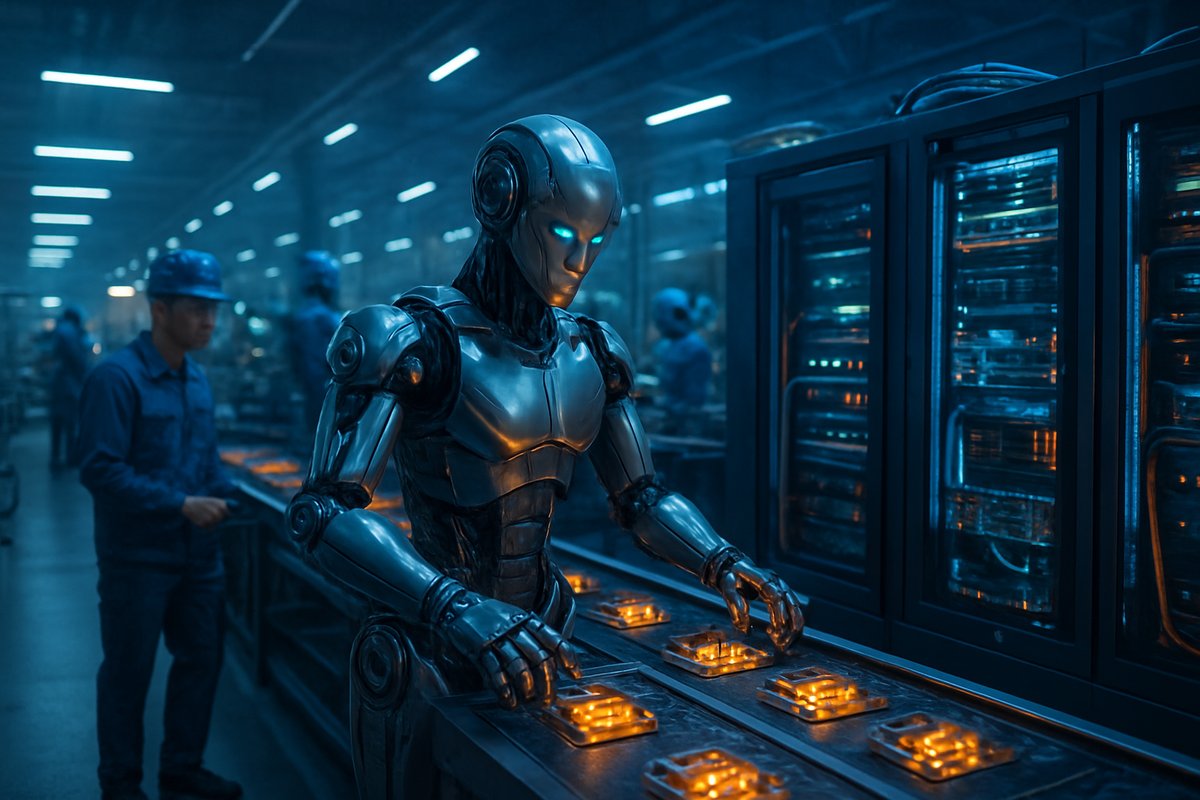
As of January 26, 2026, the global financial markets are witnessing a tectonic shift in the artificial intelligence landscape. While the "First Wave" of AI growth—dominated by large language models (LLMs) and generative software—defined the period from 2023 to 2024, the narrative has fundamentally pivoted. We have entered the "Second Wave," an era characterized by the transition from "Disembodied AI" (software-based reasoning) to "Physical AI" (embodied intelligence, robotics, and industrial automation).
This transition marks the moment when AI leaves the digital realm and begins to physically manipulate the world around it. For investors and industrial giants, the implications are profound: the focus of capital expenditure has shifted from building the "brain" of AI to building its "body" and the high-density infrastructure required to power it. This new phase is not just about writing code; it is about re-engineering the global supply chain through autonomous agents that can see, reason, and act in three-dimensional space.
The Dawn of Embodied Intelligence
The defining characteristic of early 2026 is the rise of Vision-Language-Action (VLA) models. Unlike the chatbots of years past that merely predicted the next word in a sentence, VLA models allow machines to perceive physical environments and execute complex tasks in real-time. This leap was made possible by the "Brain Building" phase of 2024, which provided the foundational reasoning capabilities now being exported to the edge. Throughout 2025, we saw a surge in "Simulate-then-Procure" workflows, where companies like Nvidia (NASDAQ: NVDA) leveraged their Omniverse platform to create hyper-realistic digital twins. These digital sandboxes allowed corporations to train robotic fleets in a virtual world for millions of hours before a single physical unit ever touched a factory floor.
The timeline leading to this moment has been rapid. Following the Blackwell architecture launch in late 2024, Nvidia transitioned from a GPU supplier to the primary architect of "AI Factories." By mid-2025, the industry reached a tipping point where the cost of inference—the act of a model making a decision—dropped low enough to make 24/7 robotic labor economically superior to traditional automated systems. The initial market reaction in early 2026 has been a massive rotation of capital into the industrial and "plumbing" layers of the AI stack, with the S&P 500 Industrial Sector outperforming the broader tech indices for two consecutive quarters.
Winners and Losers in the Physical AI Expansion
The beneficiaries of this Second Wave are those who control the physical interface and the energy required to sustain it. Nvidia (NASDAQ: NVDA) remains the undisputed leader, but its dominance now extends into robotics via its Isaac platform. Close behind is Tesla (NASDAQ: TSLA), which has successfully rebranded in the eyes of many analysts from an electric vehicle manufacturer to a premier robotics firm. Tesla’s Optimus humanoid robot has moved into pilot production as of early 2026, with thousands of units reportedly deployed within its own "Giga-factories" to handle high-precision assembly tasks that previously required human intervention.
In the infrastructure space, Vertiv Holdings Co (NYSE: VRT) has emerged as a critical winner. As AI data centers move from 10kW to over 100kW per rack, Vertiv’s specialized liquid cooling technologies have become the industry standard, solving the thermal "wall" that threatened to stall AI growth in 2025. Similarly, Rockwell Automation (NYSE: ROK) is capitalizing on the "Self-Correcting Factory" trend. Their AI-integrated control systems can now predict mechanical failures before they occur and autonomously reroute production lines, a level of efficiency that was purely theoretical two years ago. Conversely, traditional software-as-a-service (SaaS) companies that failed to integrate physical "agentic" capabilities are seeing their valuations compressed as the market demands more than just digital productivity tools.
The Energy Nexus and Wider Market Significance
The Second Wave is not without its bottlenecks, the most significant being the "AI-Energy Nexus." By January 2026, AI-driven manufacturing and data centers are projected to account for nearly 12% of total U.S. electricity consumption. This has forced a radical rethinking of industrial policy and energy management. Schneider Electric (OTC: SBGSY) and Eaton (NYSE: ETN) have seen record backlogs as they provide the high-voltage transformers and grid automation necessary to prevent a total collapse of local power grids under the weight of AI clusters.
Historically, this transition mirrors the industrial electrification of the early 20th century. Just as the motor replaced the steam engine, the AI agent is replacing the static algorithm. This shift has massive ripple effects on the commodities market; the demand for copper, essential for both high-density power distribution and the complex cooling systems of AI factories, has reached multi-year highs. Furthermore, we are seeing the emergence of "behind-the-meter" power generation, where companies are increasingly investing in Small Modular Reactors (SMRs) and onsite microgrids to bypass the two-year wait times for utility grid connections.
The Road to 2027: What Comes Next
In the short term, the market will be hyper-focused on the "Pilot-to-Production" conversion rates for general-purpose humanoids. While 2025 was the year of the prototype, 2026 is the year of deployment. Investors should watch for announcements from Fanuc (OTC: FANUY) and ABB (NYSE: ABB) regarding their integration of "imitation learning" models, which allow industrial robots to learn tasks by simply observing human workers. This "brownfield" automation—upgrading existing factories rather than building new ones—will be the primary driver of industrial CAPEX through the remainder of the year.
Long-term, the challenge remains the "Inference Economics" of the edge. As AI agents move into more unstructured environments—such as construction sites and hospitals—the need for low-latency, high-reliability 6G networking and edge-computing nodes will create a secondary boom for telecommunications infrastructure. The strategic pivot for many companies will be moving away from centralized cloud AI toward local, sovereign AI stacks that can operate independently of a primary data center, ensuring operational continuity in an increasingly automated world.
Final Assessment: A Transformed Industrial Landscape
The "Second Wave" of AI growth represents the maturation of the technology from a novelty to a fundamental utility. The era of "AI for AI's sake" is over; the era of AI for productivity, manufacturing, and physical labor has begun. The transition from software to physical infrastructure is not merely a trend but a complete re-ordering of the global economic engine, placing a premium on power, cooling, and mechanical precision.
For investors, the coming months will require a discerning eye for "Physical AI" leaders who can navigate the energy constraints of 2026. Keep a close watch on Q1 earnings for the industrial tech sector and stay alert to any regulatory shifts regarding autonomous robotics and SMR energy deployment. The Second Wave is here, and it is made of steel, silicon, and copper.
This content is intended for informational purposes only and is not financial advice