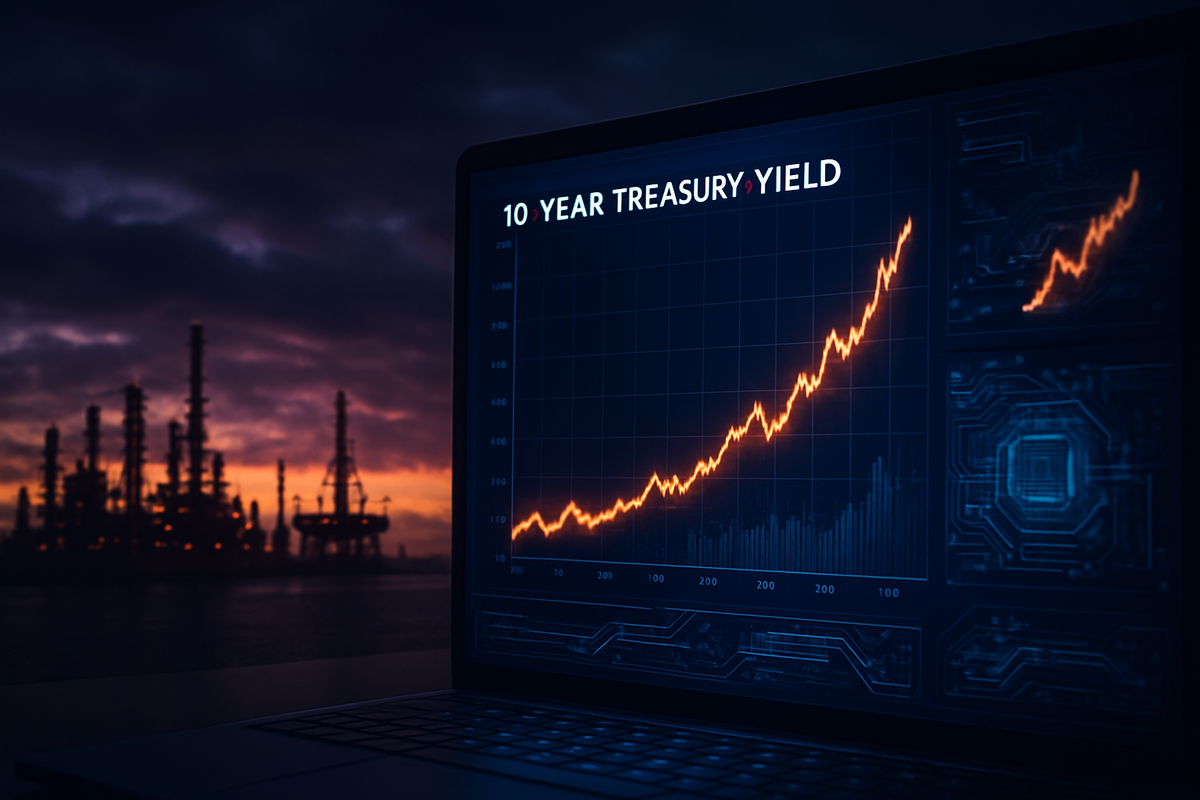
The global financial landscape shifted significantly on March 6, 2026, as the benchmark 10-year U.S. Treasury yield surged to 4.17%, its highest level in several months. This sudden spike, a nearly 20-basis-point jump in a single week, marks a dramatic departure from the "soft landing" narrative that dominated the start of the year. The catalyst for this volatility is a potent "stagflationary" cocktail: a deeply disappointing February jobs report coupled with a sharp escalation in global oil prices.
As the bond market recalibrates for a "higher-for-longer" interest rate environment, the immediate implications are being felt across the economy. Mortgage rates have reversed their recent downward trend, and the high-flying technology sector is facing a renewed valuation squeeze. Investors are now grappling with a reality where the Federal Reserve may be forced to prioritize fighting "sticky" inflation over supporting a cooling labor market, raising the specter of a prolonged economic stagnation.
A Perfect Storm: Oil Shocks and Labor Market Contraction
The road to 4.17% was paved by a series of geopolitical and domestic shocks that came to a head in early March 2026. The primary driver has been the escalating conflict in the Middle East, specifically involving Iran, which has severely disrupted maritime traffic in the Strait of Hormuz. This supply-side crisis sent Brent Crude prices soaring past $90 per barrel, peaking near $92 on Friday morning. For an economy already sensitive to energy costs, this surge acted as an immediate inflationary tax on consumers and businesses alike.
The situation was further complicated by the release of the February employment data from the Bureau of Labor Statistics. Contrary to the consensus expectation of a 50,000-job gain, the report revealed that the U.S. economy actually lost 92,000 jobs last month, pushing the national unemployment rate up to 4.4%. In a typical economic cycle, such weak labor data would trigger a "flight to safety," driving bond prices up and yields down. However, the presence of surging energy costs has rewritten the playbook.
Bond traders, fearing that energy-driven inflation will remain "sticky," have effectively abandoned hopes for imminent rate cuts. At the beginning of 2026, the market was pricing in at least three interest rate reductions by year-end; as of today, swaps markets are pricing in a 97% chance of a "hold" at the next Federal Open Market Committee meeting. This shift in sentiment represents a fundamental lack of confidence in the Fed's ability to stimulate growth without reigniting the inflationary fire.
Winners and Losers in a Rising Yield Environment
The sudden rise in yields is creating a stark divide between various sectors of the market. High-growth technology stocks, which saw record valuations in 2025, are now under the microscope. NVIDIA (NASDAQ: NVDA), currently boasting a market capitalization of nearly $4.5 trillion, remains the market's focal point. While its massive AI-driven revenues provide a buffer, the high-yield environment acts as a higher discount rate on future earnings, naturally compressing its price-to-earnings multiple. Similarly, Microsoft (NASDAQ: MSFT) and Apple (NASDAQ: AAPL), both hovering around the $4 trillion valuation mark, saw their shares dip nearly 4% this week as investors rotated toward more defensive positions.
Conversely, the energy sector is emerging as a primary beneficiary. Companies like ExxonMobil (NYSE: XOM) and Chevron (NYSE: CVX) are seeing increased interest as rising crude prices translate directly to their bottom lines. These "cash-flow positive" giants are being viewed as hedges against the very inflation that is punishing the rest of the market. Additionally, a new trend has emerged in early 2026: the rise of "HALO" stocks—Heavy Assets, Low Obsolescence. This includes utilities like NextEra Energy (NYSE: NEE), which are increasingly seen as safer bets when tech valuations become too sensitive to interest rate fluctuations.
The real estate sector, however, is on the losing end of this yield spike. With the 10-year Treasury yield serving as a benchmark for long-term borrowing, the 30-year fixed mortgage rate has climbed back toward 6.17%. This has essentially frozen the housing market for many prospective buyers, impacting homebuilders like Lennar Corporation (NYSE: LEN) and D.R. Horton (NYSE: DHI). As the "cost of carry" for debt increases, companies with high leverage or those dependent on consumer financing are seeing their growth prospects dim.
The Significance of "Sticky" Inflation and Historical Precedents
This current event marks a critical juncture in the post-pandemic economic era. The concept of "sticky" inflation—where price increases become embedded in the services sector and energy costs remain stubbornly high—is a ghost that many hoped had been exorcised in 2024. The 4.17% yield is more than just a number; it is a signal that the bond market no longer believes the "2% target" is achievable in the near term. This mirrors the stagflationary periods of the 1970s, where supply shocks and labor market shifts created a decade of economic volatility.
The ripple effects extend beyond the U.S. border. As Treasury yields rise, the U.S. Dollar often strengthens, putting pressure on emerging markets that hold dollar-denominated debt. Furthermore, the decoupling of the "jobs-to-yield" relationship is a significant shift in monetary policy theory. Traditionally, the Phillips Curve suggested a trade-off between unemployment and inflation, but the March 2026 data suggests that supply-side shocks can break this correlation, leaving the Federal Reserve with no easy options for intervention.
Regulatory and policy implications are also looming. There is growing chatter in Washington about the need for strategic energy reserve releases or even targeted fiscal measures to support the softening labor market. However, any fiscal stimulus at this stage could be perceived as adding "fuel to the fire" of inflation, potentially driving into yields even higher and creating a feedback loop that policymakers are desperate to avoid.
What Lies Ahead: Strategic Pivots and Scenarios
In the short term, the market will likely remain in a state of high volatility as it awaits further clarity on the Middle East conflict. If oil prices continue to climb toward the $150 mark, as some analysts fear, a full-scale recession in the second half of 2026 becomes almost certain. Corporations will likely begin a "strategic pivot" toward cost-cutting and capital preservation. We may see a slowdown in the massive capital expenditures (CapEx) that have fueled the AI boom, as companies like Microsoft (NASDAQ: MSFT) face pressure to justify multi-billion dollar infrastructure spends in a high-interest-rate environment.
Long-term, this period could mark the transition from an "AI growth" phase to an "AI efficiency" phase. If traditional software and service jobs are being displaced—what some are calling the "Anthropic Effect"—the economy will need to find new drivers of employment to offset the 92,000-job loss seen in February. Market opportunities may emerge in industries that provide "tangible" value, such as domestic manufacturing, infrastructure, and green energy, which are less susceptible to the obsolescence risks of the digital economy.
Potential scenarios range from a "Goldilocks" resolution, where geopolitical tensions ease and oil prices retreat, allowing the Fed to eventually cut rates, to a "Hard Landing" where high rates and high energy costs cause a significant contraction in consumer spending. Investors should be prepared for the latter, maintaining diversified portfolios that balance tech growth with inflation-protected assets.
Closing Thoughts: Monitoring the New Economic Reality
The surge in the 10-year Treasury yield to 4.17% is a clear warning that the "easy money" era is not returning anytime soon. The combination of "sticky" inflation and a contracting labor market has put the Federal Reserve in a precarious position, and investors must adjust their expectations accordingly. The resilience of tech giants like NVIDIA (NASDAQ: NVDA) will continue to be tested, but the broader market's focus is likely to remain on the "real" economy—energy, commodities, and labor.
Moving forward, the primary metric to watch will be the monthly Consumer Price Index (CPI) releases and the stability of global energy supply chains. Any further upward movement in yields could trigger a broader sell-off in equities as the "risk-free" rate becomes increasingly attractive compared to stocks. In this new economic reality, the ability to adapt to a high-rate environment will be the defining characteristic of the winners in 2026.
This content is intended for informational purposes only and is not financial advice.