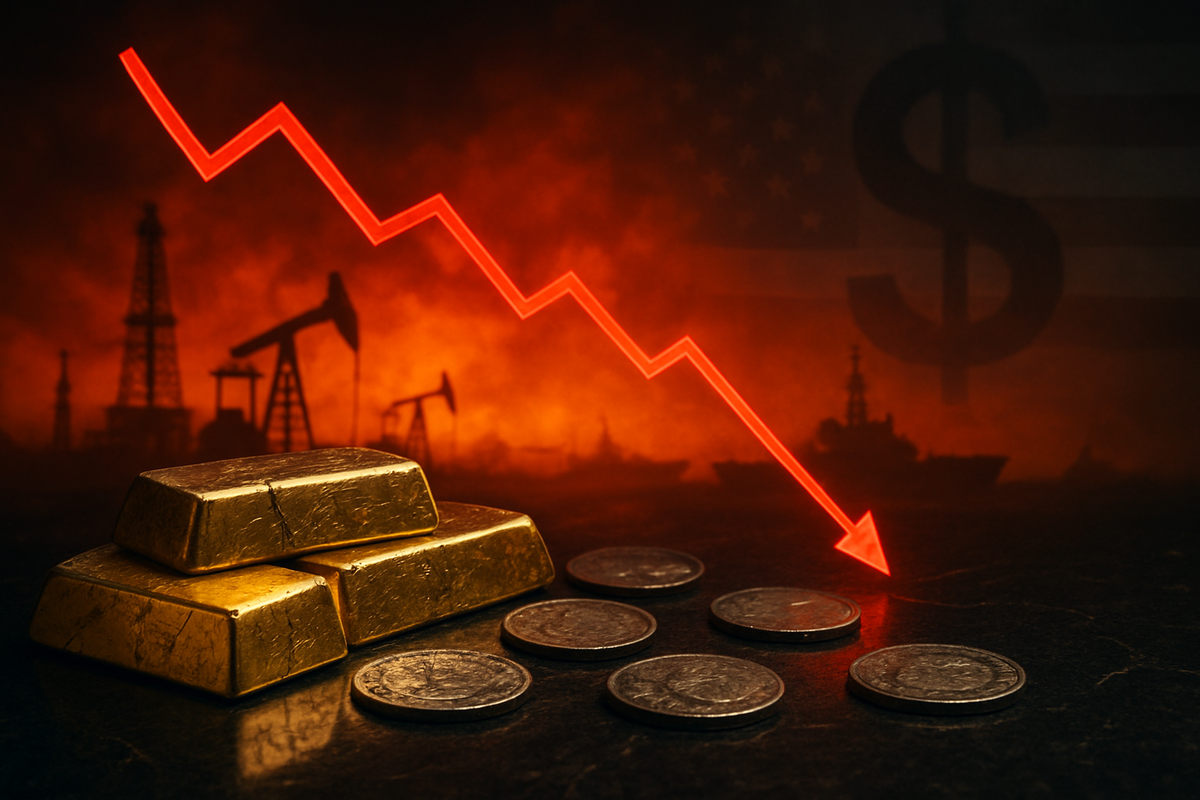
The month of March 2026 will be remembered by commodities traders not for the record-breaking highs many predicted, but for a "Precious Metals Paradox" that left investors reeling. Despite the outbreak of a direct military conflict in the Middle East and a terrifying spike in energy costs, the traditional safe havens of gold and silver suffered a staggering blow. In a single session late in the month, spot gold—tracked by the SPDR Gold Shares (NYSE: GLD)—tumbled 5.4%, while silver—tracked by the iShares Silver Trust (NYSE: SLV)—plunged over 10%, defying decades of economic theory that suggests these metals should thrive during times of war and high inflation.
This market dislocation was fueled by a unique confluence of events: a massive supply-side inflation shock driven by the "Iran War" and a subsequent "higher-for-longer" pivot by a hawkish Federal Reserve. While the initial instinct of the market was to bid up bullion to record levels, the reality of a surging U.S. Dollar and the expectation of prolonged high interest rates quickly turned a geopolitical rally into a liquidity-driven rout. For many, it was a harsh lesson in how the interplay between currency strength and monetary policy can override even the most dire geopolitical headlines.
From "Epic Fury" to a Market Meltdown
The seeds of the March collapse were sown in late February with the commencement of "Operation Epic Fury," a series of U.S. and Israeli precision strikes targeting Iranian infrastructure. The geopolitical fallout was immediate: Tehran responded by implementing a "virtual blockade" of the Strait of Hormuz. As nearly 20% of the world’s oil and liquefied natural gas (LNG) flows were throttled, Brent Crude oil prices rocketed past $120 per barrel. This energy spike filtered through the global economy with lightning speed, culminating in a March Consumer Price Index (CPI) report that showed headline inflation jumping 0.9% in a single month—the largest monthly gain in four years.
Initially, gold and silver behaved exactly as the textbooks predicted. Gold hit a fleeting record high of $5,594 per ounce, and silver briefly tested the $97 mark as the "war premium" was priced in. However, the mood shifted dramatically following the March 18 Federal Open Market Committee (FOMC) meeting. Federal Reserve Chair Jerome Powell, facing an energy-led inflation spike that threatened to unanchor long-term expectations, abandoned all talk of the rate cuts that had been anticipated for later in 2026. Instead, the Fed signaled that interest rates—currently sitting at a range of 3.50%–3.75%—might actually need to move higher if the energy blockade persisted.
This hawkish pivot sent the U.S. Dollar Index (DXY) to its highest level since mid-2025, surging past 100.5. For precious metals, which are priced in dollars and carry no yield, this was a death knell. The rising opportunity cost of holding non-yielding assets, combined with a "forced liquidation" phase where hedge funds sold their winning gold positions to cover margin calls in cratering equity and bond markets, led to the historic 5.4% and 10% daily drops in gold and silver, respectively.
A "Pincer Movement" for Mining Giants
The sudden reversal in metal prices, coupled with the explosion in energy costs, created a "pincer movement" that devastated the balance sheets of the world’s largest miners. Newmont Corporation (NYSE: NEM), the world’s largest gold producer, saw its shares crater 8.76% to $99.20 as it was forced to revise its All-In Sustaining Cost (AISC) upward from $1,358 to $1,680 per ounce. The company cited the skyrocketing cost of "red diesel"—essential for the massive trucks and machinery used in open-pit mining—as a primary driver of the margin compression.
Similarly, Barrick Gold Corporation (NYSE: GOLD) saw its shares drop nearly 7% to approximately $16.85. Beyond the immediate pricing pressure, Barrick’s situation was complicated by internal industry friction. Reports emerged of a breakdown in cooperation regarding its Nevada joint venture with Newmont, as the two giants sparred over resource allocation in a high-cost environment. The market’s reaction suggested that investors no longer viewed these companies as a hedge against disaster, but rather as high-beta industrial plays that were dangerously exposed to the dual threats of falling revenue and rising operational expenses.
Historical Echoes and the Death of the Safe Haven Myth
The events of March 2026 have prompted a frantic re-evaluation of the "safe haven" narrative. Historically, investors look to the 1970s as the golden era for gold during inflation, but analysts point out that the current scenario more closely resembles the 1980 spike, where aggressive Volcker-era rate hikes eventually crushed the metal's rally. The modern "Inflation Shock" paradox highlights a critical shift: in a world of high debt and precarious central bank balancing acts, a "bad" inflation shock (driven by supply disruptions) is often more bearish for gold than a "good" inflation shock (driven by economic growth), because the former necessitates aggressive currency-strengthening measures.
The ripple effects are already being felt across the commodities complex. The collapse of silver, often viewed as a "poor man's gold" but also an essential industrial metal, reflects fears that high energy prices will lead to a global manufacturing recession. This "dual identity" of silver made it particularly vulnerable; it lost its luster as a store of value while simultaneously being hammered by the prospect of reduced demand in the solar and electronics sectors.
The Road Ahead: Strategic Pivots and June Expectations
As we look toward the remainder of the second quarter of 2026, the precious metals market remains in a state of shock. The primary question for investors is whether the March lows represent a "flush out" of speculative excess or the start of a multi-year bear market. For mining companies like Newmont and Barrick, the path forward involves radical cost-cutting and a potential pivot toward automation and electrification of mine sites to reduce their sensitivity to diesel prices—though such transitions require capital that is currently difficult to secure.
The next major catalyst will be the June 2026 FOMC meeting. If the Strait of Hormuz remains contested and energy prices stay elevated, the market is bracing for a 25-basis-point rate hike—a move that was unthinkable just three months ago. Conversely, any signs of a diplomatic de-escalation in the Iran conflict could lead to a relief rally in metals as the "liquidity drain" slows and the U.S. dollar softens.
Final Assessment: A Changed Landscape
The March 2026 Inflation Shock has fundamentally altered the relationship between geopolitics and the commodities market. The key takeaway is that in the modern era, the Federal Reserve’s reaction function is the ultimate arbiter of value. No matter how high tensions rise or how fast energy prices climb, if those factors lead to a stronger dollar and higher rates, precious metals will face an uphill battle.
Moving forward, the market will likely remain highly volatile. Investors should watch for three critical signals: any change in the blockade status at the Strait of Hormuz, the May CPI print, and any "dovish" dissent within the FOMC minutes. The "Precious Metals Paradox" has proven that the traditional safety net is thinner than many believed. In a world of "Epic Fury" and inflationary shocks, the only certainty is that the old rules of thumb no longer apply.
This content is intended for informational purposes only and is not financial advice.