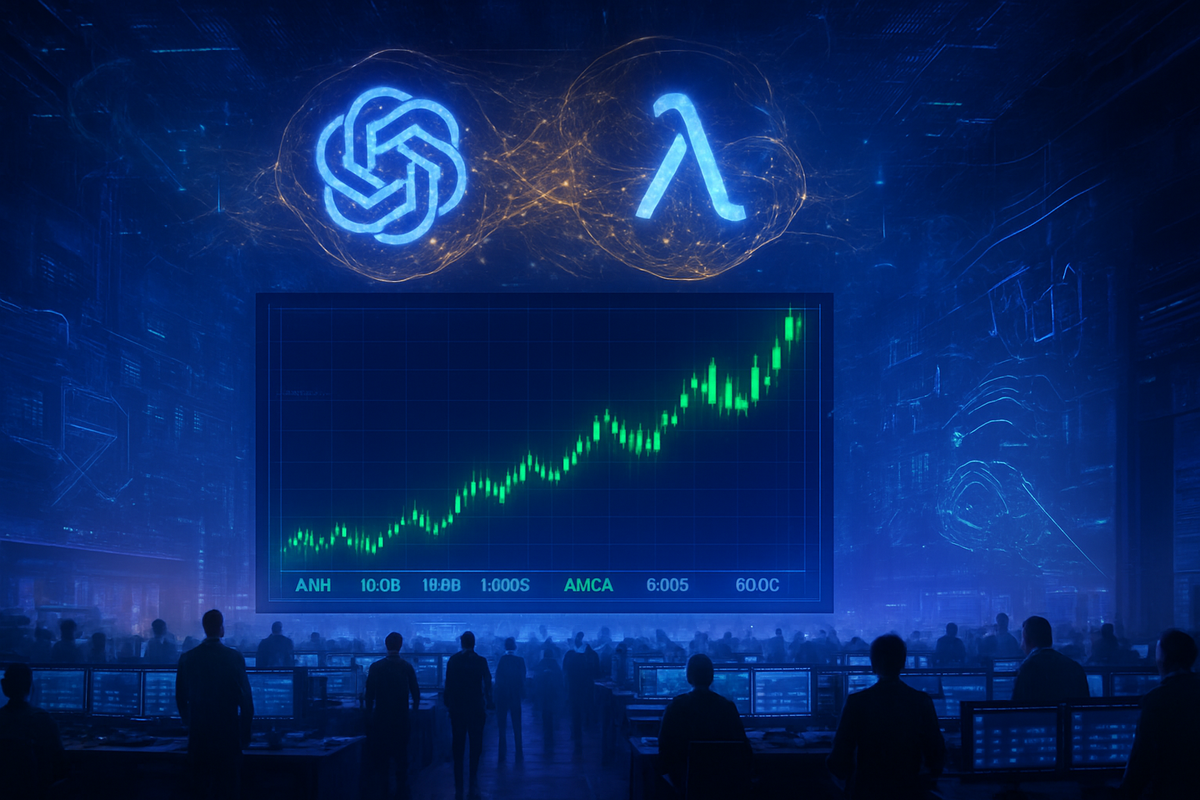
The global financial landscape is bracing for a tectonic shift as OpenAI and Anthropic, the two undisputed titans of the generative artificial intelligence era, have reportedly begun formal preparations for initial public offerings (IPOs) later this year. According to sources close to the matter, both companies are eyeing a late 2026 listing on the Nasdaq, a move that could see them collectively raising upwards of $150 billion in the largest capital markets event in history. This development marks the end of the "private era" for AI hyperscalers, as the insatiable demand for compute power and the race toward Artificial General Intelligence (AGI) drive these firms toward the deep liquidity of the public markets.
The implications of these listings are staggering. OpenAI is reportedly targeting a valuation approaching $1 trillion, while Anthropic is positioning itself in the $400 billion to $500 billion range. For investors, this represents a unique opportunity to own a direct stake in the foundational "operating systems" of the next industrial revolution. For the broader market, it is the ultimate test of the U.S. capital markets' depth, coming at a time when the "Great Reopening" of the tech IPO window is already in full swing.
The Road to the Ringing Bell: Restructuring and Record Revenue
The journey to this moment has been defined by a fundamental shift in how these research-heavy labs operate as businesses. Throughout 2025, OpenAI underwent a complex corporate restructuring to prepare for the scrutiny of public investors. In late 2025, the company officially converted its for-profit arm into OpenAI Group PBC, a Public Benefit Corporation. This move was designed to balance its mission of ensuring AGI benefits all of humanity with the fiduciary duties owed to public shareholders. Led by CEO Sam Altman, the company reached a milestone $25 billion annualized revenue run rate in February 2026, driven by the massive success of ChatGPT Pro and deep enterprise integrations.
Anthropic, led by CEO Dario Amodei, has followed an equally aggressive but more "enterprise-first" trajectory. The company has seen its revenue skyrocket from $9 billion at the end of 2025 to over $19 billion by March 2026. Much of this growth is attributed to "Claude Code," an agentic tool that has become the standard for software engineering at Fortune 500 companies. Anthropic has already engaged legal powerhouse Wilson Sonsini and a consortium of banks led by Goldman Sachs (NYSE: GS) and JPMorgan Chase (NYSE: JPM) to finalize its S-1 filing, with a target listing date as early as October 2026.
The timeline leading up to these announcements has been punctuated by massive "pre-IPO" funding rounds that served as price discovery mechanisms. In March 2026, OpenAI closed a $122 billion Series I round anchored by Amazon (Nasdaq:AMZN), while Anthropic secured $30 billion in a round led by GIC and Coatue. These injections of capital were necessitated by the eye-watering costs of training "GPT-5" and Anthropic’s "Claude 4" models, which now require specialized data centers costing tens of billions of dollars each. Market reaction to the news has been overwhelmingly bullish, with specialized tech ETFs seeing record inflows in anticipation of the listings.
Winners, Losers, and the Cloud Proxy War
The primary beneficiaries of these public listings are the early strategic backers who have used their equity stakes to cement long-term infrastructure partnerships. Microsoft (Nasdaq:MSFT), which holds a roughly 27% diluted stake in OpenAI, stands to see a massive mark-to-market gain that could add over $150 billion in non-operating income to its balance sheet. Similarly, Amazon (Nasdaq:AMZN) and Alphabet (Nasdaq:GOOGL) will see their significant investments in Anthropic validated by public valuations. These cloud giants have effectively created a "virtuous cycle" where the capital they invest in these startups is immediately spent back on their own cloud services, such as Azure, AWS, and Google Cloud.
Nvidia (Nasdaq:NVDA) remains the ultimate "arms dealer" in this conflict. As a direct equity holder in both companies and the sole provider of the Blackwell Ultra and "Vera Rubin" GPU architectures required for their training runs, Nvidia’s stock has remained resilient even as some analysts worry about a "compute bubble." Other infrastructure winners include CoreWeave (Nasdaq:CRWV), which went public in 2025 and serves as a dedicated GPU cloud provider for OpenAI, and Oracle (NYSE: ORCL), which built the massive "Stargate" data center to house OpenAI’s latest training clusters.
On the other side of the ledger, legacy software-as-a-service (SaaS) providers are facing an existential challenge. As OpenAI and Anthropic move into "agentic AI"—tools that can autonomously execute tasks—traditional seat-based software companies like Salesforce (NYSE: CRM) and Adobe (Nasdaq:ADBE) are being forced to reinvent their core business models or risk being automated away. Furthermore, Snowflake (NYSE: SNOW) and the soon-to-IPO Databricks are finding themselves in a complex "co-opetition" where they distribute these models through their data platforms while simultaneously competing for the same enterprise AI budgets.
A Paradigm Shift for Global Capital Markets
The sheer scale of these offerings is set to shatter historical records. If OpenAI and Anthropic raise the amounts currently discussed, they will easily surpass the $25 billion raised by Alibaba in 2014 and the $16 billion raised by Facebook in 2012. This event fits into a broader industry trend of "AI-driven consolidation," where the capital requirements for frontier models are so high that only the most successful players can afford to stay in the race. This has created a barrier to entry that is virtually insurmountable for smaller startups, effectively turning the AI sector into an oligopoly of public hyperscalers.
Regulatory and policy implications will likely dominate the post-IPO discourse. As public companies, OpenAI and Anthropic will be subject to quarterly transparency requirements regarding their safety protocols, energy consumption, and compute efficiency. This could provide a much-needed window into the "black box" of AI development for regulators in the U.S. and EU. Historically, when tech giants go public, it often signals the beginning of more rigorous antitrust and safety oversight, a transition that Sam Altman has recently begun to prepare for by hiring experienced government relations teams.
Furthermore, the "agentic revolution" represented by these companies marks a shift from AI as a chatbot to AI as an autonomous worker. This transition has profound implications for labor markets and GDP growth, which will now be under the direct scrutiny of Wall Street analysts. The historical precedent of the mid-to-late 1990s internet boom is often cited, but with a key difference: unlike many dot-com firms, OpenAI and Anthropic are entering the public markets with tens of billions in actual revenue, though their "burn rates" for compute remain a central point of debate among skeptics.
What Lies Ahead: The Path to AGI and Beyond
In the short term, the primary challenge for both companies will be managing the transition from visionary research labs to disciplined public entities. This will require a strategic pivot toward sustainable margins, likely involving a shift from heavy research spending to optimized commercial distribution. Investors will be laser-focused on "revenue-per-compute-unit" and how these firms manage their relationships with their cloud providers. If the IPO proceeds are used primarily to purchase more GPUs from Nvidia (Nasdaq:NVDA), the market will demand to see a clear path to positive cash flow by 2027 or 2028.
Looking further ahead, the successful public listing of these giants could trigger a wave of M&A activity in the AI sector. With "public currency" (stock) at their disposal, OpenAI and Anthropic may look to acquire specialized "edge AI" companies, data providers, or robotics firms to expand their physical-world capabilities. A potential scenario involves the emergence of "Vertical AI" giants that use the foundational models of the labs to dominate specific industries like healthcare, law, or finance, potentially leading to further spinoffs or specialized IPOs.
However, the road is not without significant risks. Any major safety failure or regulatory crackdown could derail the IPO timelines or lead to massive post-listing volatility. Additionally, as Meta (Nasdaq:META) continues to advance its open-source "Llama" models, OpenAI and Anthropic must constantly prove that their "closed" models provide enough superior value to justify their high API costs. The next few months will be a high-stakes game of financial and technical "chicken" as the companies finalize their books for public consumption.
Final Assessment: The Investor’s Watchlist
As we look toward the final quarters of 2026, the potential IPOs of OpenAI and Anthropic represent more than just a financial event; they are a milestone in the history of computing. These listings will provide the capital necessary to fuel the final sprint toward AGI, while simultaneously inviting the highest level of public and regulatory scrutiny. For the market, it is a moment of validation for the trillions of dollars of value attributed to AI over the past three years.
Investors should pay close attention to several key indicators in the coming months:
- Q3 2026 S-1 Filings: Look for details on "compute-lease" obligations and how much equity the cloud providers truly hold.
- Model Efficiency: Any breakthrough that significantly lowers the cost of inference could dramatically improve the margins of these companies before they hit the market.
- Monetary Policy: While the AI story is powerful, the broader appetite for these massive listings will still depend on the interest rate environment and overall market stability in late 2026.
Ultimately, the transition of OpenAI and Anthropic to the public markets will be remembered as the moment the AI era matured. While the risks are as vast as the potential rewards, the sheer momentum of these "trillion-dollar contenders" suggests that the 2026 IPO season will be one for the history books.
This content is intended for informational purposes only and is not financial advice