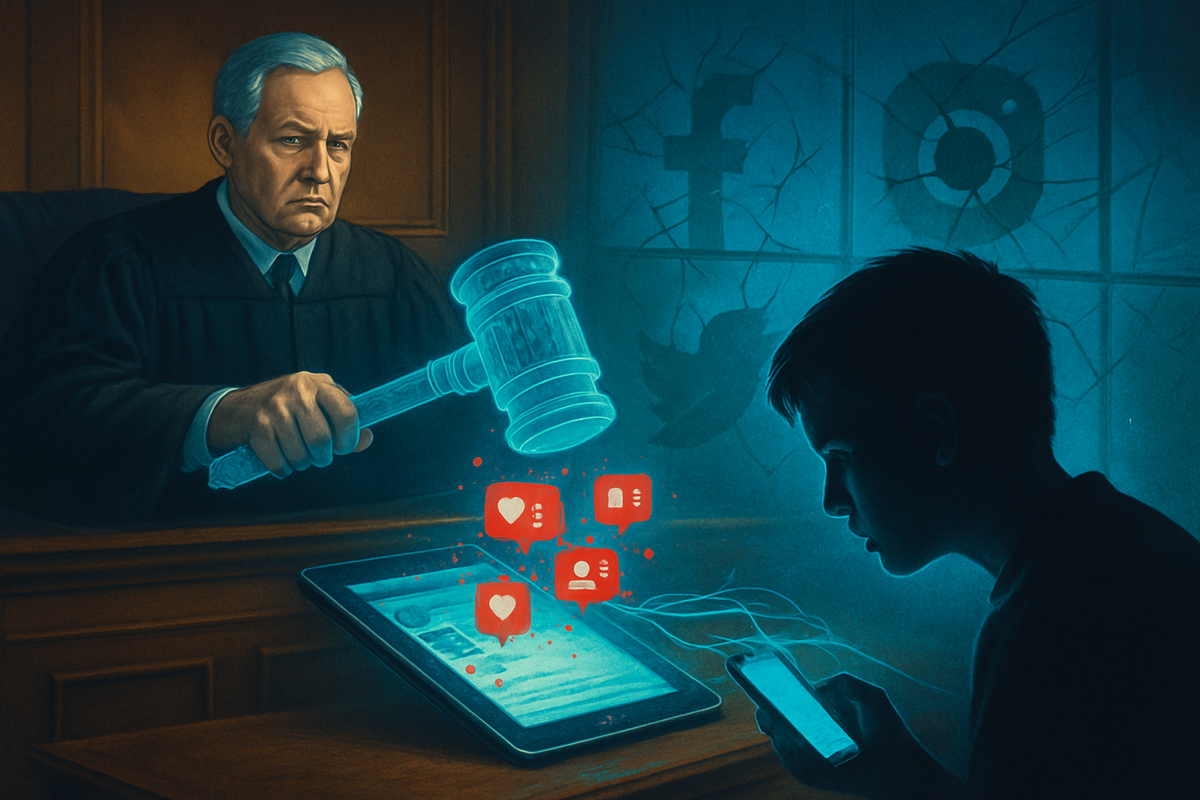
In a historic decision that has sent shockwaves through Silicon Valley and the legal community, a Los Angeles jury has found Meta Platforms Inc. (NASDAQ: META) and YouTube, a subsidiary of Alphabet Inc. (NASDAQ: GOOGL), liable for "addictive design" features that contributed to the mental health decline of a young user. The verdict, delivered on March 25, 2026, marks the first time a jury has held social media giants financially responsible for adolescent psychological harm under a product liability theory. By awarding $6 million in damages to the plaintiff, the jury has effectively bypassed the long-standing "Section 230" legal protections that have historically immunized tech platforms from liability regarding user-generated content.
The immediate implications of this verdict are profound. While the $6 million figure is relatively small compared to the multi-billion dollar revenues of these tech behemoths, the legal precedent is monumental. For decades, Big Tech has relied on the 1996 Communications Decency Act to dismiss lawsuits at the earliest stages. This verdict signals that the era of absolute immunity is over, as courts and juries begin to view social media apps not just as platforms for speech, but as engineered consumer products that can be inherently defective or dangerous.
A Watershed Moment in the Courtroom
The trial, K.G.M. v. Meta & YouTube, concluded after six weeks of intense testimony in Los Angeles Superior Court. The plaintiff, now 20 years old, alleged that Instagram and YouTube were designed with features specifically intended to exploit the neurobiology of the developing adolescent brain. The jury deliberated for four days before finding Meta 70% liable and YouTube 30% liable. The $6 million award covers medical expenses, past and future suffering, and psychological therapy. Evidence presented during the trial included internal documents—some leaked during the famous "Facebook Papers" era and others unearthed during recent discovery—showing that engineers intentionally utilized "intermittent variable rewards" to keep users engaged for longer periods.
The timeline leading to this moment began years ago with the consolidation of thousands of similar claims into the Judicial Council Coordinated Proceedings (JCCP) 5255 in California. While many cases were previously dismissed, a pivotal 2025 ruling by Judge Carolyn B. Kuhl allowed this case to proceed by distinguishing between "content" (which is protected) and "conduct/design" (which is not). Key players in the case included the plaintiff’s legal team, who successfully argued that features like "infinite scroll," "ghost notifications," and "algorithmic feedback loops" are industrial design choices equivalent to a defect in a car’s braking system.
Initial industry reactions have been defensive. Spokespeople for both Meta and Alphabet have already announced their intention to appeal, arguing that the verdict ignores the role of parental supervision and the broader societal factors affecting youth mental health. However, the market reaction was swift; shares of Meta fell 4.2% in the two days following the verdict, while Alphabet saw a 2.8% dip as investors began to price in a massive new category of legal risk that could mirror the multi-decade litigation faced by the tobacco and opioid industries.
Winners, Losers, and the Financial Fallout
The primary "losers" in this new legal landscape are undoubtedly the dominant social media platforms. Meta Platforms Inc. (NASDAQ: META) faces the most significant exposure, given its high penetration among adolescents and its history of internal research acknowledging the negative impacts of Instagram on teen girls. With over 2,400 cases still pending in a federal Multidistrict Litigation (MDL) 3047, Meta may eventually be forced to set aside billions of dollars in legal reserves, potentially impacting its aggressive capital expenditure on AI and the metaverse.
Alphabet Inc. (NASDAQ: GOOGL) is also in the crosshairs. While YouTube often positions itself as an educational and entertainment hub rather than a traditional social network, this verdict targets its core recommendation engine and "Autoplay" features. The ruling suggests that any platform using engagement-maximization algorithms could be vulnerable. Snap Inc. (NYSE: SNAP), which settled similar claims just days before the K.G.M. trial for an undisclosed amount, also faces a precarious future. If these companies are forced to "de-tune" their algorithms to avoid liability, the resulting drop in user engagement could lead to lower ad inventory and revenue growth.
On the other side of the ledger, there are few traditional "winners," but the legal industry itself is seeing a massive surge in demand. Large-scale plaintiffs' firms are already ramping up television and digital marketing campaigns to recruit more families for upcoming "bellwether" trials. Furthermore, smaller, "safety-first" social platforms that avoid addictive design features could see a competitive advantage as schools and parents migrate away from the "Big Three." Companies specializing in digital wellness and parental control software might also see increased adoption as the public's perception of social media shifts from "harmless utility" to "regulated product."
A Broader Shift in the Digital Landscape
This verdict fits into a much larger global trend of "tech-lash" and increasing regulatory scrutiny. For years, the United States was seen as a safe haven for tech companies due to Section 230, even as the European Union implemented stricter regulations like the Digital Services Act (DSA). The Los Angeles verdict effectively brings European-style accountability to American courts. By framing the issue as "design-as-defect," the American legal system has found a way to apply traditional product liability law to the digital age, a shift that could have ripple effects on every software-based industry, from mobile gaming to AI-driven productivity tools.
Historically, this event is being compared to the 1994 "Big Tobacco" hearings or the first successful lawsuits against pharmaceutical companies for the opioid crisis. In those instances, a single "crack in the armor"—a successful verdict or a leaked internal document—led to a cascade of litigation that eventually resulted in massive master settlement agreements. If the upcoming federal trials in June 2026 follow the Los Angeles precedent, we may see a multi-state settlement that forces social media companies to fundamentally redesign their platforms, potentially including mandatory "hard breaks" for minors or the elimination of personalized engagement algorithms for those under 18.
The regulatory implications are equally significant. Congressional leaders who have struggled to pass comprehensive data privacy or child safety laws may find new momentum from this jury's decision. We are likely to see renewed interest in the Kids Online Safety Act (KOSA) and similar legislation that would codify a "duty of care" for tech platforms, aligning the law with the liability standards established by the LA jury.
What Comes Next: The Path to Federal Bellwethers
The short-term focus now shifts to the federal MDL 3047, presided over by Judge Yvonne Gonzalez Rogers in the Northern District of California. The first federal "bellwether" trials—designed to test how different juries react to the evidence—are scheduled for June 15, 2026, for school district plaintiffs and August 6, 2026, for state Attorneys General. The Los Angeles verdict provides a "proof of concept" for these federal cases. If Meta and Alphabet lose in the federal court system as well, the pressure to settle all outstanding claims will become nearly irresistible.
Strategically, Big Tech companies may be forced into "defensive engineering." We could see a wave of "voluntary" safety updates in the coming months as companies attempt to show they are meeting their "duty of care" to mitigate future damages. This might include removing "like" counts, disabling infinite scroll for minor accounts, and being more transparent about how algorithms function. However, these pivots are risky; they directly threaten the high-engagement metrics that have made these platforms some of the most profitable entities in history.
The potential for a "Global Settlement" is also on the horizon. To avoid decades of localized litigation and the risk of inconsistent jury awards across different states, the tech industry may eventually seek a legislative solution or a massive settlement fund, similar to the $246 billion Tobacco Master Settlement Agreement of 1998. Such an outcome would provide the companies with "legal peace" but would permanently change their business models and oversight.
Closing Thoughts: A New Era of Responsibility
The K.G.M. v. Meta & YouTube verdict is a landmark moment that marks the end of the "Wild West" era for social media design. By holding these companies liable for the psychological impact of their engineering choices, the jury has affirmed that digital products are not exempt from the safety standards that apply to every other consumer good. For the public, this represents a major step toward accountability; for the market, it represents the birth of a new, systemic risk factor that will likely weigh on tech valuations for years to come.
Moving forward, the market will likely be characterized by heightened volatility in the communication services sector as each new trial or settlement update hits the wires. Investors should watch the upcoming federal bellwether trials in June very closely. If the "design-as-defect" theory holds up in federal court, the liability floor could rise into the tens of billions of dollars.
Ultimately, the significance of this event lies in the message it sends to the next generation of tech innovators: the "move fast and break things" mantra must now be tempered with a "duty to protect." The digital world is no longer a separate, protected space; it is a mature industry that must now answer to the same laws of liability and harm as the physical world.
This content is intended for informational purposes only and is not financial advice.